

NASA joins Japan's MMX mission to retrieve Phobos samples and explore Martian moons
Under an international partnership, NASA will supply scientific instrumentation, deep-space tracking, and sampling technology for the Japanese Aerospace Exploration Agency's mission to Mars' moons. The mission aims to recover extraterrestrial material and clarify the early history of the inner solar system.
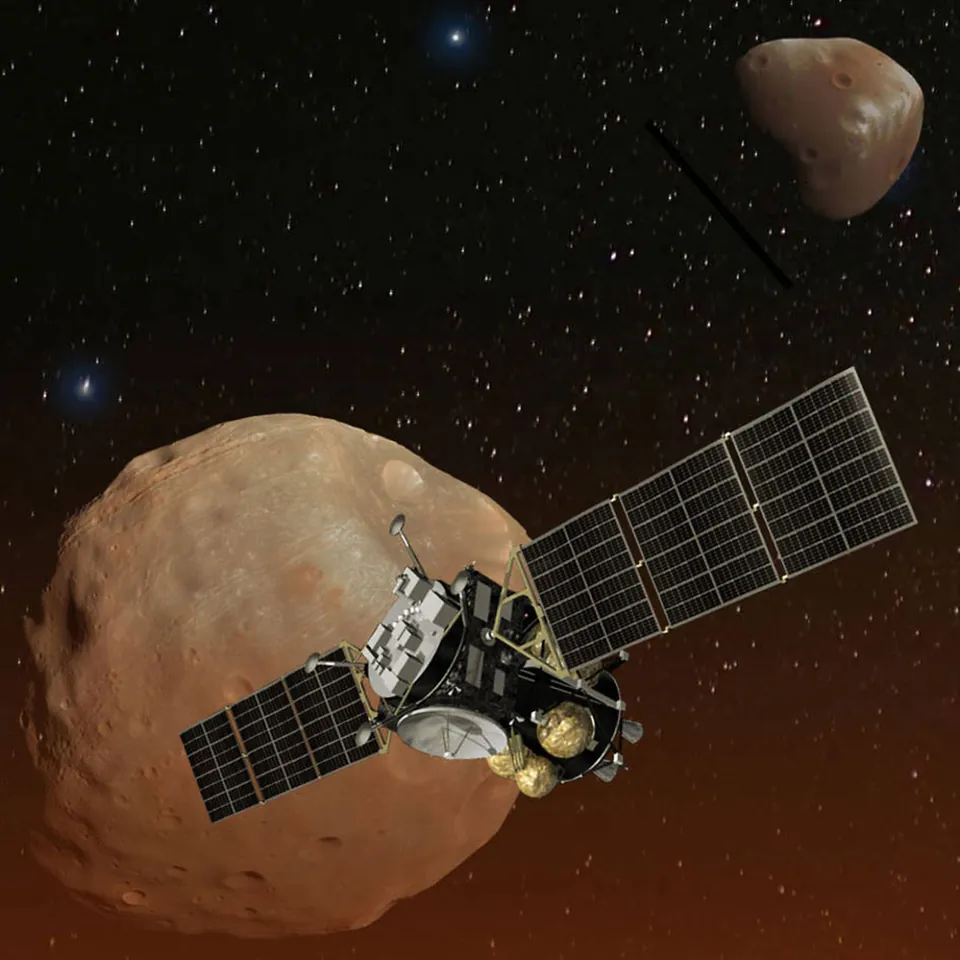
NASA is slated to receive and curate roughly 15 percent of the total sample collected.1
The spacecraft is expected to observe the Martian moons for at least 16 months before attempting Phobos sampling.1
The mission is scheduled to return the Phobos material to Earth in 2031.1
Story
Unlocking the Origins of Mars' Moons Through an International Sample-Return VoyageAn international space endeavor is taking shape as NASA teams up with the Japan Aerospace Exploration Agency on the ambitious Martian Moons eXploration venture.1 The joint project centers on resolving longstanding mysteries regarding the nature and ancestry of Phobos and Deimos while securing pristine regolith from Phobos to transport back home.1 Under the agreed scientific exchange, the United States space agency is slated to receive and curate roughly 15 percent of the total sample collected at its dedicated Astromaterials Lab within the Johnson Space Center in Houston.1 Evidence indicates that the vast majority of the samples returned from Phobos will be curated outside NASA's facilities.1 This partnership provides American researchers with direct access to physical fragments gathered from the Martian system.1 NASA's portion is roughly 15 percent, so the larger share of the returned material will be curated beyond its facilities.1
The MMX spacecraft has been scheduled to lift off from the Tanegashima Space Center in Japan on Monday, October 19 at 3:41 p.m. EDT, which corresponds locally to Tuesday, October 20 at 4:41 a.m. JST.1 Following its departure from the Japanese launch site, the probe faces a multi-year cruise across interplanetary space toward Mars.1 The spacecraft is scheduled to reach Mars in August 2027 to start surveying both Martian moons.1 Reports indicate that the MMX spacecraft will conduct Martian moon observations for at least 16 months before it attempts surface sampling on Phobos.1 Following its initial survey, the spacecraft will gather surface material from Phobos no earlier than December 2028 and return it to Earth in 2031.1 The timeline places the arrival at Mars before an observation period of at least 16 months, with Phobos sampling scheduled no earlier than December 2028 and the return set for 2031.1
NASA's provided elements for MMX comprise the MEGANE spectrograph, the Pneumatic Sampler technology demonstration, Deep Space Network tracking and communication, and funding for American team scientists.2 These hardware components and support packages were developed by NASA as part of the agency's Discovery Program.2 Day-to-day oversight of the Discovery Program is managed by Marshall Space Flight Center in Huntsville, Alabama, on behalf of NASA's Science Mission Directorate.2 Through this institutional framework, the American agency contributes critical navigation and communications capacity by leveraging its worldwide Deep Space Network installations.2 NASA's contribution combines a scientific instrument and sampling technology with tracking, communication and funding for American scientists.2
Among the primary orbital tools contributed to the mission is the MEGANE spectrograph instrument.12 The specialized spectrograph was built by the Johns Hopkins Applied Physics Laboratory.2 Once positioned above the target body, the MEGANE instrument will determine Phobos's elemental composition by detecting neutrons and gamma rays released from its surface.1 These measurements will map the chemical building blocks present across the lunar crust without touching the ground.1 MEGANE's measurements provide a way to assess Phobos's elemental makeup by sensing emissions from its surface, rather than collecting material with the instrument itself.1
When the spacecraft touches down to collect material, it will rely on sophisticated mechanisms deployed directly onto the ground.1 The Pneumatic Sampler is installed on one of the lander legs of the spacecraft to gather surface regolith from Phobos.1 Engineering records show that Honeybee Robotics, a subsidiary of Blue Origin, manufactured the spacecraft's pneumatic sampling system.2 Operationally, the Pneumatic Sampler uses high-pressure nitrogen gas pulses to collect surface regolith, working alongside JAXA's C-Sampler which drills cores deeper in the ground.1 Current mission documentation supports that the MMX mission will employ two different sampling mechanisms to collect material from both the surface and shallow subsurface of Phobos.1 The nitrogen-pulse sampler gathers surface material, while JAXA's C-Sampler drills deeper, giving the mission two ways to collect Phobos material.1
Acquiring samples from different structural depths is central to evaluating the geological history of the target satellite.1 NASA program scientist Tom Statler explained that Phobos and Deimos could either have originated from a massive impact on Mars or be asteroids gravitationally captured billions of years ago.2 Examining whether the moons consist of planetary ejecta from Mars or captured asteroidal bodies addresses long-standing debates within planetary science.12 The dual collection approach ensures that both shallow surface particulates and subsurface drill cores are available to test these competing formation scenarios.1 The two proposed origins differ in whether the moons formed from a collision with Mars or were captured asteroids, and the collected material is intended to help investigate their history.12
Beyond clarifying the provenance of the two satellites, the results carry broad implications for understanding terrestrial planetary evolution.2 Scientists point out that understanding the origins of the Martian moons will provide insights into the early period when Earth and other inner planets accumulated water and organics.2 Because primitive small bodies can preserve chemical traces from the primordial solar nebula, their materials offer a window into early delivery mechanisms for volatile compounds.12 Analyzing the physical samples in terrestrial laboratories will allow researchers to measure isotopic and organic signatures that cannot be resolved from orbit alone.12 The relevance extends beyond Mars: the mission's findings about the moons' origins are expected to inform understanding of how Earth and other inner planets acquired water and organics.2
Agency leadership emphasizes that returning these materials will alter how scientists understand the neighboring planet ahead of future exploration.2 NASA associate administrator Nicky Fox stated that the samples brought back by MMX will deliver transformative scientific insights about the Martian system for future generations, especially ahead of crewed missions to Mars.2 Knowledge gained about surface regolith will inform engineering decisions and operational planning for future human spaceflight campaigns to the red planet.2 The retrieval effort therefore bridges fundamental planetary science and long-term space exploration objectives.12 The anticipated value of the returned samples is framed both as scientific insight for future generations and as preparation ahead of crewed missions to Mars.2
After the capsule delivers the extraterrestrial payload to Earth in 2031, researchers funded by NASA are partnering with international scientists to analyze MMX data and returned samples to reconstruct the history of Phobos and Mars.12 The custody arrangement assigns roughly 15 percent of the total sample collected to the Johnson Space Center Astromaterials Lab in Houston for American curation.1 Meanwhile, the broader share will be curated outside NASA's facilities, supporting a global collaborative research network.1 Through combined orbital reconnaissance and laboratory investigation, the collaboration intends to fulfill its core goals of untangling the characteristics and origins of Phobos and Deimos.12 NASA-funded researchers and international scientists will analyze both mission data and returned material, while most samples are curated outside NASA and NASA handles roughly 15 percent.12
History
How it came to this- Monday, October 19; Tuesday, October 20 JSTMMX launch scheduledThe spacecraft is scheduled to launch from Tanegashima at 3:41 p.m. EDT, corresponding to 4:41 a.m. JST the next day.
- August 2027Arrival at MarsMMX is scheduled to reach Mars and begin surveying both moons.
- At least 16 months before samplingMartian moon observationsThe spacecraft is expected to observe the moons before attempting surface sampling on Phobos.
- No earlier than December 2028Phobos samplingThe spacecraft is scheduled to gather surface material from Phobos.
- 2031Sample return scheduledThe mission is scheduled to return the collected material to Earth.
- Nowroughly 15 percent Share of MMX’s returned Phobos sample NASA is slated to curate
- August 2027Watch for MMX’s scheduled arrival at Mars and the start of its survey of both moons.
Impact
Spreading outward, level by level- Level 1NASA sample curation
NASA is slated to receive and curate roughly 15 percent of the collected sample at the Johnson Space Center Astromaterials Lab in Houston.1
Fact - Level 2Curation beyond NASA
The vast majority of the returned samples will be curated outside NASA’s facilities.1
Fact - Level 3Scientific analysis
NASA-funded researchers are partnering with international scientists to analyze mission data and returned samples to reconstruct the history of Phobos and Mars.2
Fact - Level 4Planetary science and exploration
The mission’s stated goals include investigating the moons’ origins and characteristics; NASA leadership describes the returned samples as a source of scientific insight, particularly ahead of crewed missions to Mars.12
Fact
Ahead
Checked automatically when due; the result goes to the track recordSources
What each source supportsWritten by AI from the sources listed below: every fact was checked word for word against its source, and inference is marked apart. How we write