

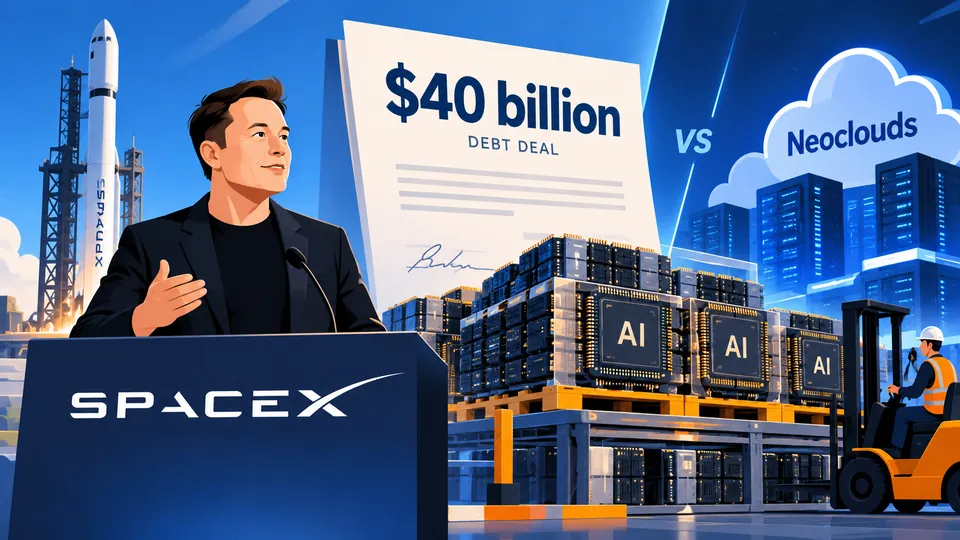
SpaceX closes $40 billion debt financing for GPU purchases
The financing is reported as mainly callable debt, which SpaceX can repay ahead of schedule. Reports place expected GPU deliveries in the first half of 2027, while one Chinese report gives a conflicting total of $400 billion. (f1, f3, f4, f5, f13, f14)
CNBC expects the GPU financing to arrive in the first and second quarters of 2027.3
SpaceX AI revenue in the third quarter, compared with $813 million in the same quarter a year earlier.3
Story
What the financing changes—and what remains unsettledSpaceX has completed a debt financing of $40 billion to purchase GPUs for its AI ambitions, according to reporting that attributes the disclosure to Elon Musk.123 The amount describes borrowing for hardware, rather than an announced purchase price for each chip or a measure of the company’s total AI spending.12 CoinDesk and CNBC describe the borrowing as primarily callable debt, a structure that allows SpaceX to repay it before the scheduled end of the borrowing.23 The reported purpose is GPU procurement, and the money may support deliveries expected in early 2027.23
The financing was reported as closed, but the reporting also describes unresolved discussion about pricing.1 People familiar with the discussions told Bloomberg that pricing talks were continuing, so the reported completion does not mean every price-related term had been settled at the time of that account.1 CNBC says Goldman Sachs led discussions with investors, including Apollo Global Management, about how to structure the financing.3 That account identifies the parties involved in structuring the borrowing, but it does not state the final pricing or assign a specific amount to any investor.13
Reports give a delivery window rather than a single delivery date: CoinDesk says the GPUs may arrive in the first half of 2027, while CNBC places the expected timing in the first and second quarters of that year.23 CNBC therefore describes the expected period more narrowly by quarter, while CoinDesk uses a broader half-year description; both accounts point to the opening portion of 2027.23 The reports do not say how many GPUs the borrowing will buy, how many separate deliveries are planned, or whether every dollar will be used only for those deliveries.23 CoinDesk characterizes the borrowing as primarily intended for GPU deliveries, and CNBC likewise links the financing to GPU purchases.23
The figure differs sharply in one account: cnBeta says Chinese reports put the completed financing at $400 billion, rather than the $40 billion reported by Bloomberg, CoinDesk, and CNBC.1234 That is a tenfold difference between the two stated totals, and the available reports do not explain the discrepancy.14 CnBeta’s account also describes the borrowing as mainly callable debt and places GPU deliveries in the first and second quarters of 2027, in line with CNBC’s timing description.34 Because the larger total appears in that account alone among the supplied reports, the other accounts support the $40 billion figure, while the conflicting report should remain visible rather than be silently reconciled.1234
The stated rationale for SpaceX’s borrowing capacity is that the company has income from activities beyond AI data centers.23 CoinDesk points to Starlink and rocket launches as revenue sources behind the company’s ability to raise the debt, and CNBC reports Musk cited those businesses when describing SpaceX’s finances.23 CNBC also reports that Musk described SpaceX as investment grade, while CoinDesk says the financing drew on the company’s strong credit rating.23 Together, these reports present the borrowing as supported by both a credit assessment and revenue outside AI, not solely by anticipated income from AI data centers.23
Musk’s broader comment on credit markets was that access to borrowing had largely closed for companies without substantial revenue independent of AI data centers.2 That observation sets SpaceX’s financing apart in the accounts: the company is described as having substantial businesses beyond AI, while the credit-market constraint is described as affecting firms without comparable independent revenue.23 The supported interpretation is that diversified, investment-grade revenue streams outside AI data centers help explain why SpaceX could obtain large-scale chip financing.3 This interpretation is presented as supported analysis, not as an additional statement by Musk or as a claim that every company with diversified revenue can borrow on the same terms.23
CNBC reports that SpaceX’s AI revenue in the third quarter reached $7.56 billion, compared with $813 million in the same quarter a year earlier.3 The reported level is nine times the earlier figure, a comparison that describes the change between those two quarterly revenue amounts.3 Those figures concern AI revenue, whereas the $40 billion figure concerns debt financing for GPU purchases; they measure different things and should not be treated as interchangeable.23 The reports do not specify that the quarterly AI revenue financed the borrowing or that it represents revenue from the same activities as Starlink and rocket launches.3
Musk also predicted that more than 200 neocloud companies would experience widespread failures and consolidation.3 The prediction concerns a group of more than 200 companies; it is not a reported count of firms that have already failed or combined.3 The supported account links his forecast to tighter borrowing conditions for firms that lack diversified revenue beyond AI data centers.2 That connection frames the forecast as a warning about financing pressure, rather than evidence in these reports that the predicted failures have occurred.23
SpaceX’s chief financial officer, Bret Johnsen, said the company was confident it could preserve its investment-grade rating while continuing the projects.5 His statement addresses the company’s expectation about its credit standing, while the financing accounts describe the borrowing as callable and tied mainly to GPU purchases.235 The reporting does not establish whether the rating will remain unchanged, and Johnsen’s confidence is a company view rather than a reported future outcome.5 The supported reading of the transaction is that SpaceX’s revenue outside AI data centers and its investment-grade standing provide context for access to this financing, while the amount, repayment flexibility, and delivery window describe its scale and intended use.23
Structure
Who is connected to whom- 1SpaceX
- ← partners withFact
- ← customer ofFact
- uses →Fact
- acquires →Fact
- agreement with →Fact
Disagreements
Where the sources do not matchReported total of the completed debt financing
cnBeta4
Possibly: The supplied reports do not explain the discrepancy; the larger figure is reported only by cnBeta, while Bloomberg, CoinDesk and CNBC give the other total.
History
How it came to this- At the time of Bloomberg's accountPricing discussions were still ongoingPeople familiar with the discussions told Bloomberg that talks over pricing had not concluded.
- Sunday, as reported by CNBCMusk said the financing had closedCNBC attributed the $40 billion financing disclosure to Musk's X post.
- Expected in early 2027GPU deliveries are anticipatedReports place expected deliveries in the first half of 2027, with CNBC specifying the first and second quarters.
- Now$40 billion SpaceX debt financing for GPU procurement
- First half of 2027Watch for the GPU deliveries the financing may support; CoinDesk gives a first-half window, while CNBC specifies the first and second quarters.
Impact
Spreading outward, level by level- Level 1GPU procurement
The financing is reported as borrowing to purchase GPUs for SpaceX's AI ambitions; the reports do not state how many GPUs it will buy.123
Fact - Level 2Repayment flexibility
The financing is described as primarily callable debt, which means SpaceX can repay it early.23
Fact - Level 3SpaceX's access to financing
[SUPPORTED] Diversified revenue outside AI data centers and investment-grade standing help explain why SpaceX could secure substantial AI-chip financing.
Analysis - Level 4Other AI-focused companies
Musk said debt-market access had largely shut off for companies without substantial revenue independent of AI data centers, and predicted widespread failures and consolidation among more than 200 neocloud companies.23
Fact
Ahead
Checked automatically when due; the result goes to the track recordWatch for the GPU deliveries the financing may support; CoinDesk gives a first-half window, while CNBC specifies the first and second quarters.
Sources
What each source supportsWritten by AI from the sources listed below: every fact was checked word for word against its source, and inference is marked apart. How we write