

Four Volvo A40 Electric haulers deployed on Lower Thames Crossing
The project introduces the world’s first serial‑produced battery‑electric articulated haulers. They operate on the Essex site, replacing diesel equipment and charging from renewable hydrogen‑generated power.
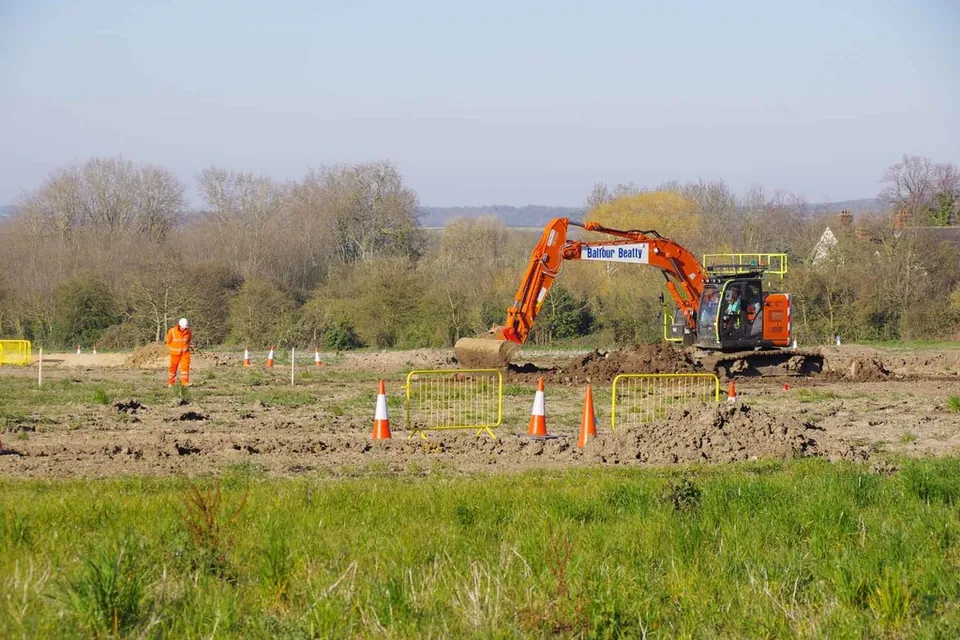
Each A40 Electric has a payload of 39 tonnes.1
Each A40 Electric is equipped with a 540 kWh battery.1
A charge provides around six hours of operation, depending on the application.1
Story
Four Volvo A40 Electric haulers deployed on Lower Thames CrossingFour battery‑electric articulated haulers are now in service on the Lower Thames Crossing project.1 Volvo Construction Equipment supplied these machines as the world’s first A40 Electric articulated haulers.1 The A40 Electric represents the first battery‑powered articulated hauler in its class to enter serial production.1 Their deployment marks the inaugural use of battery‑electric articulated haulers anywhere in the world.1 The project’s four machines are therefore more than a new equipment choice: the facts describe them as the first deployment of battery‑electric articulated haulers worldwide, while the A40 Electric is also identified as the first in its class to reach serial production.1 Those distinctions concern both the particular model and its use on a live construction project: one fact identifies the A40 Electric’s place in serial production, and another identifies the deployment itself as a world first.1 The deployment puts four such haulers to work on one infrastructure project, giving the project a defined, on-site example of this type of battery-electric equipment in use.1
The four units were delivered to the Essex worksite in the autumn of 2026.1 Volvo CE’s UK dealer, SMT GB, supplied the machines and will provide ongoing support.1 The delivery date and location place the machines at the Essex worksite in autumn 2026; the facts do not describe a broader delivery beyond these four units.1 SMT GB’s role extends beyond supplying the equipment, since it is also set to support the machines.1 That support arrangement connects the equipment’s arrival with continuing assistance from Volvo CE’s UK dealer, rather than describing the delivery as a one-off transaction alone.1
BMJV, a joint venture of Bouygues Travaux Publics and J Murphy & Sons, operates the haulers on the construction site.1 SMT GB, as the authorised Volvo CE dealer in the United Kingdom, is responsible for servicing the equipment.1 The facts distinguish the operator from the supplier and support provider: BMJV runs the haulers, while SMT GB supplied them and will support them.1 BMJV brings together Bouygues Travaux Publics and J Murphy & Sons, and that joint venture is the entity identified as operating the machines.1 For the project, this means the four haulers are in use under BMJV’s operation, with equipment support assigned to SMT GB.1
On‑site generators powered by British hydrogen produced from renewable energy charge the haulers.1 The charging arrangement links the machines’ electric operation to power produced on the site: generators provide the charging, and their fuel is British hydrogen made from renewable energy.1 The fact describes the source of the generators’ fuel, not a claim that the haulers themselves burn hydrogen; the haulers are battery-electric and the generators charge them.1 This makes the power supply part of the project’s equipment story as well as the vehicles: the haulers rely on charging, and the stated generator fuel comes from renewable-energy-produced British hydrogen.1
Each A40 Electric hauler can carry a payload of 39 tonnes and is equipped with a 540 kWh battery.1 Depending on the specific application, a full charge provides roughly six hours of operation.1 The 39-tonne payload describes what each machine can carry, while the 540 kWh figure describes its battery capacity; these are two different measures of the same hauler’s capability.1 The stated operating time is approximate rather than fixed: the machines can run for around six hours on a charge, with the duration depending on the application.1 Together, the payload and operating-time facts give a picture of both carrying capacity and time between charges, without suggesting that every task will use a charge in exactly the same way.1 For BMJV, which operates the machines, the application-dependent running time is relevant to how the haulers are used, while the payload figure describes their rated load capacity.1
Diesel-powered equipment has not been used on the Lower Thames Crossing worksites since 2025.1 Shaun Pidcock, Lower Thames Crossing Programme Director, said that going electric is now about benefits, not compromise.1 Darren Fitch, Head of Electromobility Sales Europe at Volvo CE, noted that the haulers demonstrate low‑carbon construction with zero exhaust emissions.1 The diesel fact applies to the project’s worksites and gives a time boundary: diesel has not been used there since 2025.1 The four battery-electric haulers are part of that construction setting, but the facts do not say that they alone account for the absence of diesel across the worksites.1 Pidcock’s comment frames the move to electric equipment as a matter of benefits rather than compromise, while Fitch’s description emphasizes low-carbon construction and the absence of exhaust emissions from the haulers.1 These descriptions come from project and manufacturer representatives, respectively, and both address the significance of using electric equipment on the project.1 The workers and organisations involved in the construction are the people directly connected to this equipment change: BMJV operates the haulers, and SMT GB supplies and supports them.1
The Lower Thames Crossing project includes 2.6 miles of tunnels beneath the River Thames.1 That tunnel length gives a measure of the infrastructure project in which the haulers are being used, while the four-machine deployment describes one specific type of equipment on it.1 The facts place the electric haulers within a project that includes tunnelling beneath the Thames; they do not specify which tasks the machines perform in relation to the tunnels.1
Volvo CE, founded in 1832, has introduced the A40 Electric as the first serial‑produced battery‑electric articulated hauler of its class.1 This deployment therefore represents a historic milestone in heavy‑equipment electrification worldwide.1 The company’s founding date provides background on Volvo CE, while the serial-production distinction describes the A40 Electric’s position in its equipment class.1 The worldwide first-use claim refers to the deployment of battery-electric articulated haulers, a separate distinction from the model’s status as the first in its class to enter serial production.1 The project thus brings together a manufacturer with a long history, as stated in the facts, and a deployment identified as a first for this equipment type.1
The press release announcing the deployment was issued from ESKILSTUNA, Sweden on 25 November 2026.1 That information dates and locates the announcement; it is distinct from the stated arrival of the four machines at the Essex worksite in autumn 2026.1 The release date and the arrival period both fall in 2026, but the facts give them at different levels of precision: a specific day for the announcement and a season for the site arrival.1
In summary, four electric articulated haulers are now operating on the Lower Thames Crossing, charged by renewable hydrogen‑generated power, and replacing diesel equipment on a major tunnelling project.1 The summary brings together separate elements of the project: the number of machines in use, their generator-based charging supply, the absence of diesel on the worksites since 2025, and the project’s tunnels beneath the Thames.1 The available facts establish those points but do not quantify how much diesel use or emissions the haulers have displaced.1 For BMJV, the operator, the immediate change described is the use of four battery-electric haulers; for SMT GB, the described role includes supplying and supporting them.1 The equipment’s 39-tonne payload, 540 kWh battery and approximate six-hour running time add practical operating details, with the running time dependent on application.1 Taken together, the facts describe a deployment that is distinctive both for the equipment’s claimed firsts and for the renewable-hydrogen-powered charging setup on the Essex worksite.1
History
How it came to this- Since 2025Diesel no longer used on the worksitesDiesel has not been used on the Lower Thames Crossing worksites since 2025.
- Autumn 2026Four haulers arrive at the Essex worksiteThe machines arrive for use on the Lower Thames Crossing project.
- November 25, 2026Deployment announcedVolvo CE's press release announces the first worldwide use of battery-electric articulated haulers.
- NowFour Battery-electric articulated haulers deployed on the Lower Thames Crossing
Impact
Spreading outward, level by level- Level 1Site operations
BMJV operates the four battery-electric haulers on the project, and SMT GB supplied them and will support them.1
Fact - Level 2Charging supply
On-site generators fuelled by British hydrogen produced from renewable energy charge the haulers.1
Fact - Level 3Project emissions context
The project reports no diesel use on its worksites since 2025; the facts do not quantify how much diesel use or emissions these haulers displace.1
Fact - Level 4Construction significance
The deployment offers an on-site example of battery-electric articulated haulers in infrastructure construction; the facts do not establish that this proves large-scale construction can be achieved with zero-emission heavy equipment.
Analysis
Sources
What each source supportsWritten by AI from the sources listed below: every fact was checked word for word against its source, and inference is marked apart. How we write