

EU-Indonesia pact removes tariffs on more than 98% of tariff lines
The two sides signed a trade agreement and a separate investment-protection agreement after nine years of negotiations. Tariff removal is phased across 15 years, while projected export gains sit alongside a substantial existing trade relationship.
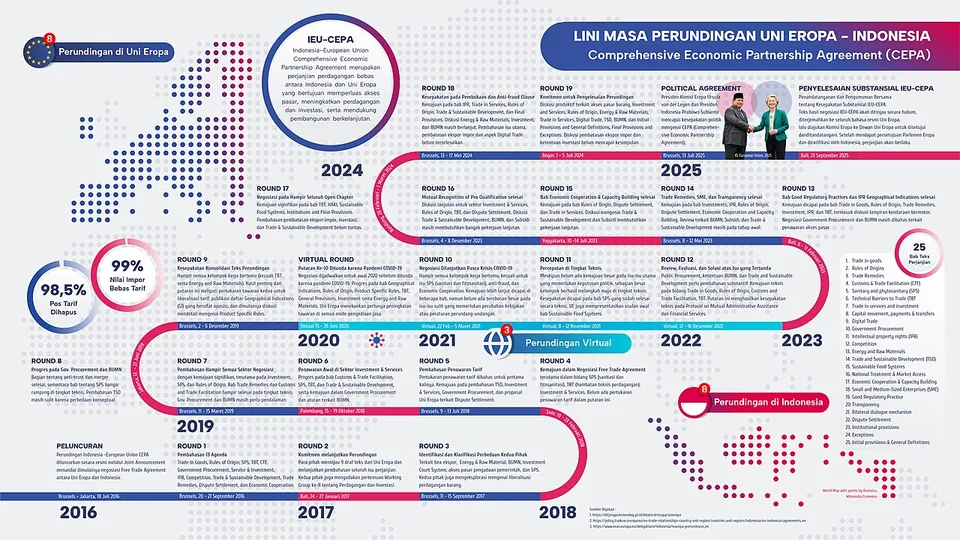
The EU and Indonesia signed the Comprehensive Economic Partnership Agreement after nine years of negotiations.1
The Commission estimates that EU exporters could save this amount annually in duties.1
The Commission projects this increase in EU exports to Indonesia, led mainly by machinery and motor vehicles.1
Story
What the EU-Indonesia agreements changeThe European Union and Indonesia have signed a Comprehensive Economic Partnership Agreement after nine years of negotiations, setting out a tariff reduction that reaches more than 98% of tariff lines and nearly all trade value over 15 years. [FACT]1 The measure is not an immediate removal of every duty: the stated coverage of nearly 100% of trade value is to be achieved across the 15-year period. [FACT]1 The two governments also signed an Investment Protection Agreement, a separate agreement alongside the trade pact. [FACT]1 The Commission estimates that EU exporters could save about 650 million euros each year in duties under the deal. [FACT]1 That annual saving is an estimate of duties avoided, while the tariff coverage describes the lines and value of trade affected; the figures therefore describe different aspects of the arrangement. [FACT]1
The Commission projects that EU exports to Indonesia will rise by more than 6 billion euros, with machinery and motor vehicles identified as the main areas of growth. [FACT]1 It also identifies possible openings for EU agri-food exports, without assigning that category a separate value in the stated projection. [FACT]1 On the Indonesian side, exports to the EU are expected to expand, led by vegetable oils, clothing and footwear. [FACT]1 The stated export outlook therefore runs in both directions, but the quantified growth figure provided is for EU exports to Indonesia rather than for Indonesian exports to the EU. [FACT]1 These are projections and expectations, not reported measurements of trade after the agreements have taken effect. [FACT]1
The scale of the existing goods relationship provides a baseline for judging the projected changes: goods trade between the partners was nearly 29 billion euros in 2025. [FACT]1 Services trade was over 9 billion euros in 2024, a separate measure covering a different type of exchange and a different year. [FACT]1 EU investment in Indonesia stood at close to 25 billion euros, a stock of investment rather than an annual trade flow. [FACT]1 The goods and services figures should not be added as though they describe the same period: one records goods in 2025 and the other services in 2024. [FACT]1 Likewise, the investment figure is not directly comparable with either annual trade measure because it describes investment in Indonesia, not the value of goods or services exchanged during a year. [FACT]1
The projected increase of more than 6 billion euros in EU exports is smaller than the nearly 29 billion euros recorded for goods trade between both sides in 2025, but the comparison is not like-for-like. [FACT]1 The first figure concerns projected EU exports to Indonesia, while the second covers goods trade in both directions in a specified year. [FACT]1 The expected annual duty saving of about 650 million euros measures a different outcome again, rather than the value of additional exports or total trade. [FACT]1 Taken together, the figures indicate the agreement’s expected effects and the scale of existing exchanges, but they do not establish how much trade will ultimately grow. [FACT]1
The Commission’s account also points beyond tariffs: Commissioner Šefčovič said the agreement tackles non-tariff barriers that obstruct business. [FACT]1 That description places the pact’s intended business effects in two areas, since tariff provisions are accompanied by action addressing other obstacles to trade. [FACT]1 Šefčovič said the agreement’s results would depend on making it known and carrying out its commitments. [FACT]1 His remarks make promotion and implementation part of the stated test for success, rather than treating signature alone as sufficient. [FACT]1 He also expressed thanks to Member States, the European Parliament and Minister Airlangga for their cooperation and backing. [FACT]1
Other European Union policy debates in the supplied reporting concern different subjects and should not be read as components of the Indonesia agreements. [FACT]12 A report said the EU put forward a plan on Saturday to tax the largest digital companies as a way to finance its next budget. [FACT]2 Separately, European Council President Antonio Costa proposed reducing a European Commission spending plan by €204 billion (US$224 billion). [FACT]2 Those budget and digital-tax proposals concern EU funding choices; they do not describe tariff terms or investment protections between the EU and Indonesia. [FACT]12
A separate set of reports concerned European participation in discussions on Ukraine, not the trade negotiations with Indonesia. [FACT]13 France said European leaders would consider travelling to Moscow for Ukraine talks if they took part fully in the negotiations. [FACT]3 A French adviser said Europe sought a full role in the next discussions involving the United States and Ukraine. [FACT]3 These statements describe a diplomatic position on Ukraine and are distinct from the EU’s agreements with Indonesia. [FACT]13
Climate adaptation finance forms another separate policy context in the reporting. [FACT]14 Uganda and Malawi were among 23 African countries that had not filed National Adaptation Plans with the UN climate convention secretariat. [FACT]4 Those plans set out climate dangers and effects and help countries explain what assistance they require. [FACT]4 At COP31, African negotiators sought to raise adaptation finance to three times its level by 2035, using an annual $40bn baseline that they said developed countries had promised to provide by 2025. [FACT]4 The proposal did not enter the summit’s formal negotiations, while the EU said it preferred delivery of existing climate-finance pledges to setting additional funding targets. [FACT]4
Darragh O’Brien said the EU had not offered extra money and wanted funds already pledged to be put to use. [FACT]4 Wopke Hoekstra said funding has little practical value if it fails to reach countries at risk. [FACT]4 Hoekstra said the EU had supplied $30bn from the $100bn climate-finance commitment made by developed countries in recent years. [FACT]4 A recent UN report estimated that developing countries would require about $300bn each year by 2035, while their 2024 receipts from developed countries amounted to about 10% of that need. [FACT]4 These climate-finance figures concern funding for vulnerable and developing countries; they are not measures of trade, tariff savings or investment under the EU-Indonesia agreements. [FACT]14 The trade agreements and climate-finance negotiations are separate matters, even though both involve the EU and international economic commitments. [SUPPORTED]1
Structure
Who is connected to whom- 1European Union
- ← regulated byFact
- sanctions →Fact
- restricts exports to →Fact
- restricts imports from →Fact
- ← regulatory exposureFact
History
How it came to this- After nine years of negotiationsTrade pact signedThe EU and Indonesia signed the Comprehensive Economic Partnership Agreement.
- At signingInvestment protection agreement also signedThe parties signed an Investment Protection Agreement alongside the trade pact.
- Nowmore than 98% Tariff lines covered by the EU-Indonesia trade agreement
Impact
Spreading outward, level by level- Level 1Tariff treatment
The agreement provides for eliminating tariffs on more than 98% of tariff lines, with coverage of nearly all trade value reached over 15 years.1
Fact - Level 2Exporter costs and trade outlook
The Commission estimates annual duty savings for EU exporters and projects growth in EU exports to Indonesia; Indonesian exports to the EU are also expected to increase.1
Fact - Level 3Business obstacles and implementation
The Commission says the agreement addresses non-tariff barriers, and Šefčovič said its success depends on promotion and implementation of its commitments.1
Fact - Level 4Existing economic relationship
The partners already have substantial goods trade, services trade and EU investment in Indonesia; these are distinct measures and should not be treated as a single comparable total.1
Fact
Sources
What each source supportsWritten by AI from the sources listed below: every fact was checked word for word against its source, and inference is marked apart. How we write