

Nearly half of Riyadh flights cancelled after missile strike damages Saudia aircraft
Operations at King Khalid International Airport were suspended following a missile attack that injured passengers and killed three people. Several airlines halted service while the airport remains partially closed ahead of a major energy summit.
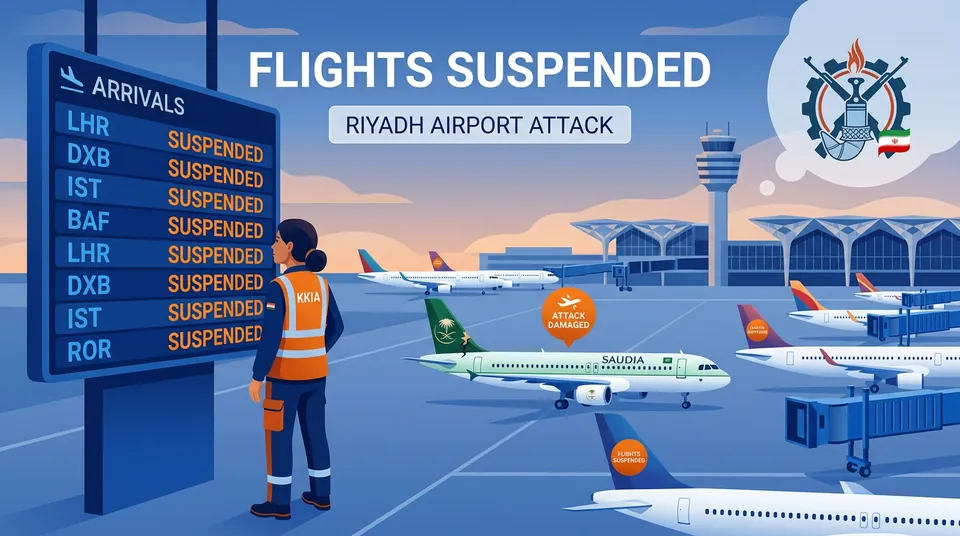
By 1500 GMT on Thursday, almost half of departures from the airport had been cancelled.2
The airport handled 576,600 tonnes of cargo in 2025.5
Saudi authorities said three people were killed in strikes on Riyadh and Abha airports that week.2
Story
Airline disruptions at Riyadh airport after missile attackData from aviation analytics firm Cirium showed that by 1500 GMT on Thursday, almost half of all scheduled departures from King Khalid International Airport had been cancelled.2 The Saudi General Authority of Civil Aviation confirmed that all operations at the airport were suspended in response to the incident.1 These cancellations represented a sharp reduction in the airport’s flight schedule, affecting both domestic and international services.2 The scale of the disruption underscores the airport’s central role in Saudi Arabia’s air transport network.2 Because nearly half of departures were removed, airlines faced significant revenue losses and passengers were forced to seek alternative routes, highlighting the economic ripple effect of the suspension.2
The disruption followed a ballistic missile strike that the Iran‑backed Houthi movement said it had launched at the airport.3 Saudi authorities have not verified that the projectile directly struck the Saudia aircraft on the ground.3 The missile’s impact nevertheless caused significant damage to the aircraft and surrounding infrastructure.3 The incident triggered a broader security response across Saudi airfields.3 Officials emphasized that the lack of confirmation about a direct hit does not diminish the seriousness of the damage reported by the airline.3 The heightened security posture is intended to prevent further incidents and reassure airlines that the airspace remains safe for future operations.1
Three people were reported killed in the attacks on Riyadh and Abha airports during the same week.2 Additional injuries were recorded among passengers and staff at King Khalid International Airport.1 Debris from an intercepted missile struck a kindergarten and a medical complex in Riyadh, adding civilian casualties to the tally.2 These human losses highlight the broader humanitarian impact of the strike beyond aviation.2 The combination of fatalities and injuries illustrates how an aviation‑focused attack can quickly affect the wider community, especially when nearby civilian facilities are hit.12
Etihad Airways and Qatar Airways cancelled multiple flights to and from Riyadh, with some cancellations extending into Monday.1 Kuwait Airways also halted its Saturday services to the capital.1 European carriers Lufthansa and Air India confirmed they were suspending flights to Riyadh as well.2 The combined effect of these cancellations further reduced the airport’s outbound traffic.12 Airlines cited safety concerns and the suspension of airport operations as primary reasons for the service cuts.1 These suspensions affect not only business travelers but also tourists and expatriates who rely on regular connections to the capital.1
Saudia Group verified that one of its aircraft was damaged on the tarmac, though no passengers were aboard at the time.5 The airline also reported that one of its captains was among those killed in the attack.5 The loss of crew and aircraft further strained Saudia’s operational capacity at the hub.5 These details were confirmed by the airline’s official statements.5 With a senior pilot among the dead, the airline faces both emotional and logistical challenges as it works to replace experienced staff.5 The damage to the aircraft also means additional maintenance resources will be required, diverting attention from normal flight schedules.5
In 2025, King Khalid International Airport handled 576,600 tonnes of cargo, according to figures from the General Authority of Civil Aviation.5 The cargo volume underscores the airport’s importance as a logistics hub for the region.5 Disruption to passenger flights does not directly affect cargo operations, but overall airport activity has been curtailed.15 Restoring full cargo throughput will depend on the resumption of normal airport functions.5 Because cargo services can continue with limited ground access, the airport still contributes to regional supply chains despite passenger flight suspensions.5
Riyadh is scheduled to host the World Petroleum Council Energy Congress this week, bringing together senior energy policymakers.2 The security situation at the airport raises concerns for delegates traveling to the summit.2 Organizers have emphasized the need for safe transport links to ensure attendance.2 The ongoing flight suspensions could complicate logistics for participants arriving by air.12 If alternative routes are required, the cost and time for delegates may increase, potentially affecting the overall attendance and agenda of the congress.2
Western embassies in Riyadh, including those of Germany, the United States, Canada and Spain, advised their citizens to avoid the airport.1 These advisories reflect heightened security concerns for foreign nationals traveling through the hub.1 The diplomatic warnings complement the Saudi authorities’ operational suspension.1 Travelers were urged to seek alternative routes or postpone trips until conditions improve.1 Such guidance can lead to a measurable drop in tourist arrivals, which in turn impacts local hospitality businesses that depend on airport traffic.1
Although King Khalid International Airport has reopened its facilities, airline services have not fully returned.5 Carriers such as Lufthansa and Air India continue to suspend flights, indicating a prolonged recovery period.25 The partial reopening allows limited ground operations while passenger services remain constrained.15 Full restoration will depend on investigations into the missile strike and the repair of damaged aircraft.35 Until the investigations are complete and safety can be assured, airlines are likely to maintain a cautious approach, prioritizing passenger confidence over rapid schedule reinstatement.13
Structure
Who is connected to whom- 1King Khalid International Airport
- located in →Fact
- located in →Fact
History
How it came to this- 2026-10-10Earlier signal: airport evacuatedAn earlier signal reported an evacuation after a reported blast.
- SaturdayAirport operations suspendedSaudi Arabia's General Authority of Civil Aviation said airport operations had been suspended after the attack.
- By 1500 GMT ThursdayCancellations reached almost half of departuresCirium data showed almost half of departures had been cancelled.
- After the attackAirlines cancelled or suspended Riyadh servicesEtihad, Qatar and Kuwait Airways cancelled flights; Lufthansa and Air India confirmed suspensions.
- Nowalmost half King Khalid airport departures cancelled
Impact
Spreading outward, level by level- Level 1Airport operations
The airport suspended operations, and by 1500 GMT Thursday almost half of departures had been cancelled.12
Fact - Level 2Airline services
Several airlines cancelled or suspended flights to Riyadh, with some cancellations extending into Monday.125
Fact - Level 3Travelers and airport users
Embassies urged citizens to avoid the airport, while the airport's reopening had not restored airline services fully.15
Fact - Level 4Wider airport activity
The airport handled 576,600 tonnes of cargo in 2025; the facts do not establish how the flight disruption affected cargo throughput.5
Fact
Sources
What each source supportsWritten by AI from the sources listed below: every fact was checked word for word against its source, and inference is marked apart. How we write