
OpenAI alleges ex-employee took more than 100 product-plan files to Apple
The accusation appears in a trade-secrets dispute, and Apple denies it. The filings also describe competing claims about confidential information moving between the companies, while separate reporting covers OpenAI’s research output and leadership changes.
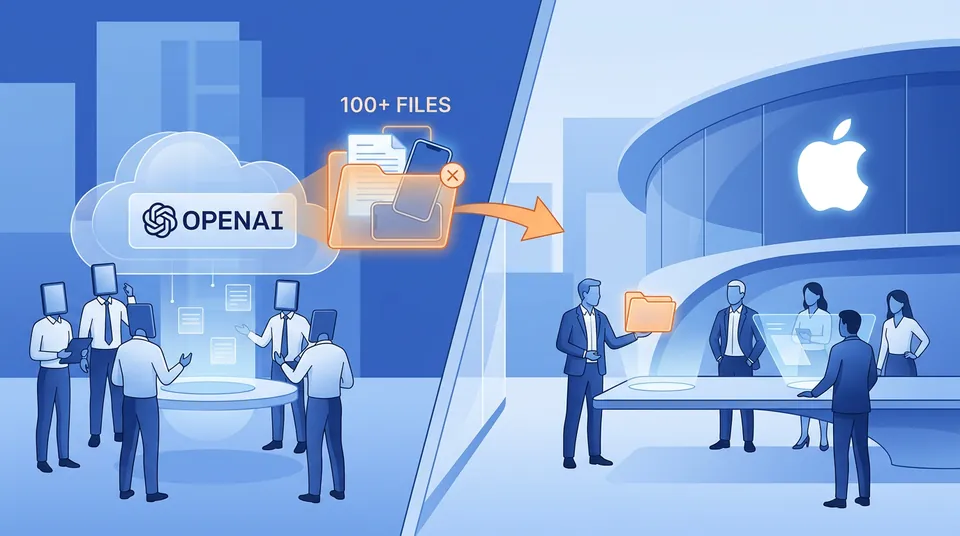
OpenAI alleges that the former employee took more than 100 files about its product plans before joining Apple.2
OpenAI says the material included images of at least one unreleased device, alongside supplier and engineering information.2
A judge approved depositions of three former Apple employees in the dispute.1
Story
The allegations, the counterclaims and the record around themOpenAI alleges that a former employee took more than 100 files concerning its product plans before moving to Apple.2 The company set out the accusation in a filing tied to a trade-secrets dispute between the two firms.2 The reported count is more than 100 files, not a stated number of products, devices or projects.2 OpenAI says the material included images of at least one product that had not been released, alongside supplier details, engineering information and project files.2 Those descriptions identify the kinds of material at issue, but the allegation itself does not establish that Apple used any of it.12
According to OpenAI’s account in the filing, the former employee transferred the information to a personal account and later showed it to Apple leaders.2 The people at the presentation reportedly included a vice president whose responsibilities covered operations in Asia.2 OpenAI says the presentation concerning an unreleased product happened months before the filing was made.1 That timing distinguishes the alleged presentation from the later legal document: the company says the first preceded the second by months, without specifying an exact interval in the cited account.12 The material described in the filing ranges from product imagery to supplier and engineering information, rather than being limited to a single type of document.2
OpenAI says it is deeply concerned that confidential information could now be circulating within Apple.1 That statement reports OpenAI’s concern, not a finding that the information spread or was used.12 Apple rejects the allegations, says safeguards apply to people it hires, and reports that it has found no evidence supporting OpenAI’s claims.1 The two companies therefore present opposing accounts, and the allegations remain disputed rather than resolving whether Apple used the material.12 The filing does not establish that allegedly misappropriated information contributed to development of Home View.1
Apple has brought a separate case that accuses former Apple employees of taking proprietary information to OpenAI’s consumer-hardware division.1 OpenAI denies Apple’s claims that employees who left downloaded confidential files and carried knowledge of unreleased technologies into their new roles.1 The two complaints thus describe alleged movement of protected information in opposite directions: OpenAI’s filing concerns a former employee moving to Apple, while Apple’s suit concerns former employees moving to OpenAI.12 This comparison describes the parties’ allegations, not established transfers or proof of use.12 The available account says the dispute concerns handling of proprietary information on both sides, while leaving the central accusations contested.2
A federal judge allowed Apple faster access to some OpenAI hiring records, including interview guides, technical presentations and documents about conversations concerning Apple technologies or components.1 The judge also approved depositions of three former Apple employees: Tang Yew Tan, Chang Liu and Alyssa Peng.1 Apple sought records to investigate whether its proprietary technology featured in OpenAI’s recruitment process.1 The judge did not grant Apple’s wider requests for OpenAI hardware research and certain engineering information.1 These steps concern records and testimony relevant to the dispute; they do not themselves resolve the allegations about what information was taken or used.12
The dispute over information moving between the companies sits alongside a separate change in OpenAI’s computing leadership.3 Infrastructure chief Sachin Katti said he would leave that position after about a year and remain an adviser after November 15.3 OpenAI’s spokesperson said Uday Ruddaraju, its chief technology officer for compute, would replace Katti and lead the company’s overall compute organization.3 The reported duration, about a year, describes Katti’s time in the role, while the succession account identifies Ruddaraju’s incoming responsibilities.3 The available facts do not connect this leadership transition to the trade-secrets allegations, so the two developments remain distinct in this account.23
OpenAI’s mathematics work provides another, separate part of the reporting about the company.45 One source says OpenAI placed 722 AI-generated mathematics manuscripts on GitHub on October 6, 2026, and attributes them to an unreleased internal frontier model.4 That account counts 372 result families and 377 new proofs among the manuscripts, and says about 42% of their main conclusions had passed Lean formal verification.4 A second report also gives a total of 722 manuscripts, but places the upload on October 7 and says some Lean proofs were included.45 The two accounts agree on the manuscript total but differ on the stated release date, so the dates should not be collapsed into one.45
The QbitAI report focuses on two manuscripts about the Kakeya problem, which together ran to 272 pages and named OpenAI as their only author.5 It says those two papers had not undergone Lean formalization or peer review.5 That report’s statement about the Kakeya papers is narrower than the other source’s approximate verification figure for the main conclusions across the manuscript collection.45 The measures are not interchangeable: one describes an approximate share of conclusions passing Lean checks, while the other addresses formalization and peer review of two specific papers.45 The available accounts therefore describe limited verification in different ways, rather than providing one uniform assessment of all 722 manuscripts.45
Taken together, the reporting covers a contested legal dispute, court-approved access to selected hiring materials, a computing leadership handoff and a large mathematics release.12345 The legal accounts identify allegations by both companies and describe procedural steps, but they do not establish that either side used the information at issue.12 The research reports provide counts and verification qualifications, including different dates for the public upload and distinct methods of describing review.45 Keeping those categories separate matters to reading the record: an allegation, a judicial decision about access, a company statement and a reported research count each describe different things.124
Structure
Who is connected to whom- 1OpenAI
- uses →Fact
- ← part ofFact
- ← invests inFact
- operates in →Fact
- depends on →Fact
Disagreements
Where the sources do not matchDate OpenAI uploaded its mathematics manuscripts
Possibly: The reports state different upload dates; the available facts do not explain the difference.
Lean verification of the mathematics manuscripts
钛媒体4
量子位5
Reason: The accounts describe different scopes and measures: an approximate share of conclusions across the collection versus the formalization status of two specific manuscripts.
History
How it came to this- Months before the filingOpenAI says a presentation about an unreleased product took placeThe company says the former employee presented information to Apple leadership before the filing.
- FilingOpenAI sets out its allegationsThe allegations appeared in a document connected to the companies’ trade-secrets dispute.
- During the disputeThe court authorizes selected records and depositionsA judge granted expedited access to certain hiring records and approved depositions of former Apple employees, while rejecting broader requests for some OpenAI materials.
- Nowmore than 100 Files OpenAI alleges a former employee took before joining Apple
Impact
Spreading outward, level by level- Level 1Information described in the filing
OpenAI says the files included unreleased-product imagery, supplier information, engineering data and project files; those descriptions identify the alleged material, not proof it was used.12
Fact - Level 2The companies’ competing claims
Apple denies OpenAI’s allegations and says it has found no supporting evidence. Separately, Apple accuses former employees of taking proprietary information to OpenAI, while OpenAI denies those accusations.12
Fact - Level 3Court process
The court-authorized access to selected hiring materials and testimony enables investigation of recruiting and employee knowledge, but does not itself establish that information was taken or used.
Analysis - Level 4Potential circulation inside Apple
OpenAI says it is concerned confidential information may be circulating within Apple. That concern is not a finding that the information spread or contributed to Home View.1
Fact
Sources
What each source supportsWritten by AI from the sources listed below: every fact was checked word for word against its source, and inference is marked apart. How we write