

Iran reports fires on two tankers after mine strikes near Hormuz
Iranian accounts describe separate incidents, with one report giving a total of three tankers and another focusing on two. The reports leave the vessels’ identities and damage unclear, and independent confirmation was not available.
Iran’s navy said three tankers caught fire after striking mines in the strait on Saturday.1
In the navy’s account, one tanker struck a mine in the eastern strait on Saturday morning.1
The navy said two more tankers struck mines later that day.1
Story
What the tanker reports say—and what remains uncertainIranian naval accounts reported fires on oil tankers after mine strikes near the Strait of Hormuz, but they did not give a single consistent total: one account described three vessels, while another centered on two.123 The three-vessel version came from Iran’s navy and was described as a Saturday series, whereas the two-vessel account concerned fires in the eastern part of the strait.12 These counts should not be combined as if every report covered precisely the same event; the available accounts refer to more than one reported incident.1 The reports attribute the fires to mines, but Reuters said it could not promptly confirm the accounts, and another report also said independent verification was absent.12
In the sequence described by Iran’s navy, a tanker hit a mine in the strait’s eastern section on Saturday morning, and two additional vessels reportedly struck mines later that day.1 A separate account carried by Iran’s IRNA news agency attributed an evening report to the Revolutionary Guards Navy, which said two tankers had entered a prohibited route before striking mines and catching fire.1 Another report placed a tanker fire after a mine strike in the eastern strait on Saturday morning and noted that Reuters could not immediately verify it.4 A Friday-night statement from the Guards also described two vessels, including a supertanker, as having struck mines and caught fire while taking what the Guards called an unauthorized route.4
The accounts differ not only in their stated totals but also in how they divide the events: one gives a morning strike followed by two later strikes, while another describes two tankers in an evening incident.1 For the two-vessel episode, the Guards said radar and navigation equipment had been switched off and warned that ships crossing without coordination with its traffic-control center could face a similar outcome.4 Iran’s navy separately said two vessels were in restricted waters after disabling tracking equipment, while a report of the Guards’ account said radar and positioning devices were off during an unauthorized passage.23 These descriptions are claims by Iranian military bodies; the reports do not independently establish the vessels’ routes, equipment status or the sequence of events.124
The vessels are not identified in the reports, and the accounts provide no consistent information about their flags, origins, owners or the scale of damage.2356 One account said the Guards described one tanker hit in the south of Hormuz as a supertanker, while another identified a supertanker among the two vessels in its Friday-night report.34 Neither description supplies the names of the ships, so the mention of a supertanker does not resolve which vessel was involved or establish the full toll.234 The accounts also differ on whether a particular vessel merely caught fire or had to stop after the strike; the conventional navy’s statement described one tanker stopping.3
Iran says it has limited which vessels may use the strait and has attacked ships it says breached those limits.1 A separate account said Tehran required authorization for passage after the war with the United States began in February and attacked ships that did not comply.3 Iran’s navy characterized tankers in restricted waters with tracking systems disabled as acting unlawfully, and its statement presented fires and explosions as the consequence.2 In another account, the Guards said the two tankers were secretly following an unauthorized route, with radar and positioning systems switched off when they struck mines.3 A report attributed to the conventional navy described a different tanker in a prohibited eastern zone with tracking and identification equipment disabled before it hit a mine.3
The Iranian Army Navy account reported two tankers catching fire after mine strikes while attempting to enter a restricted area east of the strait.5 That account said the vessels ignored warnings and had turned off radar, but did not disclose their identities, ownership, flags or the damage they sustained.5 A separate Thursday report said four tankers had experienced explosions after allegedly entering areas Iran designated as restricted, and the military said the vessels had disregarded repeated warnings.5 Another Thursday account said two tankers caught fire after hitting mines in restricted water east of the strait, with the Army’s public relations department placing the incident on Thursday afternoon and alleging that warnings were ignored and radar was disabled.6 The Thursday accounts do not establish that their reported vessels were the same as those in the Saturday reports, so their totals cannot be treated as one combined count.156
Iran’s Army blamed US President Donald Trump chiefly for the Thursday incident and also faulted the vessel owners for trusting statements from Washington that the Army called misleading.6 Iranian Foreign Ministry spokesperson Esmaeil Baqaei warned other governments not to provide naval, military or logistical assistance for US operations against Iran.5 A report said the United States had placed a naval blockade on Iranian ports in response to Tehran’s restriction of the trade route, while also providing military support to tankers using it.3 The US military says it has removed mines from the waterway’s principal routes, a position that sits alongside Iran’s reports of mine strikes rather than independently settling whether those particular strikes occurred.13
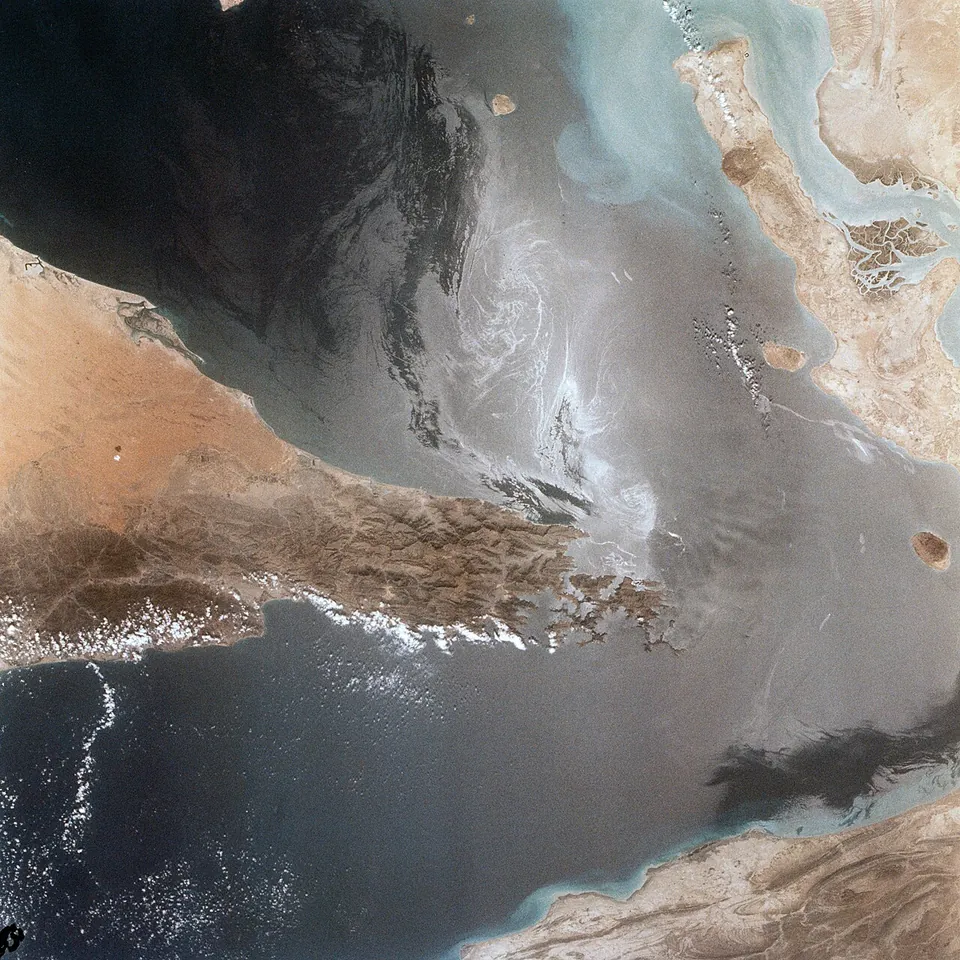
The Strait of Hormuz links the Persian Gulf to the Gulf of Oman, and reports describe repeated disruption there after the US-Israeli military offensive against Iran began on February 28.2 A separate account gives the same connection between the Gulf and the Gulf of Oman and says the disruptions followed the offensive that began on Feb. 28.6 The reported incidents also sit within a longer series of Iranian military claims: in earlier November, the Guards said four tankers were destroyed after mine strikes south of the strait and two other vessels were seized.4 The Guards said on November 1 that two tankers exploded after hitting mines, with a supertanker engulfed in flames; UKMTO, by contrast, reported a tanker struck by an unidentified projectile that day.4 In mid-October, the Guards said two tankers carrying about 2 million barrels of crude oil caught fire after mine strikes, and the reporting noted that none of the Guards’ claims had independent confirmation.4
Iran’s armed forces had also reported several shipboard fires or explosions in recent weeks, frequently linking them to mines.3 Against that record, the reports describe repeated Iranian claims of mine-related damage alongside the US military’s statement that it cleared the main routes; the competing positions do not verify the individual incidents.134 The shipping picture was not described as uniformly deteriorating: one report said tanker movements showed signs of recovery and that hopes for reduced US-Iran tensions had helped lower oil prices, although security remained fragile.5 Taken together, the available reporting supports a distinction between what Iranian forces say happened and what has been independently established: the incidents, the tanker count and the damage remain unconfirmed in the cited accounts.1246
Structure
Who is connected to whom- 1Artesh
- uses →Fact
- ← partners withFact
- geographic exposure →Fact
Disagreements
Where the sources do not matchNumber of tankers reported in the Saturday accounts
Hindustan Times1
Israel National News2
Possibly: The accounts may be describing different incidents or using different event groupings: one describes a morning strike followed by two later strikes, while another reports two tankers in the eastern strait. The reports do not establish that they cover precisely the same event.
History
How it came to this- February 28Disruptions reported after the offensive beganA report linked repeated disruption in the strait to the start of the US-Israeli military offensive against Iran.
- Saturday morningA tanker reportedly struck a mineIran’s navy said one tanker hit a mine in the eastern strait.
- Later that SaturdayFurther mine strikes reportedIran’s navy said two more tankers struck mines; a separate Guards account described two tankers on a prohibited route striking mines and catching fire.
- Nowthree Tankers Iran’s navy said caught fire after mine strikes in the Strait of Hormuz on Saturday
Impact
Spreading outward, level by level- Level 1Vessels and damage
The reports do not identify the tankers or establish the extent of their damage.2
Fact - Level 2Verification of the reported strikes
Reuters said it could not immediately verify the reports, and the cited accounts do not independently confirm the mine-strike claims.1
Fact - Level 3Shipping through the strait
Iran has restricted vessels seeking to use the strait and attacked ships it says violated those restrictions; the reported incidents may add to uncertainty for vessels navigating the route.
Analysis - Level 4Wider security context
The reports describe competing positions: Iran has reported mine strikes, while the US military says it cleared the waterway’s main routes of mines. Neither account independently settles whether these particular strikes occurred.13
Fact
Sources
What each source supportsWritten by AI from the sources listed below: every fact was checked word for word against its source, and inference is marked apart. How we write