

Perseverance confirms hydrated-silica-rich rocks at Idubi
New SuperCam measurements show that bright rocks in the Lac de Charmes region are not igneous and contain abundant hydrated silica. Their size allows a more promising investigation than earlier silica-rich deposits on Jezero crater’s inner rim, where the rover could not gather high-resolution data with its proximity instruments.
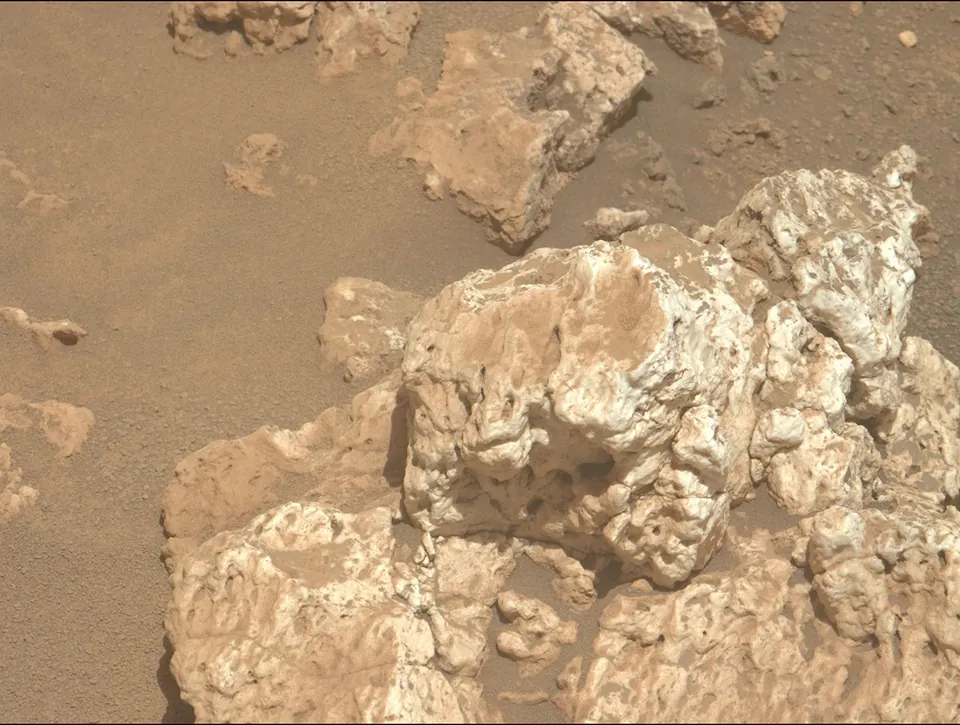
SuperCam data confirmed that the Idubi rocks are not igneous and are rich in hydrated silica.1
The Idubi rocks are large enough to offer a more promising close-investigation opportunity than the earlier silica-rich deposits on Jezero’s inner rim.1
The update raises the possibility of preserved signs of ancient life but does not report finding any.1
Story
What the Idubi rocks add to the search for Mars’s pastPerseverance has confirmed that a cluster of light-coloured rocks at Idubi is rich in hydrated silica and does not consist of igneous rock, distinguishing the find from the kinds of stones the rover team had examined there before.1 The rocks are also brighter than the igneous and impactite material the team had investigated previously, and their pale appearance sets them apart from the darker, commonly dust-coated ground nearby.1 The update describes the rocks as large enough to provide a more promising investigation opportunity than the silica-rich material Perseverance encountered earlier on Jezero crater’s inner rim.1 It gives no measurement of the rocks’ dimensions or of the amount of silica; the reported change is a compositional identification and a better opportunity for close study, rather than a quantified deposit size.1
The discovery began while Perseverance was examining Idubi, a section of ancient Martian crust exposed in Lac de Charmes, beyond Jezero crater.1 The team first noticed a concentration of pale, bright stones there, visually distinct from the darker terrain that surrounds them.1 Their brightness also separated them from igneous and impactite rocks studied on earlier rover investigations, while their appearance did not match the area's usual igneous rocks.1 That mismatch prompted the team to direct Perseverance toward the cluster for examination, turning an observed contrast into a targeted investigation.1
The new compositional evidence came from SuperCam data received by the team, which established both that the rocks are not igneous and that hydrated silica is abundant in them.1 That finding clarifies what the pale material is, but the update does not say that the rover has established how the Idubi deposits formed.1 The origin matters because the earlier silica-rich deposits on Jezero’s inner rim could not be characterized with the high-resolution chemical and mineralogical measurements needed to constrain their formation.1 The Idubi rocks’ greater suitability for rover-based close study offers a chance to collect information that was unavailable from those smaller earlier deposits.1
Hydrated silica forms in more than one type of water-related setting on Earth, with examples including hydrothermal systems, soil-forming environments and groundwater systems.1 Those terrestrial examples show why silica-bearing deposits can help researchers investigate the history of water on Mars, which is why such deposits are treated as important targets for studying the planet’s hydrology.1 The range of possible settings is important to interpretation: finding hydrated silica alone does not identify which kind of environment produced a Martian deposit.1 The update connects the Idubi material to questions about Mars’s hydrological past, but does not report a specific formation environment for these rocks.1
The deposits also matter to astrobiology because hydrated silica can preserve microfossils, making it relevant to investigations of whether traces of past life could survive in Martian rocks.1 Some environments in which hydrated silica forms on Earth could have supported life, adding a reason to examine such deposits when considering ancient conditions on Mars.1 The update raises the possibility that the Idubi rocks might preserve evidence of ancient life, but it does not say that any such evidence has been detected.1 The distinction is central to the finding: silica’s capacity to preserve microfossils makes the rocks scientifically relevant, while the reported result remains a mineralogical identification rather than a report of life.1
Perseverance had already come across silica-rich stones along Jezero crater’s inner rim, but those deposits were too small for the rover’s proximity instruments to produce high-resolution chemical and mineralogical readings.1 Without those detailed measurements, researchers lacked information needed to narrow down the deposits’ origin and evaluate their potential to preserve biosignatures.1 The Idubi rocks are large enough to make a more promising close investigation possible, addressing a practical limitation of the earlier encounter without itself resolving the questions left open by it.1 A detailed proximity-science campaign at Idubi is already in progress, so the reported identification is part of an active effort to examine the material rather than the end of that work.1
Images provide a visual record of the rocks alongside the SuperCam compositional result: Perseverance’s left Mastcam-Z camera photographed a bright, silica-rich Idubi rock on Oct. 29, 2026.1 That Mastcam-Z image was taken during Sol 2023 at local mean solar time 13:03:53, tying the view to a specific point in the rover’s operations.1 A second close view was recorded the same day by WATSON, a camera on the rover’s robotic-arm turret that forms part of the SHERLOC instrument.1 The WATSON close-up was captured during Sol 2023 at local mean solar time 17:33:55, later than the Mastcam-Z image, while the detailed proximity campaign continued.1
NASA published its update on Nov. 16, 2026, and Candice Bedford, a research scientist at Purdue University, wrote it.1 The account places the finding within Perseverance’s work at Idubi and reports the SuperCam confirmation alongside the ongoing close investigation.1 The principal comparison is with the rover’s earlier inner-rim encounter: both involve silica-rich rocks, but the older deposits were too small for the detailed proximity measurements researchers needed, while Idubi offers a more promising opportunity.1 The wider significance therefore rests on what the new rocks may allow researchers to investigate about water-related environments and preservation, not on a reported discovery of ancient life.1
History
How it came to this- Oct. 29, 2026Idubi rocks imagedMastcam-Z photographed a bright silica-rich rock, and SHERLOC WATSON captured a close-up on the same day.
- Nov. 16, 2026NASA publishes the updateThe update, written by Purdue University research scientist Candice Bedford, reports the Idubi finding.
- NowRich in hydrated silica Idubi rocks confirmed as rich in hydrated silica
- OngoingThe detailed proximity-science campaign at Idubi is already underway; its results may help investigate the rocks’ composition and origin.
Impact
Spreading outward, level by level- Level 1Rover investigation
A detailed proximity-science campaign at Idubi is already underway; the rocks offer a more promising investigation opportunity than the earlier, smaller deposits.1
Fact - Level 2Mars’ water history
Hydrated-silica deposits are important targets for investigating Mars’ hydrological history, but the update does not identify how the Idubi rocks formed.1
Fact - Level 3Potential evidence of past life
Hydrated silica can preserve microfossils, and some environments in which it forms could have supported life. The finding makes the rocks relevant to investigation, not evidence that life has been found.1
Fact
Ahead
Checked automatically when due; the result goes to the track recordThe detailed proximity-science campaign at Idubi is already underway; its results may help investigate the rocks’ composition and origin.
Sources
What each source supportsWritten by AI from the sources listed below: every fact was checked word for word against its source, and inference is marked apart. How we write