

NASA Deploys Airborne Sensors Over Texas Farmland as Planetary and Lunar Programs Adjust to Technical Constraints
A dedicated A200 aircraft is gathering low-altitude emission readings over agricultural sites while NASA shifts resources across long-term planetary exploration programs. The agency faces major budgetary reassessments on Mars while advancing resilient battery architectures for the Moon.
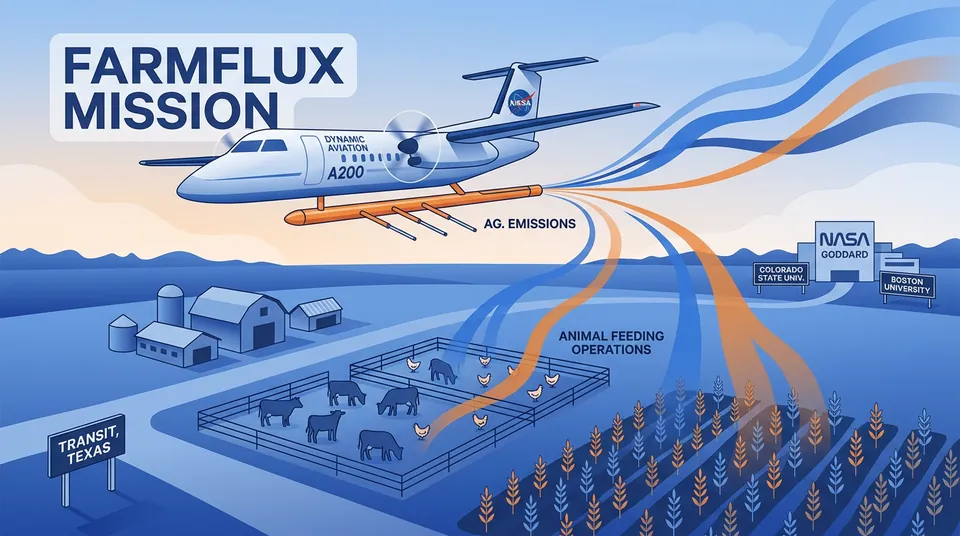
NASA plans FarmFlux low-altitude flights near Transit, Texas, during this window to monitor emissions from animal feeding operations.1
FarmFlux plans to use more than twelve instruments to detect atmospheric interactions and pollutants including ammonia, methane, ozone, and particulates.1
NASA has slated further cropland observation flights in California’s Central Valley and the Midwest using a P-3 Orion.1
Story
Mapping Agricultural Emissions and Adapting Deep-Space ArchitecturesA specialized Dynamic Aviation A200 aircraft operated by NASA has been assigned to execute low-altitude research trajectories above agricultural properties adjacent to Transit, Texas.1 The flight series spans an operational window opening on October 22 and concluding on November 9.1 These low-level flight paths are structured to gather continuous readings regarding gaseous and aerosol discharges stemming from concentrated animal feeding facilities.1 Operating under the scientific title FarmFlux, the initiative incorporates an instrumentation array exceeding a dozen distinct analytical sensors.1 The airborne equipment is configured to record intricate chemical reactions in the air while tracking concentrations of ammonia, methane, ozone, and suspended particulate matter emitted by farm operations.1
Direct scientific guidance of the FarmFlux deployment is divided among NASA's Goddard Space Flight Center alongside academic teams from Boston University and Colorado State University.1 The three entities jointly supervise the airborne data collection routines and subsequent environmental modeling exercises.1 Following the Texas surveys, the agency has planned an expanded phase of cropland atmospheric observations scheduled to begin in March 2027.1 This subsequent aerial campaign will rely on a P-3 Orion research aircraft to monitor airspace continuously through July 2027.1 That survey schedule focuses systematically on agricultural belts situated across both the Central Valley of California and the broader American Midwest.1
Beyond terrestrial atmospheric monitoring, NASA's exploration priorities continue to track ancient geological history on Mars through the ongoing operations of the Perseverance rover.2 The roving platform touched down inside Jezero Crater in February 2021 to systematically survey the dried bed of what was once an ancient open lake.2 Its primary operational focus has centered on retrieving intact core fragments that may contain fossilized clues of primitive extraterrestrial organisms.2 Among the collected inventory, researchers have identified a thumb-sized cylindrical core that holds profound potential scientific value for verifying past biology.2 This sample rests securely within the sealed internal storage repository aboard the vehicle on the Martian surface.2
Designated formally as Sapphire Canyon, the cylindrical core was drilled from an exposed rock unit called Cheyava Falls during July 2024 operations.2 Specialists analyzing onboard imagery observed distinct macroscopic patches distributed across the outer surfaces of the retrieved stone.2 These surface marks resemble chemical reduction rings produced by microbial colonies residing in moist terrestrial soils.2 Because of these chemical indicators, science teams regard the sample as an exceptionally promising candidate for ancient biological activity.2 However, obtaining direct laboratory proof on Earth has been complicated by the escalating scope and logistics of the retrieval infrastructure.2
Projected expenses for the baseline Mars Sample Return initiative climbed steadily as mechanical architectures grew intricate, ultimately touching an estimated eleven billion dollars.2 Concurrently, logistical modeling compelled program managers to slide the projected Earth delivery window back toward the year 2040.2 Faced with compounding budgetary pressure, NASA chose to formally cancel its existing architecture for the sample retrieval mission inside the fiscal year 2026 budget submission.2 The decision halted an architecture that had already absorbed approximately two and a half billion dollars in design and engineering outlays.2 Highlighting the financial scale of the planned undertaking, NASA Administrator Isaacman stated that the required funding for the retrieval mission would outstrip the capital expense of manufacturing an entire aircraft carrier.2
The discontinuation of NASA's initial retrieval architecture shifts global attention toward competing timelines for returning surface materials from Mars.2 China has structured its own Mars sample gathering endeavor, known as the Tianwen Three mission, around an operational timetable aiming for a 2031 recovery date.2 That scheduled arrival gives Tianwen Three an opportunity to secure the distinction of achieving the first successful Martian sample return in history.2 Meanwhile, the American space agency has turned portions of its advanced research budget toward mitigating physical vulnerabilities in other space environments.3 Critical hardware programs are directing attention toward high-latitude lunar exploration zones where operational requirements present steep technical barriers.3
NASA has detailed an advanced power storage development project designed specifically to withstand the punishing cold conditions encountered during lunar exploration.3 The technological output from this development track is intended to power hardware assigned to the Artemis lunar exploration campaign and related surface initiatives.3 Environmental conditions across the lunar landscape swing through massive thermal ranges, with daytime surface temperatures climbing as high as 100 degrees Celsius.3 Conversely, darkness during the lunar night across the Moon's South Pole drives ambient cold down to extreme readings of minus 200 degrees Celsius.3 To surmount these barriers, the SPEARS initiative substitutes conventional liquid electrolytes with resilient solid formulations incorporating polymers or ceramic compounds.3
Laboratory evaluations confirmed that solid-state prototypes developed under this method avoid structural destruction when exposed to acute thermal contraction.34 In cryogenic trials, an experimental solid-state cell successfully endured chilling down to minus 274 degrees Fahrenheit, equivalent to minus 170 degrees Celsius, with zero structural failure.4 The prototype cells continued to supply electrical current with degraded output down to minus 112 degrees Fahrenheit, or minus 80 degrees Celsius.4 Moreover, the power cells exhibited stable, unimpeded operational output across a thermal span between minus 76 degrees Fahrenheit, or minus 60 degrees Celsius, and 176 degrees Fahrenheit, or 80 degrees Celsius.4 Compared with standard lithium-ion assemblies, the solid-state architecture requires substantially smaller quantities of parasitic electrical energy to operate auxiliary warming hardware.3
NASA Langley testing lead Yi Lin reported the initial successful demonstration of prototype battery cells providing functional power delivery at minus 80 degrees Celsius.4 Supported by NASA's Research and Technology Mission Directorate, the SPEARS project was formally inaugurated in 2026 under the central management of Glenn Research Center.4 Materials evaluation and destructive physical analysis for the battery program are assigned directly to testing specialists at Langley.4 Simultaneously, engineers based at NASA's Ames Research Center in California are fabricating integrated electronics and specialized evaluation circuit boards.4 These control assemblies are engineered to qualify the complete solid-state battery architecture for formal spaceflight testing protocols.4
The technical capacity to withstand severe cold without constant active heating will enable lunar rovers and exploration craft to shed massive thermal insulation hardware.4 By eliminating dedicated heating subsystems, future space vehicles can redirect substantial mass margins toward scientific instruments and mission payloads.4 Evidence indicates that the SPEARS battery cells require supplementary artificial warming before they can initiate active electrical discharge during the extreme night at the Moon's South Pole.3 The ongoing maturation of this solid-state power system is supported through a joint multi-center collaborative network linking Glenn, Langley, and Ames research centers.3 This unified inter-center initiative remains supported to furnish essential low-temperature power storage for subsequent Artemis missions operating across polar craters.3
Structure
Who is connected to whom- 1NASA
- partners with →Fact
- ← servesFact
- uses →Fact
- owns →Fact
- operates in →Fact
History
How it came to this- October 22–November 9FarmFlux flight windowNASA’s Dynamic Aviation A200 is set to fly at low altitude over farmland near Transit, Texas, monitoring animal feeding operation emissions.
- October 22–November 9Instrumented atmospheric surveyThe campaign plans to use upwards of twelve instruments to detect atmospheric interactions and agricultural pollutants.
- March–July 2027Further cropland observations plannedNASA has slated P-3 Orion flights over California’s Central Valley and the Midwest.
- Nowupwards of twelve FarmFlux instruments planned for low-altitude Texas agricultural-emissions flights
- October 22–November 9NASA’s Dynamic Aviation A200 is set to conduct the FarmFlux low-altitude flights near Transit, Texas.
Impact
Spreading outward, level by level- Level 1Flight measurements
FarmFlux is designed to monitor emissions from animal feeding operations near Transit, Texas, using low-altitude flights and an instrument array that will detect pollutants including ammonia, methane, ozone, and particulates.1
Fact - Level 2Scientific leadership
NASA’s Goddard Space Flight Center, Boston University, and Colorado State University share leadership of the FarmFlux scientific mission.1
Fact - Level 3Broader agricultural observations
NASA’s planned P-3 Orion flights in California’s Central Valley and the Midwest would extend cropland observations beyond the Texas campaign.1
Fact
Ahead
Checked automatically when due; the result goes to the track recordNASA’s Dynamic Aviation A200 is set to conduct the FarmFlux low-altitude flights near Transit, Texas.
NASA has slated P-3 Orion cropland observation flights across California’s Central Valley and the Midwest.
Sources
What each source supportsWritten by AI from the sources listed below: every fact was checked word for word against its source, and inference is marked apart. How we write