

AMD Unveils Helion Agentic AI Rack Scaling Up to 32,768 EPYC Cores
The modular platform separates agent task execution from heavy neural inference across open configurations. Hardware shipments will begin rollout through major server partners ahead of broader capacity expansions.
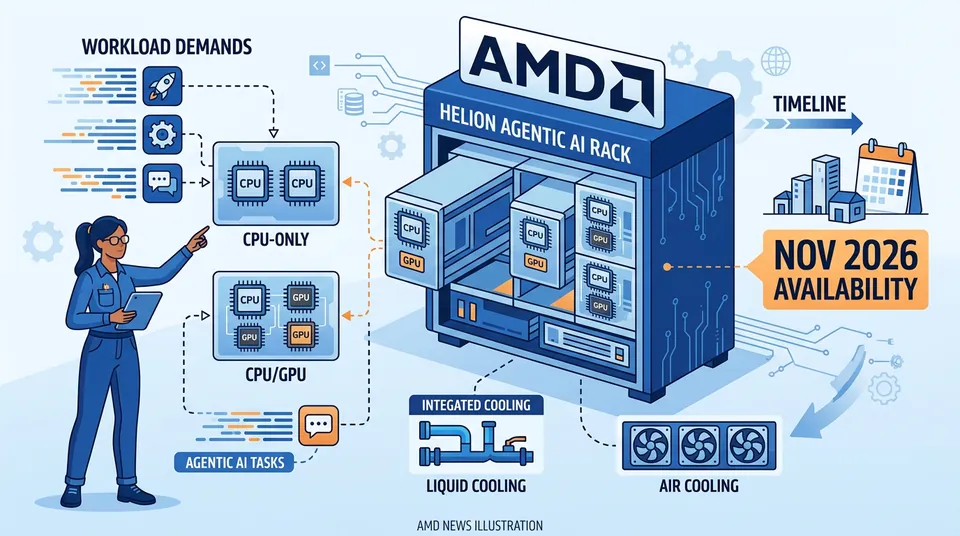
Helion hybrid configurations integrate up to 16 Instinct MI350P accelerators across 5U server modules and provide up to 102 Tbps of total system network bandwidth.3
Enterprise data center top-tier GPUs experienced delivery lead times of 36 to 52 weeks in 2026, causing prices to surge 25% to 35% above suggested retail levels.8
AMD has begun shipping Helios rack systems and Instinct MI455 chips configured with 432GB of HBM4 memory, primarily sourced from Samsung.7
Story
Decoupling Workflow Logic from Pure Acceleration in Enterprise Agent ArchitectureAMD introduced the Helion agentic artificial intelligence rack architecture on October 13, 2026, designing the platform around Open Compute Project standards to address emerging enterprise agent workloads.1 Earlier coverage by IT Home on October 12, 2026, had outlined the forthcoming system as a purpose-built rack implementation created specifically for agentic operations.5 The Helion framework continues the open ecosystem design established by AMD's earlier Helios rack generation, enabling operators to match general compute strength, core count, electrical draw, and discrete accelerators directly to functional software needs.1 Under the published engineering plans, customer availability for the initial Helion system arrangements is slated to begin in November 2026.1
The baseline computational architecture allows enterprises to split the execution of agent routines away from backend large model generation.2 To serve non-accelerated operational pipelines, the architecture outlines an entirely CPU-centered rack format scaling up to 32,768 processing cores running on sixth-generation EPYC silicon.1 This density is supported by populating a single frame with as many as 128 separate 256-core processors built upon the Zen 6 architecture code-named Venice.13 Beyond all-CPU builds, AMD designed a hybrid platform that pairs these central processors with Instinct MI350P graphics devices alongside general computing nodes inside one physical envelope.1
Autonomous agents increasingly plan complex execution sequences and issue programmatic calls across multiple external tools within enterprise environments.2 Because coordinating multi-agent orchestration and intermediate application tasks demands substantial logic handling, central processors have re-emerged as the central operational nexus inside enterprise facilities.2 AMD executive Dan McNamara emphasized that agent computing spans widely varied processing settings, making workload-adaptive infrastructure and tuned electrical efficiency essential for operational viability.1 AMD formally unveiled the underlying Helion rack architecture during the Open Compute Project gathering to demonstrate how dedicated host compute handles orchestration without consuming expensive accelerator time.2
For facilities running local inference workloads alongside orchestration, the mixed chassis configuration can accommodate up to 16 Instinct MI350P accelerators inside an integrated system frame.3 The accelerator layout utilizes 5U height server modules developed by AMD that each house an array of 8 Instinct MI350P devices.3 To keep parallelized nodes synchronized without communication bottlenecks, the combined layout provisions a maximum system-level network throughput of 102 terabits per second.3 Hardware operators can deploy these nodes using traditional ambient airflow cooling or integrate liquid chilling loops depending on facility limits.2
Helion incorporates an embedded token routing mechanism designed to direct computational calls issued by agents across various model options.4 This internal traffic director shuttles programmatic prompts outward to external frontier networks or downward to hosted open-weight installations.4 The entire operational environment maintains compatibility with open software libraries across both execution and acceleration tiers.2 AMD also intends to submit the formal mechanical and interface designs of Helion to the Open Compute Project directory for communal hardware standardization.1
Multiple major server manufacturers participated in the hardware engineering process for Helion units, including Dell, Hewlett Packard Enterprise, Lenovo, Supermicro, and Foxconn.3 Supermicro is moving to deliver Open Rack standard version 3 installations using its proprietary Data Center Building Block Solutions portfolio.6 Networking supplier Cisco is pairing its full-stack enterprise infrastructure offerings with the rack layout to ease installation hurdles.4 Jeremy Foster, general manager of Cisco's computing business, noted that joining Helion with Cisco infrastructure expands deployment flexibility and operational control for organizations running agent tasks.4
Market conditions in 2026 have amplified the need for modular computing profiles that reduce continuous reliance on high-power accelerators.8 Enterprise data centers faced extended purchasing lead windows of 36 to 52 weeks when attempting to secure top-tier graphic processing units.8 These extended factory delivery backlogs caused secondary hardware prices to surge 25 percent to 35 percent over standard manufacturer suggestions.8 Constructing dedicated CPU-dominated nodes provides enterprise infrastructure planners with an alternative pathway to sustain expanding agent operations without paying steep hardware premiums.18
AMD is simultaneously running a multi-generation rollout across its enterprise line to meet this sustained demand for processing density.1 The company has started shipping its Helios system installations alongside Instinct MI455 accelerators configured with 432 gigabytes of high-bandwidth memory.7 Supported accounts note that while these Helios clusters enter active delivery, parallel ecosystem work on the subsequent Helion platform remains on track for November 2026 deployment.1 These phased rack initiatives allow server purchasers to bridge current capacity gaps while preparing for modular agent architectures.1
Securing upstream component fabrication has been a primary operational priority for AMD leadership during this transitional phase.7 Chief executive officer Lisa Su traveled to South Korea during October 2026 to negotiate direct commitments for critical memory module supplies.7 This followed an earlier three-year non-binding memorandum signed between AMD and Samsung in March 2026 encompassing fourth-generation high-bandwidth memory, DDR5 modules, and foundry assessments.7 Samsung serves as the primary manufacturer supplying HBM4 components for the newly deployed MI455 accelerator hardware.7
Earlier in October 2026, Lisa Su conducted meetings across Taiwan to review contracted production capabilities across foundry and assembly lines.8 Following those industry consultations, she confirmed that the firm had implemented capacity increases across its supply chains.8 Those operational upgrades are established to deliver substantial volume expansions for both central processors and graphic accelerators throughout 2027.8 Coupled with the modular OCP-compliant specifications planned for Helion, these manufacturing commitments aim to mitigate ongoing component scarcities for enterprise buyers.18
Structure
Who is connected to whom- 1AMD
- customer of →Fact
- ← partners withFact
- invests in →Fact
- enables →Fact
- supplies →Fact
History
How it came to this- March 2026AMD and Samsung establish memory and foundry partnershipAMD and Samsung sign a three-year non-binding memorandum of understanding covering HBM4, DDR5, and foundry evaluations.
- Early October 2026Supply expansion confirmed in TaiwanAMD CEO Lisa Su visits Taiwan and confirms capacity expansion moves intended to substantially boost CPU and GPU deliveries in 2027.
- October 2026HBM procurement secured during South Korea visitLisa Su visits South Korea to secure HBM supply as AMD ships Helios systems and MI455 chips using Samsung HBM4.
- 2026-10-12Initial reports outline Helion agentic rack architectureIT Home reports on AMD's upcoming Helion rack solution engineered specifically for agentic artificial intelligence workloads.
- 2026-10-13AMD officially announces Helion rack at OCPAMD unveils the OCP-standard Helion agentic AI rack architecture during the OCP Summit, supporting both pure CPU and hybrid GPU designs.
- Now32,768 Maximum CPU core count in AMD Helion pure CPU rack
- November 2026AMD expects to launch Helion rack configurations and submit the system specifications to the Open Compute Project.
Impact
Spreading outward, level by level- Level 1Workload separation between agent orchestration and model inference
By shifting programmatic agent coordination, multi-agent workflows, and token routing onto pure CPU nodes, Helion frees specialized accelerators to focus strictly on large model inference.24
Fact - Level 2Server manufacturing and ecosystem adoption
Hardware partners including Dell, HPE, Lenovo, Foxconn, and Supermicro are developing Helion systems, with Supermicro implementing ORv3 designs and Cisco integrating full-stack enterprise infrastructure.346
Fact - Level 3Alternative to high-cost GPU bottlenecks in enterprise data centers
Deploying dense CPU-centric nodes allows enterprises to expand agentic operations without absorbing 36- to 52-week lead times and 25% to 35% price markups on scarce high-end accelerators.
Analysis
Ahead
Checked automatically when due; the result goes to the track recordAMD expects to launch Helion rack configurations and submit the system specifications to the Open Compute Project.
AMD plans to significantly expand the market supply volume of both CPUs and GPUs following capacity increases.
Sources
What each source supportsWritten by AI from the sources listed below: every fact was checked word for word against its source, and inference is marked apart. How we write