

US Treasury sanctions eight Canadian currency-exchange businesses
The Treasury alleges the firms helped Iranian entities evade US financial sanctions, including through currency conversion and digital assets. The measures also sit alongside a separate US action against a cryptocurrency exchange, which involved different targets and restrictions.
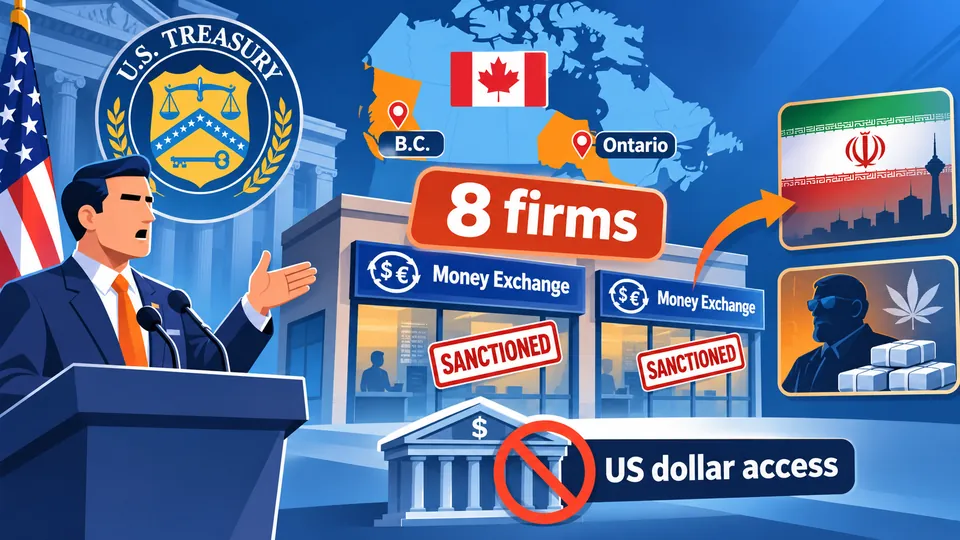
The Treasury named eight Canadian currency-exchange businesses in the sanctions announcement.1
The Treasury announced the measures on Friday, November 6.1
Story
What the sanctions target and how the actions differThe US Treasury announced sanctions on eight Canadian currency-exchange businesses on Friday, November 6, making the number of targeted firms the clearest measure of the action’s scale.1 The Treasury accused the businesses of assisting Iranian entities in getting around US financial sanctions.2 The action was presented under the Treasury’s “Operation Economic Outcast” designation, which identifies the campaign as the stated framework for these measures.2 The Treasury said some of the firms changed Iranian rials and other currencies into digital assets, with cryptocurrency among the forms it identified.2 The allegations describe a chain that begins with currency conversion and involves digital assets, while the Treasury’s stated concern is the alleged evasion of US financial sanctions on behalf of Iranian entities.2 The action therefore targets alleged financial activity rather than describing a general restriction on all currency exchange businesses in Canada; the sanctions apply to the firms named by the Treasury.12
The eight businesses named by the Treasury are Diverse Trade Inc, 1380079 BC Limited, Top PC Technician Inc and NIA Nations Currency Ltd.1 The remaining named firms are 2397639 Ontario Ltd, CCC Inc, B Galaxy Inc and Darvish Exchange.1 The reporting places the businesses in Ontario and British Columbia, identifying their provincial locations rather than giving a count for each province.2 Taken together, the names make clear that the action covers multiple separately identified businesses, rather than one company operating under a single name.1 The provincial information locates the affected businesses in two parts of Canada, but the reporting does not specify how many of the named firms are in either province.12 That distinction matters because the location information describes where the firms are based, while the sanctions themselves are announced against the named businesses.12
The Treasury alleged that some of the businesses dealt with Iranian cryptocurrency exchanges already under US sanctions.1 It also alleged links between some firms and digital-wallet addresses associated with Iran’s Islamic Revolutionary Guard Corps, or IRGC.1 A supported synthesis of the reporting is that the firms face allegations involving both sanctions evasion for Iranian entities and money linked to an alleged drug-trafficking operation.2 The allegations about exchanges and wallet addresses add detail to the Treasury’s account of how some firms may have interacted with entities or addresses connected to Iran.1 The reporting does not say that every one of the named businesses engaged in each alleged activity; it attributes these dealings to some firms and the money links to several designated businesses.1 The two strands of allegations are distinct: one concerns Iranian entities and sanctioned exchanges, while the other concerns money linked to an alleged trafficking network.12
The sanctions freeze any assets the firms hold in the United States and prohibit transactions with American people or entities.2 These restrictions address property and dealings connected to the United States, as described in the account of the measures.2 The reported effects concern the sanctioned firms and their potential US assets or transactions; the source does not provide a total value for assets frozen.2 The freeze applies to assets the firms hold in the United States, whereas the transaction bar concerns dealings with American people or entities.2 Those are two different practical consequences of the sanctions: property may be frozen, and transactions involving the specified American parties are barred.2 The available account sets out the types of property and dealings affected, but does not say whether any particular firm holds assets in the United States or identify specific transactions.2 As a result, the stated restrictions are clear even though the reporting does not quantify their financial effect on the businesses.2
US Treasury Secretary Scott Bessent said Canada should not serve as a refuge for financial intermediaries helping Iran and its proxies evade sanctions.2 The Treasury also said its broader sanctions campaign is intended to cut off economic support for the Iranian regime and the IRGC.2 Bessent’s statement sets out the US government’s view of the risk: financial facilitators based in Canada should not help Iran or its proxies get around sanctions.2 The campaign’s stated goal reaches beyond the firms in this action, framing sanctions as a way to disrupt economic support for the Iranian regime and the IRGC.2 These are statements of policy and purpose; the reporting does not establish that the measures have already severed those economic lifelines.2
FINTRAC said it worked with the US Financial Crimes Enforcement Network, known as FinCEN, in imposing the measures against the money-service businesses.2 FINTRAC also described its broader practice of cooperating with foreign financial intelligence units.2 The account thus identifies cooperation between Canadian and US financial-crime agencies in this particular action, while also describing FINTRAC’s regular international work.2 FINTRAC said that its work with foreign intelligence units addresses money laundering, terrorist financing and sanctions evasion, placing the cooperation in a wider enforcement context.2 The reporting describes FINTRAC as a partner in the process, but does not give details about what information each agency contributed.2
The Treasury also alleged that several of the designated businesses handled money connected to Ryan Wedding, a former Canadian Olympic snowboarder accused of heading an international drug-trafficking network.1 US authorities said businesses in the Toronto and Vancouver areas converted drug proceeds into digital assets and sent them abroad.1 These allegations add a drug-proceeds dimension to the account of the businesses, alongside the claims about Iranian entities and cryptocurrency exchanges.12 The reported conversion of proceeds into digital assets and their transfer abroad describes the alleged movement of funds, but the account does not identify which individual businesses performed each step.1 Wedding is described as accused of leading the network, not as having been convicted in the facts provided here.1 The distinction between allegation and established outcome is important: the reporting attributes the claims to the Treasury and US authorities and describes the trafficking network as alleged.1
In a separate action, FinCEN issued an order aimed at MEXC Global, a cryptocurrency exchange incorporated in Seychelles.2 That order bars US financial institutions from processing transfers of funds involving MEXC Global.2 FinCEN said the exchange had facilitated at least $16bn in illicit transactions associated with Iran, North Korea, Russia and other sanctioned actors.2 The MEXC Global order focuses on a cryptocurrency exchange and the ability of US financial institutions to process transfers involving it; it is not the same measure as the sanctions against the Canadian businesses.12 FinCEN’s estimate of at least $16bn concerns transactions it said the exchange facilitated, not the value of assets frozen under the Canadian-firm sanctions.2 The actors cited in connection with those transactions include Iran, North Korea and Russia, as well as other sanctioned actors, so the reported activity spans more than one country.2 The order’s practical restriction is on US financial institutions processing transfers, while the reported transaction figure describes the scale FinCEN attributed to illicit activity.2
A supported synthesis of the reporting is that the Canadian-firm sanctions and the MEXC Global order are separate actions, although both concern alleged illicit financial activity involving Iran.1 The actions differ in their targets and stated restrictions: one names Canadian money-service businesses and freezes their US assets while barring specified transactions, and the other concerns a Seychelles-incorporated exchange and transfer processing by US financial institutions.12 Their overlap is the reported connection to alleged illicit financial activity involving Iran; the two measures should not be read as one joint case or as actions against the same businesses.12 The reporting also presents the Canadian-firm allegations as concerning both Iranian sanctions evasion and funds linked to an alleged drug-trafficking operation, while the MEXC Global figure concerns illicit transactions associated with several sanctioned actors.2 Together, the accounts show different enforcement tools being applied to different targets, without establishing that the firms and exchange were part of one network.12
Structure
Who is connected to whom- 1U.S. Treasury
- sanctions →Fact
- ← part ofFact
- sanctions →Fact
- ← part ofFact
- sanctions →Fact
History
How it came to this- Friday, November 6Treasury announces sanctions on Canadian businessesThe announcement named eight currency-exchange businesses and accused them of helping Iranian entities evade US financial sanctions.
- Noweight Canadian currency-exchange businesses targeted by US Treasury sanctions
Impact
Spreading outward, level by level- Level 1Named businesses
The measures freeze any assets the firms hold in the United States and bar transactions with American people or entities.2
Fact - Level 2Alleged financial activity
The Treasury said some businesses converted Iranian rials and other currencies into digital assets; it also alleged dealings with sanctioned Iranian cryptocurrency exchanges and wallet addresses linked to the IRGC.12
Fact - Level 3Other alleged funds and activity
Several designated businesses were alleged to have handled money linked to Ryan Wedding; US authorities said businesses in the Toronto and Vancouver areas converted drug proceeds into digital assets and transferred them abroad.1
Fact - Level 4Enforcement context
FINTRAC said it worked with FinCEN on the sanctions. The reporting presents the Canadian-firm action and the MEXC Global order as distinct measures, despite both involving alleged illicit financial activity connected to Iran.12
Fact
Sources
What each source supportsWritten by AI from the sources listed below: every fact was checked word for word against its source, and inference is marked apart. How we write