

TORM board member leaves as Oaktree-linked holder sells its remaining 6.17% stake
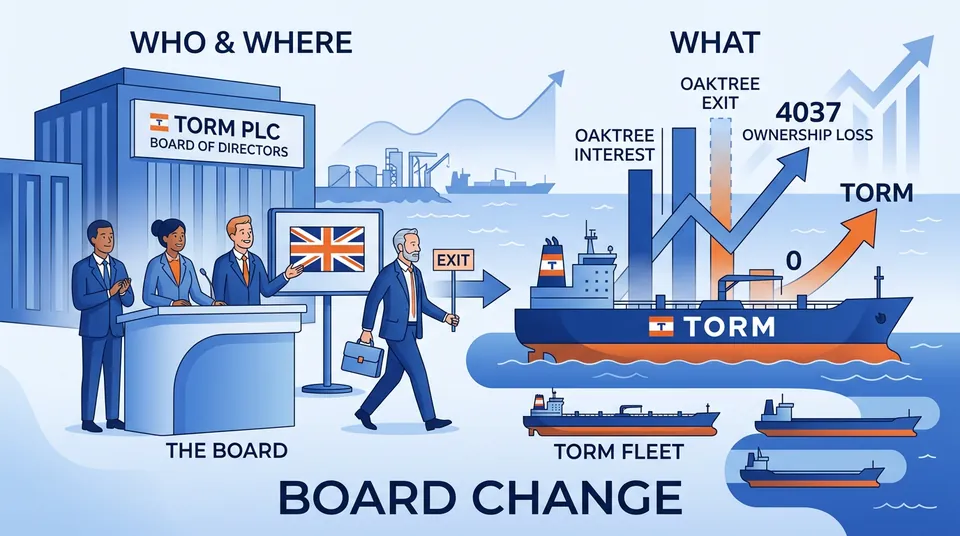
Christopher Boehringer left TORM’s board after Oaktree Capital Management and related entities gave up their entire equity position. The remaining stake was offered through a secondary sale, which did not provide TORM with funds or involve newly issued shares.
OCM Njord offered its remaining reported ownership stake in TORM.2
The secondary offering covered all the Class A shares Njord still held.2
Christopher Boehringer had served on TORM’s board since this year before leaving immediately after the equity exit.1
Story
A board departure follows the end of Oaktree’s TORM investmentChristopher Boehringer departed TORM’s board immediately after Oaktree Capital Management and associated entities fully surrendered their equity interest in the company.1 The change ended Boehringer’s board service, which had begun in 2015, and coincided with the end of the Oaktree-linked ownership position.1 The stake at the center of the final sale was 6.17% of TORM, the portion still held by OCM Njord before the offering.2 A supported account says the remaining 6.17% was sold between the October 6 announcement and October 9, 2026, completing the exit.1 That completion brought an end to a position that had stood at 19.86% in late July, before being reduced in stages.12
The offering covered every Class A share Njord still possessed: 6,329,874 shares, equivalent to the reported 6.17% holding.2 The transaction was structured as a secondary public offering, meaning the shares being sold were Njord’s existing shares.2 TORM neither received proceeds from the sale nor issued additional shares as part of the transaction.2 JP Morgan alone underwrote the offering, according to the account of the proposed sale.2 The reported scale of the sale therefore describes an ownership transfer rather than new capital raised by TORM.2
Njord’s ownership had been 19.86% when Brookfield took control at the end of July, then stood at 6.33 million shares by September 28.2 The September holding was reported as 6.17%, matching the percentage described for the remaining stake put up for sale.2 Those two percentages show the contraction between the initial position and the final portion offered, rather than separate new investments.2 The sale was estimated at roughly $260 million using TORM’s Nasdaq closing price of $41.05 on October 5.2 That estimated value is an assessment of the offered stake, while the company itself was not due to receive sale funds.2
A regulatory filing identified Hafnia as TORM’s largest shareholder, with 20,356,061 shares, or about 19.83% of the company.2 Hafnia’s reported percentage was more than three times the 6.17% Njord offered, though the figures refer to different holders.2 Hafnia assembled its position through three transactions, investing roughly $514 million in total.2 The account of Hafnia’s position provides a comparison with the departing holder, but does not say that Hafnia bought Njord’s offered shares.2 SEB analysts said the proposed sale would effectively conclude the holding Oaktree had built during TORM’s 2015 restructuring.2
After Boehringer’s departure, TORM’s board comprised Simon Mackenzie Smith, Annette Malm Justad, Göran Trapp, Jann Brown, and Jacob Meldgaard.1 Mackenzie Smith serves as the board’s chair, one role identified separately from the full list of directors.1 The departure reduced the board’s membership from the arrangement before Boehringer left, while the company’s announcement named the directors who remained.1 Boehringer’s tenure began in 2015, linking his exit from the board to the period in which Oaktree’s investment was formed.12 The stated trigger was the full relinquishment of the equity stake by Oaktree and associated entities, not a separate explanation about board performance.1
TORM’s public shares are traded on Nasdaq exchanges in Copenhagen and New York, giving the ownership change a listed-company setting.1 The October 5 Nasdaq close of $41.05 was the price reference used to estimate the offered holding at roughly $260 million.2 That estimate should be read as a valuation based on the stated market price, not as cash paid to TORM.2 The offering involved shares already held by Njord, while the company’s share count was not increased through new issuance in the transaction.2
Analysts at SEB also viewed a merger between TORM and Hafnia, with net asset values matched, as the most probable outcome.2 That assessment is an analyst projection, distinct from the completed sale and the reported holdings of the two companies’ shareholders.12 The account does not describe a merger as agreed or completed; it records SEB’s view of what was most likely.2 Hafnia’s position of about 19.83% and its reported investment of roughly $514 million provide context for that projection, but do not establish its outcome.2
Alongside the ownership change, TORM exercised options late in the third quarter for two more MR product tanker newbuilds.2 The additions expanded the order at Zhoushan Changhong International Shipyard to eight vessels.2 The first six ships in that order are due in 2029, while the two later additions are scheduled for delivery in 2030.2 The different delivery years distinguish the initial order from the two vessels added through the later options.2 These fleet decisions are reported alongside the shareholder exit, but the facts do not state that one caused the other.12
TORM sold the 2008-built MR tanker Torm Laura for roughly $22.5 million while expecting six MR resale newbuildings during 2027 and 2028.2 The company controls and manages 95 product tankers, a fleet figure that describes its wider operating base.2 The sale of one older tanker and the expected arrival of six resale newbuildings appear alongside the order for eight ships at Zhoushan Changhong.2 TORM was established in 1889 and operates across the globe, placing the board and ownership change within a company with a long operating history and international reach.1 The available details establish the ownership exit, board roster, share offering, and fleet activity, while the merger outcome remains an analyst projection.12
Structure
Who is connected to whom- 1Torm
- regulatory exposure →Fact
- located in →Fact
- operates in →Fact
- trade exposure →Fact
- transports →Fact
History
How it came to this- 2015Boehringer joins TORM’s boardHis board service began in 2015.
- End of JulyNjord holds a larger positionNjord held a 19.86% interest when Brookfield took control.
- September 28Position reduced to the remaining stakeNjord’s reported holding had fallen to 6.33 million shares, or 6.17%.
- October 5Market price used for sale estimateTORM shares closed at $41.05 on Nasdaq, underpinning the estimated value of the offered stake.
- October 6–9, 2026Final stake soldA supported account says OCM Njord completed the sale of its remaining stake during this period, ending its entire late-July position.
- After the saleBoehringer leaves the boardHe immediately departed following Oaktree and associated entities’ full relinquishment of their equity stake.
- Now6.17% Oaktree-linked stake remaining before the sale
Impact
Spreading outward, level by level- Level 1TORM board
Boehringer’s departure left a board comprising Simon Mackenzie Smith, Annette Malm Justad, Göran Trapp, Jann Brown, and Jacob Meldgaard.1
Fact - Level 2TORM share capital
The sale involved Njord’s existing shares; TORM received no funds and issued no shares in the offering.2
Fact - Level 3Ownership context
A regulatory filing identified Hafnia as TORM’s largest shareholder, with 20,356,061 shares, representing about 19.83% of the company.2
Fact - Level 4Possible corporate outcome
SEB analysts considered a NAV-for-NAV merger between TORM and Hafnia the most probable outcome; this is an analyst projection, not a reported agreement or completed merger.2
Fact
Sources
What each source supportsWritten by AI from the sources listed below: every fact was checked word for word against its source, and inference is marked apart. How we write