

NASA commits $12 million across 12 domestic universities to advance planetary exploration hardware
Twelve institutions will receive up to $1 million each to develop specialized systems for Moon and Mars expeditions. The academic awards proceed as the agency recalibrates its deep-space portfolio amid major robotic program cancellations.
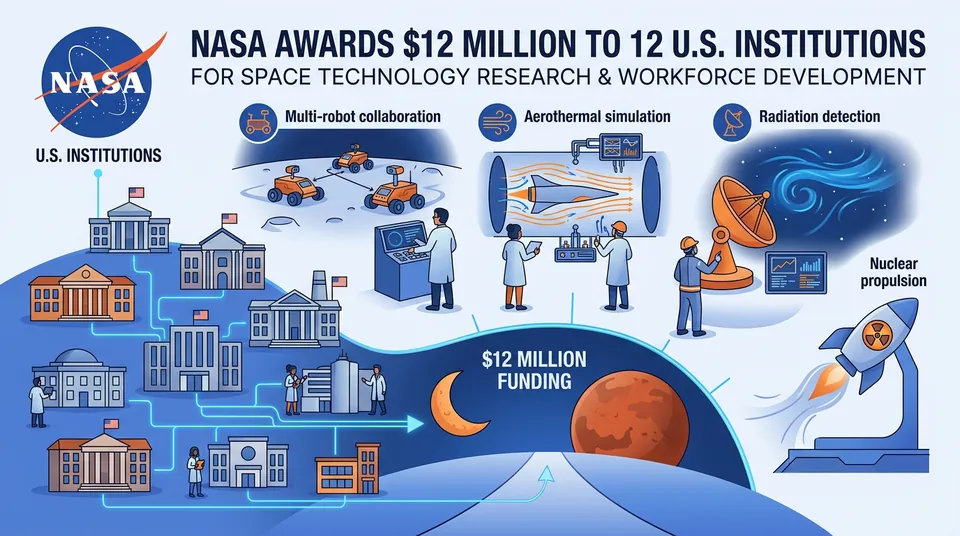
NASA allocated a total of $12 million across 12 domestic institutions to address technological gaps for deep space missions.1
Each selected university is eligible to receive an individual grant allocation capped at $1 million.1
Twelve higher education institutions were chosen under the M-STAR initiative to advance space technologies and train students.1
Story
Distributed Academic Research Bolsters Artemis as Flagship Deep-Space Missions Face Major ReorganizationThe United States civilian space agency has directed a total sum of $12 million toward a group of twelve higher education establishments spread across the country.1 Every chosen campus qualifies to obtain an individual financing allocation capped at $1 million.1 This federal commitment is structured to back investigative projects tailored directly to the technical objectives of outbound space journeys.1 By spreading capital across twelve discrete academic hubs, the program provides distributed backing for laboratory development rather than concentrating funds in a solitary installation.1
The federal outlays are channeled through the agency's Minority University Research and Education Project Space Technology Artemis Research framework, officially designated as M-STAR.1 The initiative functions as a collaborative effort joining two internal divisions: the Office of STEM Engagement and the Research and Technology Mission Directorate.1 Through this institutional arrangement, workforce training targets align with specific hardware objectives needed for long-term off-world activity.1 The organizational partnership establishes an administrative channel that directs national aerospace resources toward emerging scholars and technical faculties.1
Addressing the rationale behind these allocations, MUREP program manager Alicia Baturoni Cortez stated that the targeted funding assists the agency in overcoming technical gaps essential for long-duration surface missions on the Moon and Mars.1 Official statements emphasize that these investments nurture technical readiness across areas where commercial solutions do not currently satisfy spaceflight parameters.1 Available evidence indicates that despite terminating its premier robotic surface retrieval venture, the agency sustains baseline scientific inquiry directed toward Mars by issuing smaller academic allocations.1 Through this incremental grant structure, specialized laboratories retain active study pipelines geared toward long-range interplanetary targets.1
Individual grants address distinct technical disciplines across different terrestrial testbeds.1 California State University, Sacramento obtained support to advance investigations regarding how multiple automated robotic platforms can coordinate tasks cooperatively across alien landscapes.1 In Florida, the University of Central Florida was selected to conduct testing and aerothermal modeling directly tied to the requirements of the Artemis lunar exploration campaign.1 These undertakings address atmospheric re-entry stresses and multi-agent mechanical cooperation required during prolonged planetary reconnaissance.1
Radiation mitigation and propulsion chemistry represent additional core pillars supported within the distributed grant grouping.1 The University of Hawaii at Manoa is slated to utilize its funding share to educate and instruct university scholars in building radiation measurement tools and specialized instrumentation.1 Concurrently, researchers situated at Virginia Commonwealth University are testing composite structures tailored to withstand radiation hazards for integration into nuclear thermal propulsion machinery.1 Both ventures focus heavily on human survivability and hardware resilience against hazardous cosmic environments situated far beyond low Earth orbit.1
Off-grid power infrastructure constitutes another primary objective financed through the M-STAR initiative.1 At the University of New Mexico, researchers are dedicating their grant toward creating specialized batteries and chemical fuel cells capable of functioning during prolonged lunar and Martian deployments.1 Supported program documentation indicates that the M-STAR grants work in conjunction with agency-wide technological roadmaps designed for the overarching Artemis lunar timeline.1 Developing storage architectures capable of handling severe operational cycles forms a necessary condition for continuous human and robotic surface presence.1
Alongside academic grants, the federal space agency pursues in-house technological programs focused on extreme thermal storage solutions.3 NASA is engineering solid-state battery designs engineered to survive and deliver power amid the bitter cold encountered during Artemis lunar expeditions.3 Initiated in 2026, the dedicated battery undertaking bears the internal designation SPEARS and operates under the direction of NASA's Glenn Research Center.34 Engineers on the SPEARS team intend to eliminate standard volatile liquid electrolytes entirely, substituting resilient solid configurations composed of polymer or ceramic materials.3
Thermal conditions near the lunar south pole can decline drastically to minus 328 degrees Fahrenheit, which equates to minus 200 degrees Celsius.4 Such severe environments routinely freeze conventional electrolyte liquids, causing catastrophic structural destruction to ordinary power cells.34 Experimental solid-state hardware prototypes withstood exposures down to minus 274 degrees Fahrenheit, or minus 170 degrees Celsius, experiencing no physical impairment.4 While operational output diminished, the experimental cells continued to generate electric current at temperatures as chilly as minus 112 degrees Fahrenheit, equivalent to minus 80 degrees Celsius.4 Even though these units demonstrate deep-freeze survivability without cracking, technicians must still raise them to a designated operating temperature before electrical power can be harvested.4
Agency documentation supports the view that administrators are maintaining parallel paths to solve deep-cold power challenges.1 This dual-track approach combines internal engineering work through the SPEARS endeavor with exterior campus research funded under the M-STAR initiative.14 The simultaneous programs aim to generate complementary energy solutions suitable for challenging off-world mission architecture.13 By funding campus-led innovation alongside laboratory testing at federal centers, the agency shares technical risk while developing an experienced aerospace workforce.14
The university grants arrive while major interplanetary exploration lines undergo steep budgetary contraction elsewhere in the agency.12 In its fiscal year 2026 budget proposal, NASA formally ended the Mars Sample Return endeavor following significant fiscal restrictions.2 Projected financial requirements for the complex retrieval effort had ballooned to an estimated $11 billion, while its earliest recovery timeline slipped backward to 2040.2 Prior to this official abandonment, the agency had already expended roughly $2.5 billion in federal funds on the canceled robotic retrieval concept.2
The shuttered Martian campaign had been organized to ferry back an extraterrestrial core dubbed Sapphire Canyon, which the Perseverance rover drilled and stowed during July 2024.2 Astrobiologists view the Sapphire Canyon core as a viable candidate for past life indicators because it bears speckled textures comparable to markings made by microscopic organisms on Earth.2 While the United States program stands dissolved, China has arranged its robotic Tianwen-3 flight to attempt gathering and returning Martian surface samples in 2031.2 Against this shifting competitive and budgetary backdrop, modest university outlays such as M-STAR represent the principal avenues through which the agency preserves grassroots technical development.1
Structure
Who is connected to whom- 1NASA
- partners with →Fact
- ← servesFact
- uses →Fact
- owns →Fact
- operates in →Fact
History
How it came to this- July 2024Perseverance Rover Collects Sapphire Canyon SamplePerseverance collected the Sapphire Canyon core sample bearing potential microbial patterns on Mars.
- 2026NASA Launches SPEARS Battery ProjectNASA's Glenn Research Center began developing solid-state batteries engineered for extreme lunar temperatures.
- Fiscal Year 2026Mars Sample Return Canceled in Budget RequestNASA terminated the Mars Sample Return project amid budget cuts after projected costs climbed to $11 billion.
- Now$12 million Total NASA funding awarded to U.S. institutions under M-STAR
Impact
Spreading outward, level by level- Level 1Academic Research and Workforce Development
The grants support targeted academic projects spanning multi-robot collaboration, aerothermal modeling, radiation detection, propulsion composites, and battery chemistry across selected campuses.1
Fact - Level 2Artemis Technology Readiness
The M-STAR university awards operate in parallel with internal initiatives such as the SPEARS project to deliver power and survivability solutions for the Artemis program.13
Fact - Level 3Planetary Research Continuity
Dispersed university grants allow NASA to sustain essential baseline research for future Moon and Mars exploration despite budget-driven cancellations of flagship missions.
Analysis
Sources
What each source supportsWritten by AI from the sources listed below: every fact was checked word for word against its source, and inference is marked apart. How we write