

EU adds Presidential Foundation for Cultural Initiatives (entry 185039) to sanctions list
The European Union placed the Presidential Foundation for Cultural Initiatives on its consolidated financial sanctions list under the RUSDA programme. The designation, effective 15 June 2026, triggers an asset freeze for the Russian‑based entity.
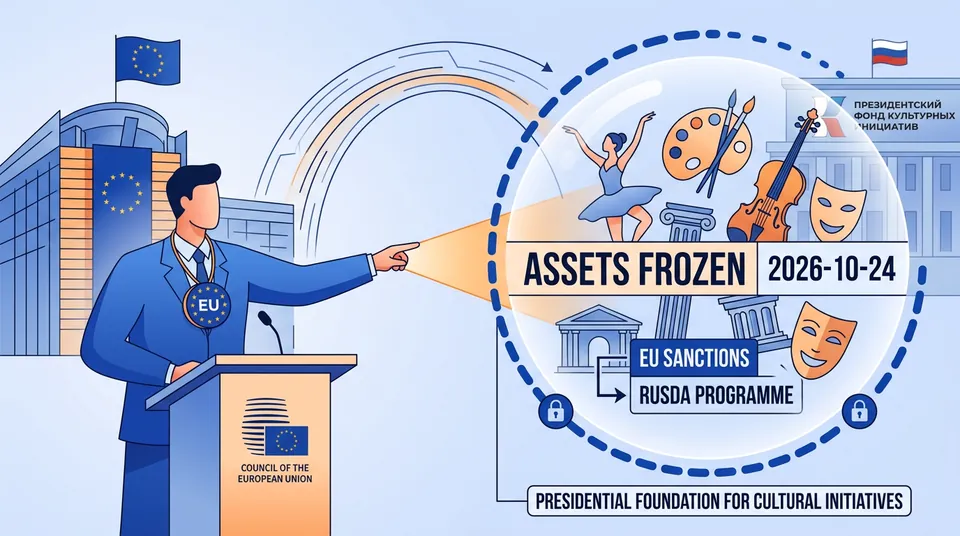
The foundation’s entry reference number is 185039.1
The EU list records 2026-06-15 as the entity’s designation date.1
The list containing the entry was published on 2026-10-24.1
Story
EU sanctions update: Presidential Foundation for Cultural Initiatives listedThe European Union has added the organisation known as the Presidential Foundation for Cultural Initiatives, abbreviated PFKI, to its consolidated sanctions list.1 The entry appears under the sanctions programme identified as RUSDA.1 The official reference number assigned to this entry is 185039.1 The list that contains this entry was made public on 24 October 2026.1 The designation of the entity was recorded as occurring on 15 June 2026.1 The RUSDA programme is part of the EU’s broader strategy to pressure entities linked to Russian state activities, reinforcing the political intent behind the listing.1 By freezing assets, the EU seeks to curtail the foundation’s capacity to finance projects that could support Russian cultural influence abroad.1
In the EU document, the foundation is also presented in Russian as Президентский Фонд Культурных Инициатив / ПФКИ.1 The country code linked to the entity is RU, indicating its Russian affiliation.1 Placement on the list subjects the foundation to an asset freeze across EU jurisdictions.1 The information originates from the official consolidated financial sanctions file released by the European Commission.1 AiSeek identified this addition by comparing the current list with the version published the previous day.1 The RU country code signals that the entity will be scrutinised under the EU’s Russia‑related sanctions regime, affecting any cross‑border dealings.1
The asset‑freeze measure means that any funds or economic resources owned or controlled by the foundation within EU territory must be immobilised.1 Financial institutions are required to block transactions involving the entity and report compliance to authorities.1 The sanction aligns the EU’s approach with other measures targeting Russian entities linked to cultural financing.1 The entry’s reference number, 185039, enables regulators to locate the specific record quickly in the database.1 The designation date of 15 June 2026 establishes the point from which the freeze is retroactively applicable.1 Compliance teams now need to update screening tools with the new reference to avoid inadvertent breaches.1
The listing was published on the EU’s official portal on 24 October 2026, providing public transparency.1 The publication date also serves as the reference for analysts tracking changes day by day.1 By documenting the change, AiSeek offers a traceable record that links the new entry to the prior day’s list.1 Such traceability supports accountability and enables stakeholders to verify the sanction’s legitimacy.1 The EU’s consolidated list aggregates sanctions from multiple programmes, including RUSDA, to provide a single reference point.1 Daily monitoring by tools like AiSeek ensures that any amendment, such as this entry, is quickly visible to regulators.1
The foundation’s Russian name, Президентский Фонд Культурных Инициатив, appears alongside the English translation, ensuring clarity for multilingual users.1 The dual‑language entry aids compliance officers in matching domestic records with the EU list.1 The country code RU signals that the entity is subject to the EU’s Russia‑related sanctions regime.1 Entities with the RU designation are typically scrutinised for links to Russian state‑linked activities.1 The inclusion of the foundation therefore expands the scope of cultural‑sector sanctions.1 Targeting cultural organisations reflects the EU’s intent to limit soft‑power channels that may support Russian policy goals.1
The EU’s decision reflects a broader policy to target organisations that support cultural initiatives tied to the Russian government.1 By freezing assets, the EU aims to limit the foundation’s ability to fund projects abroad.1 Financial actors must now screen for the reference number 185039 when processing transactions involving cultural funds.1 Non‑compliance could result in penalties under EU financial regulations.1 The sanction therefore has practical implications for banks, charities, and cultural institutions that might interact with the foundation.1 Violations of the asset‑freeze rule can attract substantial fines, reinforcing the need for diligent screening.1
The official source for this information is the European Commission’s consolidated financial sanctions file, which is regularly updated.1 The file serves as the definitive reference for all EU member states when enforcing sanctions.1 AiSeek’s methodology of daily comparison ensures that any new entry, such as this one, is promptly highlighted.1 The approach provides a transparent audit trail linking the change to its source document.1 Stakeholders can therefore rely on the data’s provenance when assessing compliance obligations.1 Member states coordinate their enforcement actions based on this central file, ensuring a unified EU response.1
The sanction’s impact is measured by the number of frozen assets and the reduction in the foundation’s ability to move funds.1 While the exact value of assets is not disclosed in the list, the asset‑freeze status signals a complete prohibition on transactions.1 The EU’s consolidated list does not provide quantitative asset data, focusing instead on legal status.1 Consequently, analysts must combine the listing with other financial intelligence to gauge economic effect.1 The designation date of 15 June 2026 establishes a clear temporal marker for any subsequent analysis.1 Supplementary data sources are required to estimate the monetary scale of the freeze, highlighting the need for broader intelligence.1
In summary, the EU’s addition of the Presidential Foundation for Cultural Initiatives to its sanctions list represents a targeted measure under the RUSDA programme.1 The entry, numbered 185039, was published on 24 October 2026 and carries an asset‑freeze obligation.1 The foundation’s Russian designation and country code confirm its linkage to Russia.1 The official EU source and AiSeek’s daily comparison provide a transparent record of the change.1 These facts together illustrate how the sanction is applied, who it affects, and how it is documented.1
Structure
Who is connected to whom- 1Presidential Foundation for Cultural Initiatives
- ← sanctionsFact
History
How it came to this- 2026-06-15Designation date recordedThe list gives this date for the foundation’s designation.
- 2026-10-24List published with the entryThe European Commission’s consolidated financial sanctions file showed the foundation’s listing.
- 2026-10-24Change identified by comparisonAiSeek identified the entry by comparing the list with the previous day’s version.
- Now185039 EU sanctions-list entry for the Presidential Foundation for Cultural Initiatives
Impact
Spreading outward, level by level- Level 1Asset freeze
The listing means the organisation is subject to an asset freeze.1
Fact - Level 2Sanctions-list identification
The entry appears under RUSDA and identifies the entity with the country code RU.1
Fact - Level 3Compliance screening
The listing may lead organisations that screen against the EU consolidated list to check for this entity and its entry reference.
Analysis
Sources
What each source supportsWritten by AI from the sources listed below: every fact was checked word for word against its source, and inference is marked apart. How we write