

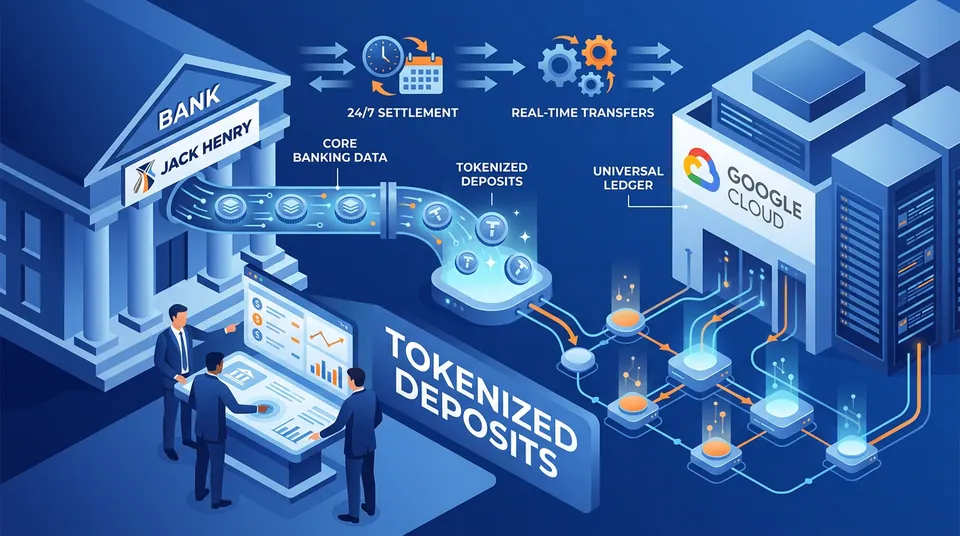
Jack Henry becomes first core banking provider to integrate Google Cloud Universal Ledger for tokenized deposits
Jack Henry announced it will be the first core banking technology firm to link with Google Cloud's Universal Ledger service. The move expands a collaboration that began in 2022 and was refreshed in October 2026.
Jack Henry serves more than 7,200 clients, including banks and credit unions.1
The Jack Henry–Google Cloud partnership began in 2022.1
The solution is described as providing payment execution around the clock, every day of the year.1
Story
Jack Henry becomes first core banking provider to integrate Google Cloud Universal Ledger for tokenized depositsJack Henry is set to pioneer the use of Google Cloud Universal Ledger among core banking technology firms.1 The integration is included in an expanded collaboration that was announced on Oct. 16, 2026.1 The partnership between Jack Henry and Google Cloud originally began in 2022.1 This milestone marks a new phase in a relationship that has already lasted four years.1 By being first, Jack Henry can shape the implementation standards that other providers may later follow, leveraging its extensive client base.1 Tokenized deposits are intended to help community and regional banks keep deposit relationships while adding digital payment capabilities.1
Google Cloud Universal Ledger is a fully managed, distributed ledger service that enables tokenization and real‑time transfer of money and assets with programmable 24/7 settlement.1 The service is designed to support tokenized deposits, which aim to help community and regional banks retain deposit relationships while offering new digital payment capabilities.1 It provides instant, 24/7/365 payment execution across multiple participants, currencies and asset classes.1 These capabilities are built on automated programmable workflows that can operate continuously.1 Because the ledger runs on Google Cloud’s infrastructure, it inherits the provider’s global scalability and security certifications, which are critical for financial institutions handling sensitive data.1 The token‑based model also allows banks to experiment with new product formats, such as instant settlement of payroll or cross‑border remittances, without redesigning core systems.1
Capital efficiency is achieved through automated clearing and multilateral netting without requiring pre‑funded accounts.1 Such efficiency reduces the need for banks to hold large idle balances.1 Jack Henry serves more than 7,200 clients, including banks and credit unions, giving it a broad base to apply these efficiencies.1 The large client base means many institutions could benefit from the reduced capital requirements.1 Automated clearing and multilateral netting can achieve capital efficiency without requiring pre-funded accounts.1 Automated netting also simplifies reconciliation processes, lowering operational costs and error rates.1
Jack Henry CTO Ben Metz explained that tokenized deposits could fundamentally change the flow of money within the financial system.1 He highlighted that the integration enables new programmable value‑exchange models for members.1 Metz emphasized that the technology could drive faster, more flexible settlement for everyday transactions.1 His comments underscore the strategic importance of the partnership for Jack Henry’s roadmap.1 Metz added that by tokenizing deposits, banks can offer customers instant access to funds while maintaining regulatory compliance.1 He also noted that the programmable nature of the ledger allows banks to embed business rules directly into settlement flows, reducing manual intervention.1
Google Cloud’s James Tromans said GCUL provides a secure and scalable foundation for programmable value exchange for community and regional institutions.1 He noted that the service’s security and scalability are essential for widespread adoption.1 Tromans added that the platform is built to handle the high‑volume, always‑on demands of modern banking.1 His remarks reinforce the technical confidence behind the integration.1 Tromans pointed out that Google Cloud’s global network ensures low‑latency transaction processing, which is vital for real‑time settlement.1 He also mentioned that the service complies with major financial regulations, easing the path for banks to adopt tokenized deposits.1
Tokenized deposits are intended to help community and regional banks retain deposit relationships while offering new digital payment capabilities.1 The solution delivers instant, 24/7/365 payment execution, which can improve customer experience.1 Automated programmable workflows enable banks to coordinate across multiple participants and asset classes without manual intervention.1 These features together create a more agile and responsive payment infrastructure.1 By reducing settlement times, banks can offer merchants faster fund availability, strengthening their competitive position.1 The tokenized model also opens possibilities for new revenue streams, such as fee‑based instant settlement services.1
Jack Henry’s client portfolio exceeds 7,200 banks and credit unions, providing a substantial market for the new tokenized deposit service.1 With such a wide reach, the integration could influence a significant portion of the community banking sector.1 The breadth of the client base also offers a testing ground for refining the technology.1 Broad adoption among these clients would amplify the impact of the programmable ledger.1 Early feedback from diverse institutions will help Jack Henry tailor the tokenized deposit product to different regulatory environments.1 Success in this segment could encourage larger banks to consider similar token‑based solutions in the future.1
Being the first core banking provider to adopt GCUL positions Jack Henry at the forefront of programmable settlement innovation.1 The universal ledger’s real‑time, programmable settlement features align with the capital‑efficiency benefits described by Jack Henry.1 Together, they promise to reduce reliance on pre‑funded accounts while enabling continuous settlement.1 This combination could set a new standard for how community banks handle deposits and payments.1 If the tokenized deposit service proves scalable, it may become a benchmark for other core providers seeking to modernize their platforms.1 GCUL enables tokenization and real-time transfers of money and assets with programmable 24/7 settlement.1
The integration builds on a partnership that began in 2022 and was expanded in October 2026.1 The earlier collaboration laid the groundwork for deeper technical integration.1 The 2026 announcement signals a commitment to extend the relationship into new service areas.1 The partnership began in 2022, and an expanded collaboration was announced on Oct. 16, 2026.1 GCUL enables tokenization and real-time transfer of money and assets with programmable 24/7 settlement.1 Stakeholders anticipate that the combined expertise of Jack Henry and Google Cloud will accelerate the rollout of programmable finance solutions across the sector.1
Structure
Who is connected to whom- 1Jack Henry
- serves →Fact
- partners with →Fact
- uses →Fact
- member of →Fact
History
How it came to this- 2022Jack Henry and Google Cloud establish a partnershipThe integration builds on a partnership that began in 2022.
- Oct. 16, 2026The collaboration expandsThe announced GCUL integration is part of an expanded collaboration.
- Nowfirst Jack Henry’s position in integrating with Google Cloud Universal Ledger
Impact
Spreading outward, level by level- Level 1Payment capabilities
The solution is described as enabling instant, around-the-clock payment execution and programmable workflows across participants, currencies and asset classes.1
Fact - Level 2Deposit relationships
Tokenized deposits are intended to help community and regional banks retain deposit relationships while adding digital payment capabilities.1
Fact - Level 3Capital efficiency
Automated clearing and multilateral netting are described as enabling capital efficiency without requiring pre-funded accounts.1
Fact - Level 4Potential adoption
Jack Henry’s client base could offer a broad group of banks and credit unions to which the integration may be relevant; the facts do not establish how many will adopt it.
Analysis
Sources
What each source supportsWritten by AI from the sources listed below: every fact was checked word for word against its source, and inference is marked apart. How we write