

Azenta expands gene synthesis with Elegen licensing and SynPlexity acquisition
Azenta announced an exclusive licensing deal with Elegen Corp. and the purchase of synthetic‑biology firm SynPlexity, adding new platforms to its GENEWIZ service line.
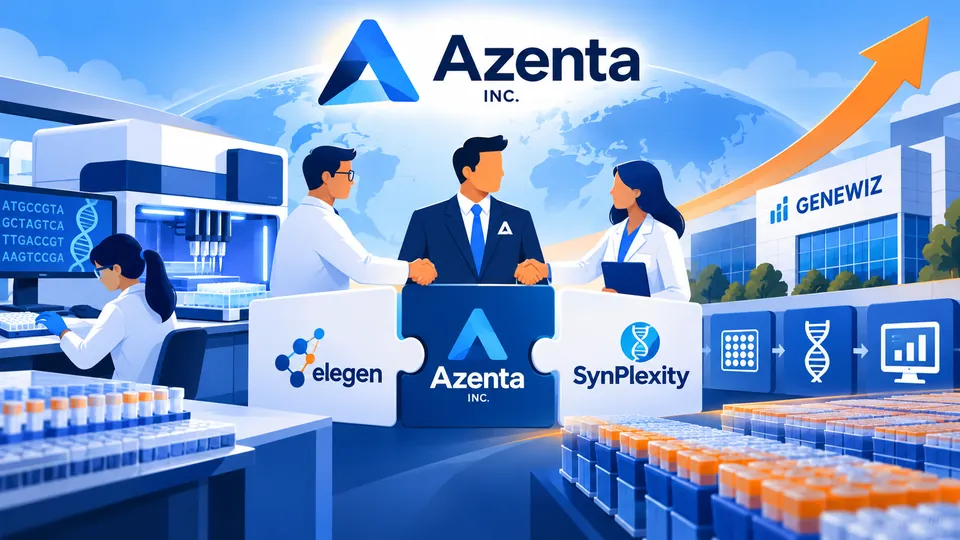
SynPlexity’s pooled assembly technology provides thousands of full-length gene variants in a single library.1
Azenta was founded in New Jersey in 1999.1
Azenta plans to provide more details about the investments during its fourth-quarter fiscal 2026 earnings call.1
Story
Azenta expands gene synthesis with Elegen licensing and SynPlexity acquisitionAzenta disclosed two simultaneous moves to broaden its gene‑synthesis portfolio: an exclusive licensing agreement with Elegen Corp. and the acquisition of SynPlexity Inc.1 Both actions are intended to reinforce the capabilities of the company’s GENEWIZ brand.1 The licensing deal brings a cell‑free DNA synthesis platform into Azenta’s suite of tools.1 The purchase adds a high‑throughput pooled gene‑assembly technology to the same portfolio.1 The two additions address different parts of gene synthesis: Elegen contributes a platform focused on DNA quality, delivery speed and manufacturing scale, while SynPlexity adds a way to assemble many gene variants in a library.1 That distinction matters to researchers because the announced capabilities include both preparing DNA for downstream work and producing large sets of candidates to build and test.1 Azenta’s announcements describe a licensing agreement for Elegen’s platform and an acquisition of SynPlexity, rather than two arrangements of the same type.1
The Elegen platform is described as a cell‑free system that improves DNA quality, speeds delivery, and scales manufacturing for GENEWIZ.1 It also supplies sequence‑verified DNA constructs and templates, simplifying preparation for downstream experiments such as antibody discovery.1 These attributes aim to make the synthesis process more reliable for customers.1 The platform’s design supports rapid response to market needs.1 Sequence verification is relevant because the platform is designed to provide constructs and templates before researchers move on to experiments such as antibody discovery.1 The stated improvements span three practical dimensions—quality, delivery speed and manufacturing scalability—rather than describing only a change to the DNA production method.1 For GENEWIZ customers, the intended connection is that better-quality DNA delivered faster can support downstream work, while scalable manufacturing can support the service as demand changes.1
Elegen’s compact production workflows allow Azenta to add regional capacity close to customers as demand fluctuates.1 Proximity of production sites is intended to reduce turnaround times for orders.1 This approach aligns with the company’s goal of scaling services without sacrificing speed.1 The added capacity is counted by the number of additional regional sites that can be activated on short notice.1 The announcement presents regional production as a flexible response: capacity can be placed near customers when needed, rather than treating production scale as fixed.1 This could matter to customers whose demand varies, because the stated purpose of the compact workflows is to add capacity as demand calls for it.1 The fact describes an ability to add regional capacity close to customers; it does not give a count of sites or a specific activation schedule.1
SynPlexity contributes a pooled gene‑assembly technology that can generate thousands of full‑length gene variants within a single library.1 The technology enables the creation of large, multiplexed libraries for functional screening.1 By delivering many variants at once, the platform reduces the time and cost of library construction.1 These capabilities are measured by the number of distinct gene variants produced per library batch.1 The figure described is thousands of variants in one library, indicating that the offering brings many full‑length options together in a pooled format.1 That contrasts with considering each candidate separately: SynPlexity’s stated value is assembling a large set in a single library for researchers’ discovery work.1 Functional screening is among the uses named for these large multiplexed libraries, alongside drug discovery and therapeutics.1
Researchers can use SynPlexity’s system to efficiently build and test extensive candidate sets, including designs generated by artificial intelligence.1 The high‑throughput nature of the technology supports rapid iteration in drug discovery and therapeutic development.1 The ability to evaluate many candidates simultaneously accelerates the identification of promising leads.1 Performance metrics focus on the volume of candidates screened per experiment.1 Including AI-generated designs means the system is described as useful for candidate sets created by researchers as well as those produced through AI design.1 The relevant benefit is the ability to build and test large numbers of candidates efficiently, not a claim that any one candidate will succeed.1 Drug discovery and therapeutics are among the application areas for SynPlexity’s libraries, connecting the high-throughput approach to work that evaluates potential candidates.1
Trey Martin, President of Multiomics at Azenta, said the investments strengthen GENEWIZ’s competitive position and accelerate growth.1 His comment underscores the strategic intent behind the licensing and acquisition moves.1 The statement was released through a PR Newswire announcement.1 Martin’s perspective reflects senior leadership’s view of the expected market impact.1 Martin’s remark characterizes the moves as investments in GENEWIZ’s position and growth, but the cited statement does not provide a quantified estimate of either outcome.1 The comment therefore explains the company’s stated rationale, while the concrete additions described elsewhere are the Elegen platform and SynPlexity’s pooled assembly technology.1 For customers and researchers, the strategic ambition is tied to the expanded capabilities Azenta says the two moves bring to GENEWIZ.1
Azenta indicated that further details about the investments will be shared during its fourth‑quarter fiscal 2026 earnings call.1 The upcoming call will provide additional quantitative information and operational plans.1 Stakeholders are invited to listen for specifics on rollout timelines and financial expectations.1 The timing of the disclosure aligns with the company’s regular reporting schedule.1 The earnings call is the stated venue for more information, so the current announcement leaves some details for that later update.1 Investors and other stakeholders seeking additional details about the investments will have to look to the fourth-quarter fiscal 2026 call, according to Azenta.1 The cited information identifies when Azenta plans to provide further details, but does not itself specify those details.1
Founded in New Jersey in 1999, Azenta has built a global sequencing and gene‑synthesis business under the GENEWIZ brand.1 The company’s headquarters are now in Burlington, Massachusetts, with operations spanning North America, Europe, and Asia.1 Its worldwide footprint supports a broad customer base across multiple continents.1 The historical growth of the firm provides a foundation for the new technology integrations.1 The company’s origins and current headquarters are in different states: it was founded in New Jersey and is now headquartered in Massachusetts.1 Its operations in North America, Europe and Asia give the business a presence across those regions, while the announced Elegen workflows are intended to support regional capacity near customers.1 That existing geographic reach is part of the context for adding technologies to the GENEWIZ business, which Azenta has developed in sequencing and gene synthesis.1
Elegen’s proprietary cell‑free technologies are capable of building longer, higher‑quality DNA on a faster timeline for sectors such as agriculture, chemicals, healthcare, and pharma.1 SynPlexity’s offerings focus on large, multiplexed libraries used in functional screening, drug discovery, therapeutics, and related applications.1 Together, the two platforms expand the range of services GENEWIZ can provide to its diverse client base.1 The combined capabilities are quantified by the increased volume of DNA constructs and library variants that can be delivered to customers.1 Elegen’s stated industry reach includes agricultural and chemical work as well as healthcare and pharma, while SynPlexity’s applications include screening, drug discovery and therapeutics.1 The platforms therefore serve different but related needs: one builds longer, higher-quality DNA faster, and the other supplies large libraries for functional evaluation.1 Researchers in the fields named for either offering are the prospective users described in the announcement, though the facts do not specify customer numbers or adoption levels.1
Structure
Who is connected to whom- 1Azenta, Inc.
- located in →Fact
- agreement with →Fact
- serves →Fact
- acquires →Fact
- serves →Fact
History
How it came to this- 1999Azenta foundedAzenta was founded in New Jersey and built a global sequencing and gene-synthesis business under the GENEWIZ brand.
- Nowthousands Full-length gene variants in a SynPlexity library
- Fourth-quarter fiscal 2026 earnings callAzenta plans to provide additional details about the investments during the call.
Impact
Spreading outward, level by level- Level 1DNA synthesis and preparation
The Elegen license adds a cell-free platform to GENEWIZ that improves DNA quality, delivery speed, and manufacturing scalability, and provides sequence-verified constructs and templates for downstream experiments.1
Fact - Level 2Library construction and candidate testing
SynPlexity adds pooled gene assembly for large sets of variants, helping researchers build and test many candidates, including AI-generated designs.1
Fact - Level 3Customer access and capacity
Compact production workflows allow regional capacity to be added near customers as demand calls for it; the announcement does not specify a number of sites or an activation schedule.1
Fact - Level 4GENEWIZ’s market position and growth
Azenta’s Multiomics president said the investments strengthen GENEWIZ’s competitive position and accelerate growth. The announcement does not quantify those outcomes.1
Fact - Level 5Potential service expansion
Together, the platforms could give GENEWIZ faster, higher-quality, higher-throughput services; this is an expected benefit, not a reported outcome.
Analysis
Ahead
Checked automatically when due; the result goes to the track recordAzenta plans to provide additional details about the investments during the call.
Sources
What each source supportsWritten by AI from the sources listed below: every fact was checked word for word against its source, and inference is marked apart. How we write