

XREAL AURA launches as Android XR wired glasses, with prices starting at $1,099
Google and XREAL announced AURA on October 28, describing it as wired XR glasses that run Android XR. Its launch includes two configurations, a separate computing puck and battery, and a mix of mobile apps, XR experiences, and connected-device screens.
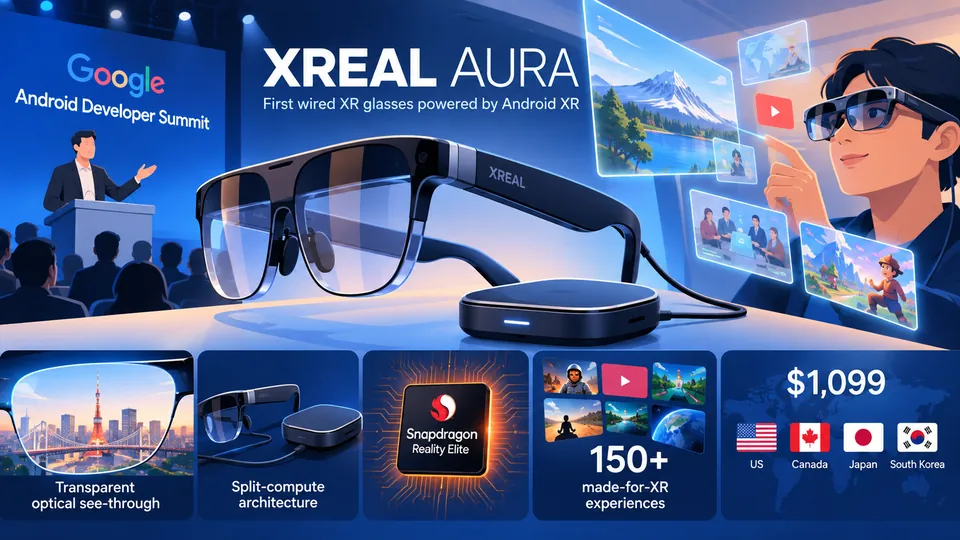
Google and XREAL announced AURA as wired glasses running Android XR.1
The limited-time launch offer priced the 12GB + 256GB configuration at this amount.2
The limited-time offer priced the 16GB + 512GB configuration at this amount.2
Story
What XREAL AURA brings to the Android XR launchGoogle and XREAL announced AURA on October 28 as wired glasses running Android XR, marking the product’s arrival as a new device in the XR category.1 XREAL described AURA as the first wired XR glasses to use Android XR and the first wired XR glasses to debut with the Snapdragon Reality Elite Platform.2 The company introduced the glasses on stage at Google’s Android Developer Summit, making the announcement part of a developer-focused event.2 The launch pricing covers two memory and storage combinations rather than one universal configuration: 12GB + 256GB costs $1,099, while 16GB + 512GB costs $1,299.2 That comparison supports describing $1,099 as the entry price for the lower-capacity model, not as the price of every AURA configuration.2
The higher-capacity option includes more memory and storage than the lower-capacity one, and its listed price is also higher.2 The prices were presented as a limited-time launch offer, so they describe launch-period terms rather than an unqualified permanent price.2 A report from Japan separately said the promotional offer would run through year-end, with prices beginning at 1099ドル.1 The Japanese report also gave a direct-sale price of 22万9800円 and said orders there were scheduled to start November 2.1 These reports give prices in different currencies and describe different market details, so the figures should not be treated as a direct currency comparison.12
For customers in the United States, Canada, Japan, and South Korea, ordering could begin on October 28, according to the company’s release.2 The Japanese coverage gave a later local ordering date, November 2, and specified a direct-sale price for that market.1 The company expected devices to start shipping in mid-November, placing delivery after the initial order period.2 The Japanese report said the product was intended for people aged 18 and older, identifying an age limit in that market coverage.1 Together, the ordering dates, shipping estimate, and age guidance describe distinct parts of availability: when orders could be placed, when units might ship, and who the report said the device was for.12
XREAL developed AURA in collaboration with Google and Qualcomm Technologies, Inc., linking the glasses to both the Android XR platform and Qualcomm technology.2 The company’s split-compute design puts the principal computing components and battery in a small separate puck joined to the glasses by a cable.2 The Japanese report identifies the chip in that separate device as Qualcomm’s Snapdragon Reality Elite.1 The glasses themselves use transparent optical see-through lenses, allowing the wearer to view the surrounding room and people while digital material appears within their view.2 The Japanese report gives the field of view as 70 degrees and the glasses’ weight as 95g, two measures of the eyewear rather than of the separate puck.12
AURA can display several apps at the same time, and users can change the dimensions and placement of those app windows.1 At launch, the company said users could draw on millions of familiar mobile apps and games from Google Play alongside XR-focused software.2 It also described a growing collection of over 150 experiences made specifically for XR, a separate measure of content built for the format.2 These figures describe different types of available content: the millions refer to mobile apps and games, while the over-150 count refers to XR-made experiences.2 AURA is therefore presented as supporting both standard mobile software and purpose-built XR material, rather than relying on only one of those libraries.2
A computer or handheld gaming console can connect over USB-C through Wired Mirroring, allowing its screen to appear beside native Android XR apps.2 The Japanese report specifies that the USB-C cable must support video output and says the connection does not require dedicated software installation.1 The combination is described as bringing external-device displays and native XR applications into one spatial workspace, rather than limiting the glasses to either source.2 This arrangement gives the device a route for showing content from a connected computer or console as well as software running in the Android XR environment.2 The listed connection requirements matter to that use: the cable needs video capability, but the Japanese account says a dedicated program is unnecessary.1
AURA supports Bluetooth keyboards and mice, and the compact connected device can also serve as a touchpad.1 Those control options complement the ability to position and resize multiple app windows, although the reports do not specify which input method is required for each task.1 The Japanese report also says the glasses support Gemini, which can answer questions using surroundings or screen material that the user shares with it.1 That description ties the assistant’s responses to information supplied from the wearer’s environment or display, rather than presenting it as an unrestricted source of context.1 The combination of app controls, mirrored screens, and Gemini support indicates several forms of interaction, while the cited reports do not quantify how often users might use them.12
XREAL CEO Chi Xu said the aim was to make spatial computing available without cutting users off from the world around them.2 That stated aim aligns with the see-through lens design, which lets users retain a view of rooms and nearby people as digital content is shown.2 The product’s wired construction and separate computing puck are also part of its described hardware arrangement, with the main processing components and battery located off the glasses.2 Taken together, the materials describe a device that combines Android XR software with a tethered hardware layout and transparent viewing, rather than a self-contained glasses unit.12 The launch information does not provide a comparative benchmark against other glasses, so its first-of-kind descriptions remain XREAL’s characterization of AURA.2
The announcement places AURA at the intersection of Google’s Android XR ecosystem, Qualcomm’s platform technology, and XREAL’s wired glasses design.12 Its supported use cases span Google Play mobile apps and games, a library of over 150 XR-specific experiences, and displays from connected computers or handheld consoles.2 The launch geography named by the company includes the United States, Canada, Japan, and South Korea, while the cited Japanese coverage adds local ordering and price details.12 The reported start of shipping in mid-November follows the October 28 announcement and ordering date in several markets, with Japan’s report giving November 2 as its scheduled order date.12 What changed at launch is the arrival of wired Android XR glasses with stated first-of-kind platform claims, two priced configurations, and access to both native and connected-device content.12
Structure
Who is connected to whom- 1XREAL AURA
- uses →Fact
- enables →Fact
- ← suppliesFact
- ← producesFact
- uses →Fact
History
How it came to this- October 28AURA announcedGoogle and XREAL announced the wired Android XR glasses at Google's Android Developer Summit.
- October 28Ordering opened in named marketsCustomers in the United States, Canada, Japan and South Korea could order AURA starting on this date.
- November 2Japanese orders scheduled to beginCNET Japan reported a local order start and direct-sale price of 22万9800円.
- Mid-NovemberShipping expectedThe company expected devices to begin shipping in this period.
- Now$1,099 XREAL AURA launch price, 12GB + 256GB configuration
- Mid-NovemberWatch whether AURA shipments begin as the company expected.
Impact
Spreading outward, level by level- Level 1Configuration choice
The offer distinguishes a 12GB + 256GB model from a 16GB + 512GB model, with the higher-capacity configuration carrying the higher listed price.2
Fact - Level 2Availability
The launch offer was limited-time; the Japanese report said its promotional price would be available through year-end.12
Fact - Level 3Customer ordering
The company listed ordering from October 28 in the United States, Canada, Japan and South Korea, while Japan's report gave a November 2 local start.12
Fact
Ahead
Checked automatically when due; the result goes to the track recordThe Japanese report said the promotional price would run through year-end; watch for any subsequent pricing information.
Sources
What each source supportsWritten by AI from the sources listed below: every fact was checked word for word against its source, and inference is marked apart. How we write