

UN commission says genocide continued in Gaza during ceasefire
The commission says its finding extends an earlier conclusion made before the US-brokered truce. Its latest report also describes an expanding Israeli-controlled area in Gaza and grave deterioration in the West Bank.
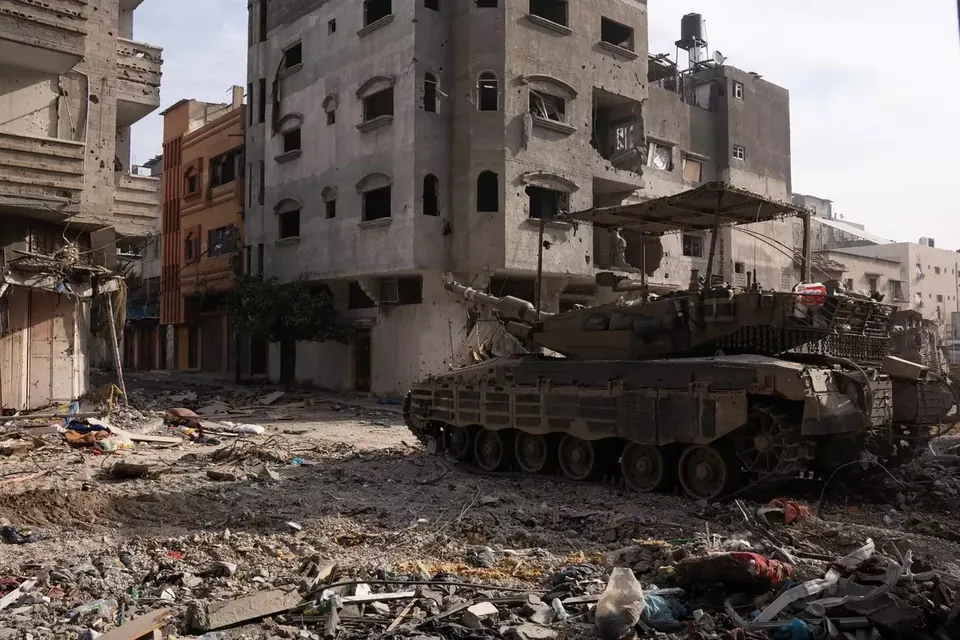
More than 74,000 Palestinians have been killed according to Israel's health ministry.3
Over 34,000 Palestinians were displaced in the West Bank by August, the largest displacement since 1967.2
At least 196 Palestinians, including 43 children, were killed near the Yellow Line from the ceasefire signing until early April.3
Story
The commission’s findings across Gaza and the West BankA United Nations commission says Israel continued committing genocide in Gaza after the ceasefire that began last October.2 The conclusion carries forward an earlier determination: a report issued last September had already said Israel was committing genocide in Gaza, before the US-brokered ceasefire.3 The latest report therefore places the commission’s finding in the period after the truce began, rather than presenting the genocide conclusion as new to this report.23 The commission also attributed crimes against humanity and war crimes to Israeli forces in the Occupied Palestinian Territory.3 Its listed findings include extermination, persecution, torture, rape and other forms of sexual violence.3
The report places the latest findings against the Hamas-led attacks in 2023, which its account says killed 1,200 people and led to 251 people being taken hostage.3 It also records the scale of Israel’s response using figures from the health ministry: more than 74,000 Palestinians killed and nearly all Gaza’s population displaced.3 The two measures describe different effects: one counts deaths, while the other describes displacement across the population.3 The report’s earlier genocide finding came in September, before the ceasefire; the new finding says the commission considers the conduct to have continued after that change in conditions.23 The commission’s earlier work was chaired by Navi Pillay, whom RNZ described as a 2026 Nobel Peace Prize laureate.2
In June, the commission issued a separate report accusing Israel of deliberately targeting and killing children in Gaza.3 Israel condemned that report, according to the account of its release.3 The latest report turns attention to the West Bank as well, describing its situation as having deteriorated gravely since the Hamas attacks of October 7, 2023.2 It says sustained settler violence there formed part of an attack against Palestinians that was widespread and systematic.2 The commission also said sexual violence was used to force Palestinians from their homes and accused Israeli forces of intentionally killing and injuring children in the West Bank.3
The report gives a comparison of deaths from West Bank air strikes: 254 Palestinians were killed between October 7, 2023 and the end of September that year, against six deaths between 2008 and the October 7 attacks.23 Those counts cover different periods, and the commission’s comparison sets the shorter interval around the 2023 attacks against the earlier span beginning in 2008.23 Military operations in the West Bank since January last year had displaced more than 34,000 Palestinians by August, according to the commission.2 The commission characterized that as the largest displacement there since 1967, making the figure a comparison with earlier displacement in the West Bank rather than a count of all Palestinians affected by the conflict.2 Chair Srinivasan Muralidhar said the West Bank actions belonged to a broader strategy aimed at exterminating and displacing Palestinians.3
The commission’s account also describes the ceasefire boundary in Gaza as changing over time.3 It says the Yellow Line shifted from a temporary marker into a de facto border that continued to advance.3 When the ceasefire was declared in October 2025, the Israeli military held roughly 51 per cent of Gaza’s territory, while the commission later put Israeli-controlled areas at at least 60 per cent.3 The commission’s description thus presents control as extending across a larger share during the truce, rather than remaining at a fixed line.3 The two percentages refer to territory held or controlled, not to the share of Gaza’s population counted as displaced.3
From the signing of the ceasefire until early April, the commission counted at least 196 Palestinians killed near the Yellow Line, including 43 children.3 That figure is specific to people killed near the line during the stated interval; it is not the report’s overall death toll for Gaza.3 The commission reported that Israeli forces used heavy munitions, drones, quadcopters, artillery and sniper fire in densely populated places during the truce.2 The report’s account therefore pairs a changing territorial boundary with continued military activity and deaths near that line.23 These findings concern the ceasefire period, while the commission’s separate comparisons of West Bank deaths and displacement cover their own specified time windows.23
The report also criticized the Palestinian Authority, linking it to killings after it targeted Palestinians who expressed dissent, including journalists and human rights defenders.3 Muralidhar said the authority had not properly investigated those deaths.3 He also noted that the use of unnecessary and disproportionate force had risen since the October 7 attacks.3 These criticisms address the Palestinian Authority’s actions and investigations; the report’s findings about Israeli forces and settlers are distinct claims in the same account.23 The report’s treatment of responsibility therefore includes allegations concerning more than one actor, without making the findings interchangeable.3
Israel’s foreign ministry rejected the latest report, describing it as propaganda detached from reality and accusing the commission of seeking to delegitimize Israel.2 Israel’s mission in Geneva separately called the report part of a misinformation effort intended to demonize the country.3 The account of the report’s release says it came the day before Israel’s general election.2 Another account says the national election was scheduled for October 27, with Netanyahu and Gadi Eisenkot close in polls cited by NPR.5 Danny Citrinowicz said Netanyahu’s election-season security message presented him as Israel’s protector who would respond harshly.5
A separate West Bank operation followed the killing of two soldiers near Hebron by Palestinian gunmen, and municipal authorities said it displaced more than 3,000 people.3 The Israeli military said that operation would run for several days and reach dozens of other West Bank areas.6 Homes near the shooting location were being bulldozed on Friday afternoon, according to the report.5 The Israeli High Court then temporarily stopped demolitions after a lawyer filed a petition for two factory owners.4 The sources present the operation as both a response to a deadly attack and an action occurring just before an election, while reporting that analysts linked its scale to electoral politics.35
Separate counts of violence against agriculture also describe different periods and categories.46 The Palestinian Colonization and Wall Resistance Commission recorded 409 attacks by Israeli forces or settlers against farmers and agricultural property during October to date.6 OCHA counted 199 settler attacks connected to the olive harvest between September 1 and October 12, with one Palestinian killed, 124 injured and more than 2,500 trees and saplings damaged.4 The 409 and 199 totals cannot be read as competing counts of the same set: their stated time ranges and definitions differ.46 Together, the reports describe findings in Gaza, West Bank displacement and violence, and attacks affecting Palestinian agriculture, while keeping their counts tied to separate places, periods and measures.2346
Structure
Who is connected to whom- 1Israel
- ← agreement withFact
- ← partners withFact
- ← regulated byFact
- sanctions →Supported
- ← partners withFact
History
How it came to this- October 2025Ceasefire declaredThe ceasefire began, with the Israeli Defense Forces holding roughly 51 % of Gaza territory.
- June 2026UN commission report releasedThe commission reported Israeli‑controlled areas had expanded to at least 60 % of Gaza and affirmed ongoing genocide.
- Nowat least 60 % Israeli-controlled Gaza territory
Impact
Spreading outward, level by level- Level 1Territorial control
Israeli forces now control a larger share of Gaza, reducing space for civilian movement and aid distribution.3
Fact - Level 2Humanitarian conditions
Increased control correlates with continued high civilian casualties and displacement, worsening the humanitarian crisis.
Analysis - Level 3Political dynamics
The expanding control is cited by analysts as influencing Israel's domestic election environment.
Analysis
Sources
What each source supportsWritten by AI from the sources listed below: every fact was checked word for word against its source, and inference is marked apart. How we write