

United States Accuses Canadian Officials of Midterm Interference as Trade Dispute Deepens
Diplomatic friction between Washington and Ottawa escalated after American officials alleged Canadian attempts to shape United States congressional races. Canadian leaders dismissed the claims while pointing to retaliatory trade defenses and reciprocal sovereignty concerns.
Prime Minister Mark Carney announced relief funding to safeguard domestic workers and businesses against American trade actions.1
A Canadian petition gathered signatures demanding the dismissal of US Ambassador Pete Hoekstra.1
A US Embassy document identified Canadian citizens charged or convicted over voting in American elections between 2012 and 2024.2
Story
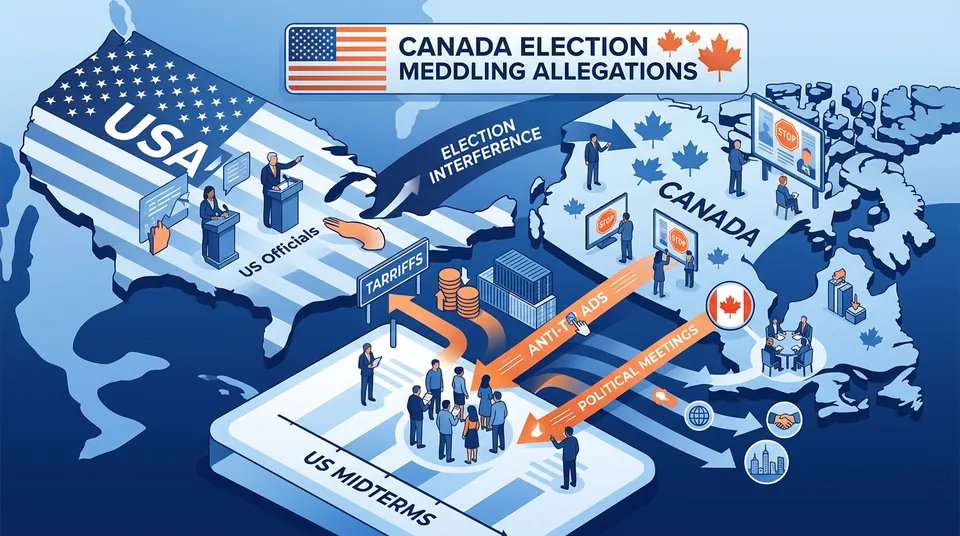
Diplomatic Rift Widens as Washington Claims Canadian Meddling in Congressional ElectionsDiplomatic ties between Washington and Ottawa strained significantly after the American diplomatic mission in Ottawa accused Canadian political leaders of meddling in approaching United States midterm ballots.1 American diplomats asserted that leadership in Canada disregarded warnings over cross-border interference while publicly detailing plans to manipulate the American electoral landscape.1 A formal notice distributed by the United States embassy explicitly instructed citizens of Canada to remain entirely detached from American electoral processes.2 The upcoming vote will decide which party controls both the Senate and the House of Representatives, carrying profound ramifications for the administration of Donald Trump.1 Earlier in the month, Pete Hoekstra, the United States Ambassador, issued a public warning that federal agencies were actively tracking Canadian figures for unlawful involvement.1
Prime Minister Mark Carney and senior members of his government promptly dismissed the meddling charges as groundless.1 Carney maintained that the trade measures taken by his administration were purely defensive steps meant to shelter local industries, workforce payrolls, and national prosperity after Washington initiated trade hostilities.1 To soften the blow of these border penalties, the Prime Minister announced an economic stabilization program worth nearly 9 billion Canadian dollars, equivalent to roughly 6.2 billion in United States currency.1 The financial package was presented in concert with Industry Minister Mélanie Joly and Ontario Premier Doug Ford to counter the financial pressures created by American tariff duties.1 Evidence supports that Canadian authorities allocated billions in state funds specifically to mitigate economic shocks stemming from the tariff conflict launched by Donald Trump during his second presidency.1
The dossier compiled by American diplomats documented specific instances where Canadian representatives allegedly sought common ground with United States Democrats while pushing for aggressive counter-tariffs.1 United States officials highlighted autumn gatherings where Mélanie Joly convened with Democratic leaders in Boston and Chicago during September.2 The American memorandum also singled out Canadian parliamentarian Anthony Housefather for assisting Florida Democrat Debbie Wasserman Schultz during her primary campaign in August.2 In addition to recent political interactions, an official United States fact sheet cited 11 Canadian nationals who faced criminal indictments or convictions related to voting in American elections between 2012 and 2024.2
Addressing the accusations, Mélanie Joly argued that her official missions south of the border were designed solely to attract commercial capital and multinational investment into Canada.1 Earlier in August, however, Joly had remarked publicly that Canadian tariff designs were structured strategically against selected American jurisdictions to produce political leverage.2 When pressed about whether trade policies might shift if Democrats secured majorities in Congress, Joly explained that such a possibility prompted her engagements with state governors and prospective presidential hopefuls.1 Canadian authorities have continued to insist that routine diplomatic engagement and trade defense should not be conflated with illicit electoral disruption.1
Provincial authorities have similarly found themselves at the center of the dispute over cross-border influence.1 Ontario Premier Doug Ford had publicly recommended that federal trade negotiators aim retaliatory duties squarely at districts and states critical to Donald Trump's political coalition.1 Despite those past recommendations, Ford firmly declared that he harbors no personal ambition or intention to meddle in United States balloting.1 The Premier's earlier media strategy had already provoked sharp irritation from the White House during negotiations over trade barriers.2 In October 2025, Donald Trump walked away from bilateral trade negotiations after Ontario launched an advertising broadcast featuring historical anti-tariff remarks delivered by former President Ronald Reagan.2
The persistent trade hostilities between the two North American neighbors have been ongoing since Donald Trump began his second presidential term in 2025.2 Tensions escalated rapidly as Washington applied tariffs on Canadian imports, eliciting targeted reciprocal duties from Ottawa designed to defend domestic markets.12 Canadian policymakers defended their selective customs tariffs as standard commercial diplomacy intended to protect domestic businesses and regional employment.12 Conversely, the United States embassy framed these targeted fiscal responses as an inappropriate endeavor to manipulate the political fortunes of sitting lawmakers ahead of competitive midterm races.1
The diplomatic friction has provoked a strong backlash among the Canadian public toward American representatives.1 More than 280,000 individuals affixed their names to a public petition requesting the expulsion of United States Ambassador Pete Hoekstra.1 Organizers and signers contended that Hoekstra's statements and warnings had inflicted unnecessary damage on bilateral relations between the two long-standing allies.1 The envoy's admonitions about monitoring Canadian officials marked a rare public confrontation in modern North American diplomacy.1
Concerns over external political meddling are not one-sided, as available reporting supports the conclusion that both capitals have directed allegations of electoral tampering at each other.1 Donald Trump has repeatedly sparked outrage across the border by making public statements suggesting the annexation of Canada to become the 51st American state.2 Furthermore, proponents of Albertan independence reportedly communicated with officials inside the Trump administration seeking backing ahead of an unsuccessful separation ballot.2 In an interview with Global News, Mark Carney emphasized that Canada expects all foreign powers, including the United States, to keep out of Canadian sovereign governance.2
The clash over midterm interference illustrates how deeply the economic confrontation has spilled into partisan political debate in both nations.12 With control of both houses of Congress at stake, American authorities view foreign outreach to Democratic leaders as an intolerable attempt to sway legislative power against Donald Trump.1 Canadian leaders counter that outreach across party lines and retaliatory customs measures are legitimate instruments to safeguard national interests during an escalating tariff conflict.1 As the midterms approach, the ongoing exchange of warnings and diplomatic complaints continues to test cross-border cooperation between Washington and Ottawa.12
History
How it came to this- 2025Trade dispute beginsCross-border trade tensions erupted between the United States and Canada following the start of Donald Trump's second term.
- AugustState-targeted tariffs and campaign outreachMélanie Joly noted tariffs were aimed at US states for political leverage, while MP Anthony Housefather campaigned in Florida for Debbie Wasserman Schultz.
- SeptemberMeetings with Democratic leadersIndustry Minister Mélanie Joly met with Democratic officials in Boston and Chicago.
- October 2025Trade negotiations collapseDonald Trump halted bilateral trade discussions with Canada after Ontario launched an advertising campaign using Ronald Reagan's anti-tariff speech.
- Nownearly 9 billion Canadian dollar Canadian relief package to counteract US tariffs
Impact
Spreading outward, level by level- Level 1Diplomatic confrontation
The US Embassy in Ottawa accused Canadian officials of meddling in American midterm elections and issued a public warning to Canadians to stay out of US votes.12
Fact - Level 2Economic and fiscal response
Canada instituted targeted counter-tariffs and committed nearly 9 billion Canadian dollars to shield domestic industries and employment from US trade pressure.1
Fact - Level 3Bilateral political relations
Cross-border allegations of democratic interference and political posturing compound economic friction and strain long-term alliance ties.
Analysis
Sources
What each source supportsWritten by AI from the sources listed below: every fact was checked word for word against its source, and inference is marked apart. How we write