

FCA expands whistleblowing review timeline, now expects January 2027 progress update
The Financial Conduct Authority has broadened its independent review of the Andriesz case to cover compliance with whistleblowing law and its own policies. The expanded scope pushes the progress update to January 2027 and the final report to spring 2027.
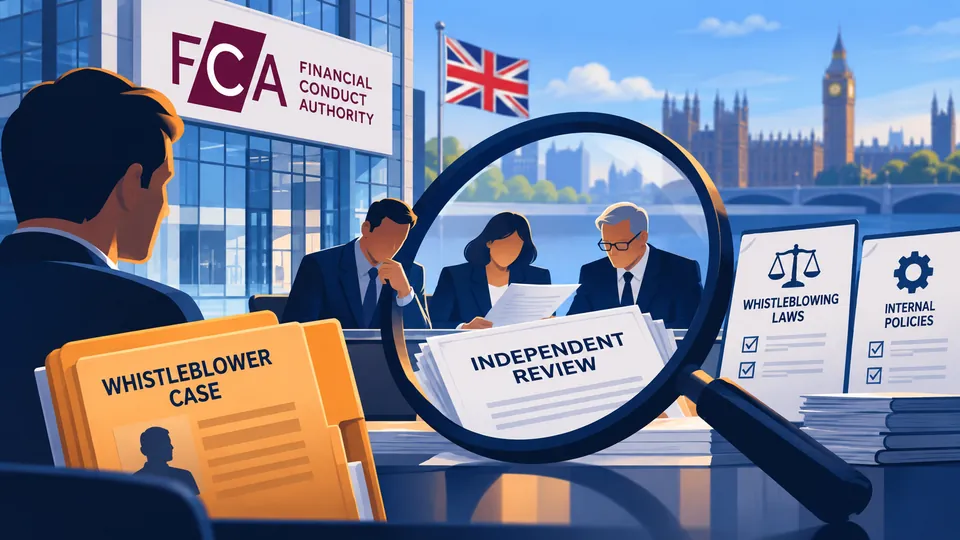
The review will cover the period from at least 2017 to 2026.1
The FCA now expects to provide a progress update in January 2027.1
The FCA now expects to publish the final report in spring 2027.1
Story
FCA Independent Review of Andriesz Case: Scope, Timeline, and Expected OutcomesThe FCA announced that it has commissioned an independent review concerning Mr Andriesz.1 Lea Paterson CBE, an independent non‑executive director of the FCA, has been appointed to conduct the review.1 The review will examine how the FCA interacted with Mr Andriesz.1 Its scope has been expanded to assess compliance with whistleblowing law and the FCA’s own policies and procedures.1 By adding a legal compliance check, the review now measures the regulator against statutory expectations rather than solely internal standards.1 This broader mandate means the reviewer must compare past FCA actions with the requirements set out in UK whistleblowing legislation.1
The review will cover a period extending from at least 2017 to 2026.1 It is tasked with identifying lessons learned and making recommendations for future engagement with external whistleblowers and vulnerable individuals.1 The FCA previously indicated an intention to publish findings in early 2027.1 Because of the broader scope, the regulator now expects to issue a progress update in January 2027 and to release the final report in spring 2027.1 Extending the review back to 2017 captures several cycles of regulatory reform, allowing the reviewer to spot patterns over time.1 The longer timeframe also increases the volume of documents and testimonies that must be examined, which explains the shift in reporting dates.1
The change in timeline reflects the addition of compliance assessment to the original review mandate.1 By extending the period under review to a decade, the FCA can evaluate systemic issues rather than isolated incidents.1 The inclusion of whistleblowing law compliance introduces a legal benchmark against which the FCA’s internal procedures will be measured.1 These adjustments increase the amount of evidence that must be gathered and analyzed.1 Analyzing a ten‑year span means the reviewer will need to reconcile changes in policy guidance with evolving legal expectations.1 Such a comprehensive evidence base is intended to produce recommendations that are robust across future regulatory environments.1
The review’s findings will be relevant to whistleblowers who interact with the FCA, as well as to vulnerable individuals who may rely on the regulator’s protections.1 Recommendations are expected to shape future engagement protocols, potentially altering how the FCA processes external disclosures.1 Stakeholders such as industry participants, consumer groups, and policy makers will monitor the progress update for early indications of reform.1 The timeline for the final report aligns with the FCA’s earlier commitment to publish findings in early 2027, albeit shifted to spring.1 If the interim update highlights significant gaps, regulators elsewhere may adopt similar timelines to demonstrate accountability.1 Conversely, a smooth rollout of recommendations could reassure market participants that the FCA is addressing systemic weaknesses.1
The FCA expressed condolences for Mr Andriesz’s tragic death and sympathy for his family.1 This statement underscores the regulator’s acknowledgment of the personal impact of the case.1 It also signals a tone of responsibility that the forthcoming review aims to reinforce through its recommendations.1 The public communication of condolences is part of the FCA’s broader effort to maintain trust during the investigative process.1 By publicly mourning the loss, the FCA signals that it values the human dimension behind regulatory failures.1 Such empathy can help mitigate reputational damage while the review proceeds.1
The independent nature of the review, led by a non‑executive director, is intended to ensure objectivity.1 By commissioning an external reviewer, the FCA seeks to separate the investigative function from internal decision‑making.1 This structure is designed to bolster confidence among external observers that the findings will be impartial.1 The FCA’s choice of an experienced non‑executive director reflects a commitment to governance standards.1 An outsider’s perspective can also surface issues that internal teams might overlook due to familiarity.1 Consequently, the review’s credibility is likely to be higher among whistleblowers and advocacy groups.1
The expanded review period, from 2017 to 2026, captures multiple regulatory cycles and policy changes.1 Analyzing this span allows the review to identify trends in whistleblowing handling over time.1 It also provides a basis for comparing past practices with current expectations under whistleblowing law.1 Such longitudinal analysis is essential for formulating durable recommendations.1 The decade‑long view helps distinguish temporary lapses from entrenched cultural issues within the FCA.1 Understanding this distinction is crucial for designing reforms that address root causes rather than symptoms.1
The scheduled progress update in January 2027 will give stakeholders an interim view of the review’s direction.1 It will likely outline preliminary findings and indicate any emerging themes.1 The final report in spring 2027 is expected to deliver comprehensive conclusions and actionable steps.1 Together, these milestones create a transparent timeline for accountability.1 Stakeholders can use the January update to prepare for potential policy adjustments before the full report arrives.1 This staged release mirrors best practices in regulatory oversight, where early insights guide interim actions.1
In the broader context, the FCA’s decision to broaden the review aligns with heightened regulatory focus on whistleblower protection across the UK.1 Recent legislative developments have reinforced obligations for organisations to handle disclosures appropriately.1 The FCA’s expanded scope therefore positions it to benchmark its own practices against evolving legal standards.1 The outcome may influence how other regulators structure their whistleblowing frameworks.1 If the FCA’s recommendations prove effective, they could become a model for sector‑wide reforms.1 Conversely, any identified shortcomings might prompt legislative bodies to tighten oversight of regulator‑led reviews.1
History
How it came to this- Earlier timetableThe FCA aimed to publish findings in early 2027
- Review scope expandedCompliance assessment addedThe review’s scope was expanded to assess compliance with whistleblowing law and FCA policies and procedures.
- Updated timetableProgress update and final report dates announcedThe FCA expects a progress update in January 2027 and the final report in spring 2027 because of the broader scope.
- Nowspring 2027 Expected final report on the FCA’s independent review
- January 2027The FCA expects to issue a progress update on the review.
Impact
Spreading outward, level by level- Level 1Review process
The review will assess the FCA’s interactions with Mr Andriesz and compliance with whistleblowing law and the FCA’s own policies and procedures.1
Fact - Level 2Future engagement
The review is tasked with identifying lessons and making recommendations for future engagement with external whistleblowers and vulnerable individuals.1
Fact - Level 3Transparency during the review
The progress update may offer stakeholders an earlier view of the review’s direction before the final report is published.
Analysis
Ahead
Checked automatically when due; the result goes to the track recordSources
What each source supportsWritten by AI from the sources listed below: every fact was checked word for word against its source, and inference is marked apart. How we write