

EU and Indonesia sign two agreements after nearly ten years of talks
The agreements are intended to remove duties on almost all trade between the partners and establish rules for trade and investment. Their announcement comes amid separate EU debates over its budget and climate finance, and alongside reports on Ukraine talks and drought in Uganda.
The agreement is set to remove duties on almost all trade between the EU and Indonesia.1
Von der Leyen described the two partners’ combined market as comprising 730 million people.1
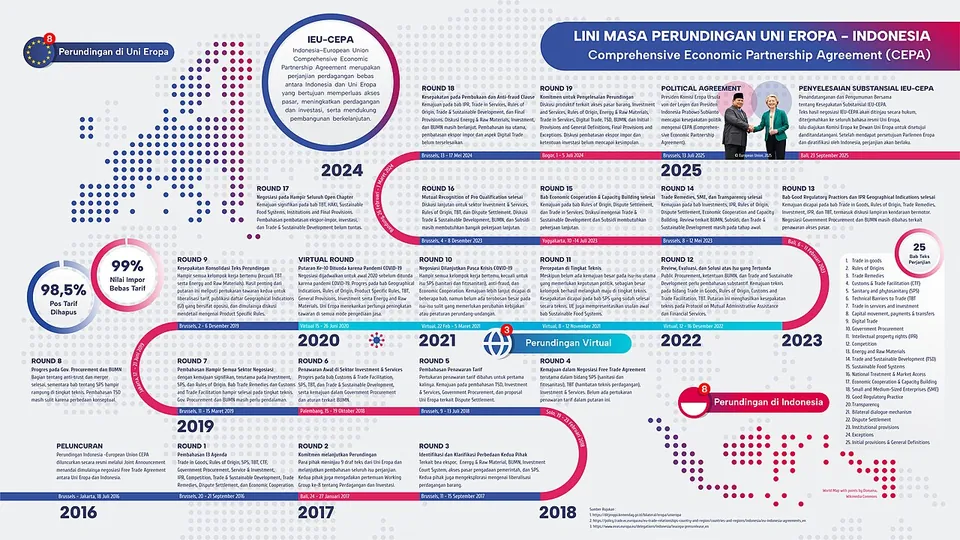
The two agreements were signed after negotiations lasting nearly ten years.1
Story
What the EU–Indonesia agreements changeThe European Union and Indonesia have signed a Comprehensive Economic Partnership Agreement and an Investment Protection Agreement, concluding nearly ten years of negotiations.1 The central trade change is the planned removal of duties on almost all trade between the two partners.1 The agreements therefore address both the treatment of traded goods and the conditions for investment, though the available account does not specify individual products, duty rates or implementation dates.1 European Commission President Ursula von der Leyen characterized the pact as among the EU’s most ambitious agreements in Asia.1
The negotiations lasted almost a decade before the two agreements were signed, making the signature the outcome of a prolonged process rather than a newly opened round of talks.1 The account gives no intermediate negotiating milestones, so it does not show when particular issues were settled or how the parties reached agreement.1 It does, however, identify two distinct instruments: a comprehensive economic partnership agreement and an agreement focused on investment protection.1 Together, those names indicate the two areas covered by the signed arrangements, while the stated tariff change concerns almost all trade between the partners.1
The two sides are presented as a large combined market of 730 million people, according to von der Leyen.1 She separately described the EU as having 450 million people, so the combined-market figure refers to the EU and Indonesia together, not to the EU alone.1 Von der Leyen called Indonesia Southeast Asia’s largest economy and the fourth most populous country in the world.1 Those descriptions supply the Commission president’s account of the partners’ scale, but the reported figures do not break down the 730 million total by country.1
Von der Leyen said the agreement would create openings for companies, farmers and workers in both Europe and Indonesia, with particular attention to smaller firms.1 She also said companies would have more predictable conditions, clear rules, access to open markets and a stable setting for trade and investment.1 These are stated aims and expected benefits, rather than reported measurements of jobs already created or businesses already using the agreement.1 The announcement provides no count of the companies, farmers or workers expected to benefit, and gives no separate estimate for small businesses.1
The Commission president said the agreement was expected to support growth and create good jobs for farmers, manufacturers and small businesses on both sides.1 That expectation extends beyond the groups named in her description of new opportunities by explicitly including manufacturers.1 The account does not quantify projected growth or employment, specify a timeframe for those effects, or distinguish expected outcomes between the EU and Indonesia.1 The broad duty-removal commitment and the stated aim of predictable rules are the concrete features presented alongside these anticipated economic effects.1
Von der Leyen said the partnership was intended to promote sustainable growth, make supply chains more resilient and assist a clean economic transition.1 These aims place the agreements in a wider policy frame than tariff reduction alone, while the available account does not set out specific measures or targets for achieving them.1 Her stated rationale also links predictable trading and investment conditions with the partnership’s broader economic purpose.1 The announcement describes these outcomes as intentions, not as effects already demonstrated by the signed agreements.1
Von der Leyen said she looked forward to receiving Indonesian President Prabowo in Brussels on 11 December, before the two travelled to Miami for the G20.1 Her statement placed that planned meeting after the signing and connected it with onward travel to the G20, but did not provide a year for 11 December.1 The announcement therefore records a planned diplomatic encounter rather than confirming that the visit or travel took place.1 It reports no additional commitments made at that planned meeting.1
Other EU policy developments in the reported material concern the next budget: the EU proposed taxing the world’s largest digital companies to help finance it.2 European Council President Antonio Costa presented a spending proposal €204 billion below the plan first advanced by the European Commission.2 The €204 billion figure measures the gap between those two budget proposals; the report does not give the total spending level of either plan.2 These budget discussions are separate from the EU–Indonesia agreements, and the reported facts do not connect the proposed digital-company tax or spending reduction to the trade deal.12
The wider reports also describe differences over Ukraine negotiations and climate finance, without identifying either as part of the Indonesia agreements.134 France said European leaders would be prepared to travel to Moscow for Ukraine discussions if they took part fully in the negotiations.3 At COP31, African negotiators called for adaptation finance to rise to three times its level by 2035, using an annual $40bn baseline that they said developed countries had committed to provide by 2025.4 The EU said it preferred delivery of climate-finance promises already made to vulnerable countries over setting new funding targets, and the African proposal had not been accepted into formal summit negotiations.4 A separate report from Uganda’s Karamoja region said drought beginning in April had ruined crops and left Elijah Lobur’s family eating once each day, while local officials said crop failure exceeded 90%.4
Structure
Who is connected to whom- 1European Union
- ← regulated byFact
- sanctions →Fact
- restricts exports to →Fact
- restricts imports from →Fact
- ← regulatory exposureFact
History
How it came to this- 2026-11-21Agreements signedThe EU and Indonesia signed the Comprehensive Economic Partnership Agreement and Investment Protection Agreement after nearly ten years of negotiations.
- Nowalmost all Trade between the EU and Indonesia covered by planned duty removal
- 11 DecemberVon der Leyen said she looked forward to welcoming Indonesian President Prabowo to Brussels before they travelled to Miami for the G20; the announcement gives no year for the visit.
Impact
Spreading outward, level by level- Level 1Trade in goods
The agreement is set to remove duties on almost all trade between the partners.1
Fact - Level 2Business conditions
The Commission president said the pact would offer companies predictable conditions and a stable framework for trade and investment.1
Fact - Level 3Businesses, farmers and workers
Von der Leyen said the agreement would open opportunities for companies, farmers and workers on both sides, especially small businesses.1
Fact - Level 4Growth and jobs
The Commission president said the deal was expected to support growth and create good jobs for farmers, manufacturers and small businesses on both sides.1
Fact - Level 5Wider economic aims
The partnership is intended to support sustainable growth, resilient supply chains and a clean economic transition.1
Fact
Ahead
Checked automatically when due; the result goes to the track recordVon der Leyen said she looked forward to welcoming Indonesian President Prabowo to Brussels before they travelled to Miami for the G20; the announcement gives no year for the visit.
Sources
What each source supportsWritten by AI from the sources listed below: every fact was checked word for word against its source, and inference is marked apart. How we write