

US Department of Energy to Lend $4.4 Billion to Restart Three Closed Nuclear Plants
The federal government is providing loans to revive facilities in Michigan, Pennsylvania, and Iowa, which could generate 2.25 gigawatts of power. This initiative marks the first time any commercial nuclear plant in the U.S. would resume operations after starting the formal decommissioning process.
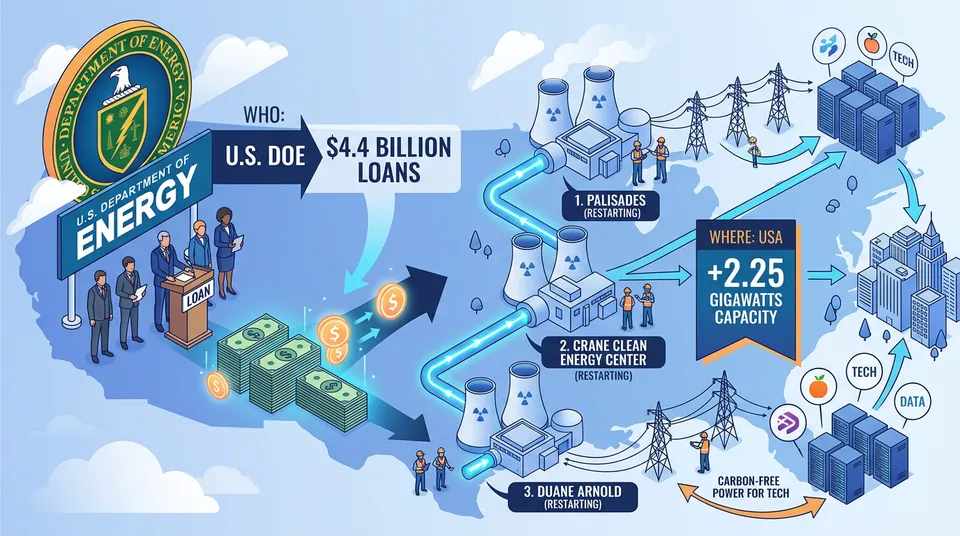
The three restarts are intended to add 2.25 gigawatts of electrical capacity.1
That capacity could supply electricity to around 2 million households and businesses.1
The Palisades and Three Mile Island loans together make up more than half of the overall lending initiative.1
Story
A New Dawn for Nuclear: The Unprecedented Revival of Shuttered US PlantsThe United States Department of Energy is directing up to $4.4 billion in loans to support the revival of three nuclear plants that had been shut down.1 Located in Michigan, Pennsylvania, and Iowa, these facilities are projected to add a combined 2.25 gigawatts of electrical capacity to the nation's grid.1 This level of output is estimated to be sufficient to provide electricity for around 2 million businesses and households.1 This effort is historic, as no commercial nuclear facility in the U.S. has ever returned to service after initiating the formal process of decommissioning.1
The primary reason all three plants were previously closed, despite having time remaining on their operating licenses, was economic.1 Their electricity had become too costly to generate compared to other sources available in the wholesale market.1 For instance, analysis before the Duane Arnold plant's closure suggested that moving to less expensive power sources, including wind generation, would save Iowa consumers $300 million.1 Similarly, the operational reactor at Three Mile Island was deactivated in 2019 after Pennsylvania's legislature opted against providing financial subsidies to keep it running.1
A significant shift in market dynamics is now driving the effort to bring these plants back online.2 Two of the facilities have arranged agreements with major technology companies that need zero-carbon energy to operate their data centers.2 These tech firms are reportedly willing to pay higher prices for electricity to meet their clean energy goals.2 This trend aligns with the Trump administration's active promotion of nuclear power for artificial intelligence and manufacturing, which includes issuing billions in loans to upgrade existing facilities.2
The Duane Arnold facility in Iowa, which first began producing power in 1975, is one of the plants slated for revival.3 It had been scheduled for a permanent shutdown in October 2020.3 However, the plant ceased operations two months ahead of schedule, in August 2020, after it sustained damage from a derecho storm.1 The plant's owner, NextEra Energy, has conveyed optimism through its CEO, John Ketchum, about the feasibility of restarting the facility.1
NextEra Energy is partnering with Google on the project with the objective of bringing the Duane Arnold plant back into service.1 The current target for the plant's return to operation is early 2029.1 A long-term agreement with a hyperscale data center operator is a key component of the financial strategy for the restart.2 John Ketchum has indicated that this arrangement ensures that the costs associated with the restart will not be shouldered by Iowa's residential customers.2
In Michigan, the Palisades plant generated electricity from 1971 until its closure in 2022.1 The shutdown happened when its owner at the time, Entergy, made the decision to withdraw from the wholesale energy market.1 At the time of its closure, the plant's federal operating license was still valid and was not due to expire until 2031.1 Following the shutdown, Holtec International purchased the plant and began decommissioning work that was specifically designed to be reversible.1
The campaign to restart Palisades received a major boost when the state of Michigan provided public funding to encourage the effort.1 Subsequently, the Biden administration authorized a $1.5 billion loan in 2024 to help finance the plant's revival.1 The Trump administration has continued the disbursement of these loan funds.1 This loan for Palisades, combined with another for Three Mile Island, accounts for over half of the total federal lending initiative for restarting nuclear plants.1
As stipulated by its power purchase contracts, the Palisades facility must be operational and generating electricity by March 2027.1 The recommissioning process has encountered at least one technical problem.1 In August, Holtec was forced to temporarily suspend the process of loading fuel into the reactor.1 This pause was required after it was found that one of the fuel assemblies had tilted and was no longer in its correct vertical position.1
The third facility, now called the Crane Clean Energy Center, is located on Three Mile Island in Pennsylvania.1 This site was where the United States experienced its most severe accident at a commercial nuclear plant in 1979.1 That incident led to the permanent destruction of one of the plant's two reactors.2 The second reactor unit was not damaged in the 1979 accident and was able to continue operating for many years.2
The remaining operational reactor at Three Mile Island was taken offline in 2019.1 In 2024, Constellation Energy declared it would invest $1.6 billion to bring the reactor back into service.1 This investment is underpinned by a 20-year power contract with Microsoft and a $1 billion loan from the Department of Energy.1 Constellation Energy is aiming to reconnect the reactor to the electrical grid in 2027.1 If these schedules hold, both Palisades and the Crane Clean Energy Center are expected to be supplying power approximately two years before the Duane Arnold plant.1
Advocates for the loan program present it as a sensible way to address growing energy needs.13 Todd Allen of the University of Michigan has asserted that recommissioning an existing reactor offers a faster and less expensive path to large-scale power than constructing a new facility.1 Jennifer Gordon from the Atlantic Council has also characterized the use of federal loan mechanisms as an excellent method for obtaining necessary electricity.3 The World Nuclear Association views the recommissioning of nuclear units as a positive step, while also stating that it is preferable to keep plants from closing in the first place.3
The initiative has, however, attracted criticism and warnings from other observers.2 Edwin Lyman of the Union of Concerned Scientists has pointed out that the majority of American nuclear plants were constructed between 1970 and 1990.2 He cautioned that these facilities were not designed to handle the escalating severity of natural disasters driven by climate change.2 Separately, Jack Spencer from The Heritage Foundation has argued that providing taxpayer-backed federal financing is inappropriate, as high power demand already makes these restart projects low-risk ventures.2
Structure
Who is connected to whom- 1U.S. Department of Energy
- finances →Fact
- requires →Fact
- ← regulated byFact
- ← partners withFact
- ← regulatory exposureFact
History
How it came to this- 1979Three Mile Island accidentThe site experienced the most severe accident at a U.S. commercial nuclear plant; one reactor was ruined, while the other continued operating.
- 2019Three Mile Island reactor shut downExelon switched off the operating reactor after Pennsylvania legislators declined to provide financial subsidies.
- 1975–August 2020Duane Arnold operated, then closed earlyThe Iowa plant opened in 1975 and ended operations ahead of its planned October 2020 shutdown after storm damage.
- 1971–2022Palisades closedThe plant generated electricity until Entergy withdrew from the wholesale energy market; its federal license was set to continue through 2031.
- 2024Restart financing and agreements advancedThe Biden administration authorized a Palisades loan, while Constellation agreed to invest in restarting Three Mile Island under a power contract with Microsoft.
- AugustPalisades fuel loading pausedHoltec temporarily halted fuel loading after discovering a tilted fuel assembly.
- Nowup to $4.4 billion Department of Energy loans to restart three shuttered nuclear plants
- March 2027Palisades is required by its power purchase contracts to be operational by this point.
Impact
Spreading outward, level by level- Level 1Electricity supply
The planned restarts target 2.25 gigawatts, enough to supply approximately 2 million households and businesses.1
Fact - Level 2Plant customers and financing
Two facilities have agreements with major technology companies willing to pay higher rates for zero-carbon power. For Duane Arnold, a long-term agreement with a hyperscale data center operator is described as protecting Iowa households from restart costs.2
Fact - Level 3Federal financing debate
The loans are supported as a way to obtain needed electricity, while a Heritage Foundation analyst argues taxpayer-backed financing is inappropriate because high demand makes restart projects low-risk.23
Fact - Level 4Safety and resilience considerations
A Union of Concerned Scientists expert warns that many U.S. nuclear facilities were built before worsening climate-driven natural disasters were accounted for; this may make resilience a relevant consideration as plants return to service.
Analysis
Ahead
Checked automatically when due; the result goes to the track recordPalisades is required by its power purchase contracts to be operational by this point.
Constellation Energy aims to reconnect the Three Mile Island reactor to the grid.
NextEra Energy and Google are targeting this period to bring Duane Arnold back into service.
Sources
What each source supportsWritten by AI from the sources listed below: every fact was checked word for word against its source, and inference is marked apart. How we write