

More than 100 civilians killed in a week of attacks across Ukraine
The UN Security Council convened as attacks hit civilian sites and infrastructure, leaving people dead or injured and parts of the country without power. Separate reports describe strikes in two regions, the effects on agriculture and planned discussions about ending the war.
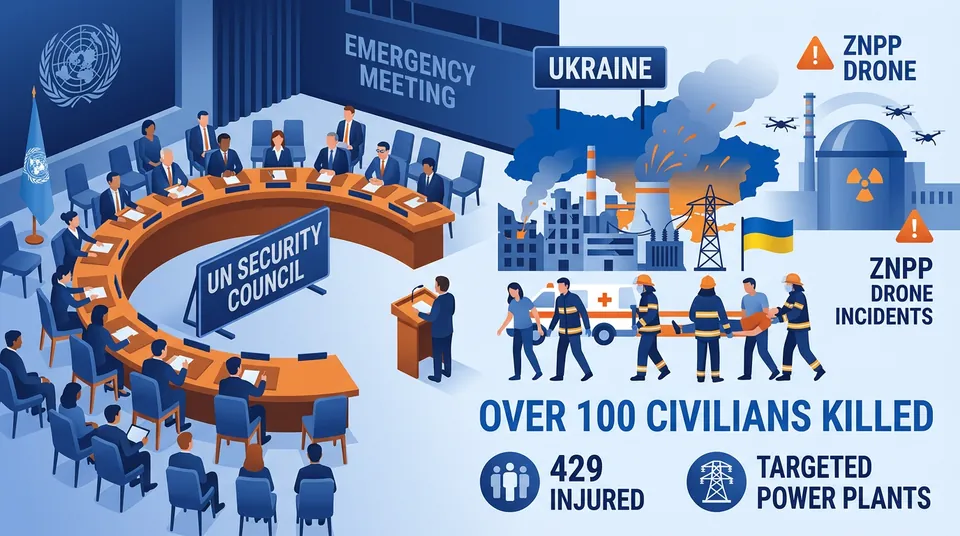
The UN report counted at least 429 civilians injured across Ukraine during the week it covered.2
The latest data recorded this many civilians killed or injured in Ukraine during the first eight months of the year.2
Ukraine exported this volume of grain and legumes in August, about 58% less than a year earlier.3
Story
Civilian casualties, damaged infrastructure and the wider costs of the warMore than 100 civilians died and at least 429 were injured across Ukraine during the week covered by the UN report, a measure of harm within that particular period.2 After attacks on civilian sites and infrastructure, the Security Council turned its attention to worsening violence and rights abuses in the war between Russia and Ukraine, now in its fourth year.2 The account therefore records more than deaths alone: it also describes injuries and damage to systems that people rely on.2 Volker Türk, the UN human rights chief, condemned the attacks’ scale and methods as “reprehensible,” according to UN News.2
The weekly toll is not interchangeable with the separate figure of 15,280 civilians killed or injured in Ukraine during the first eight months of the year.2 That larger total combines deaths and injuries over a longer span, while the weekly account gives deaths and injuries as separate counts.2 The two figures describe different reporting windows, so they do not offer rival estimates for the same stretch of time.2 Read together, they convey both the harm reported in one week and the cumulative civilian toll recorded over the first eight months.2
A separate Deutsche Welle report relayed President Volodymyr Zelenskyy’s statement that Russian strikes had killed more than 70 people in Ukraine over the preceding two days.4 That figure refers to deaths during two days, rather than the combined deaths and injuries in the UN’s first-eight-month total.24 The same report said a Russian attack on buses in Kramatorsk killed 30 civilians.4 It also described an earlier Russian missile strike on a five-storey apartment building in Chernihiv region, where 22 Ukrainians died, including five children.4
These reports count people killed in particular attacks, while the UN weekly account includes both those killed and those injured across the country.24 The attack accounts identify civilians among the dead in Kramatorsk and children among those killed in Chernihiv region.4 The facts provided do not establish whether the people described in those two attack reports are also included in the UN weekly total.24 Keeping the counts distinct avoids treating figures drawn from different descriptions and time periods as if they were one tally.24
The damage described extended to electricity infrastructure: Russian long-range attacks on substations and power plants left many parts of Ukraine without power.2 The UN account also reported that the International Atomic Energy Agency had received reports of drone incidents at Ukraine’s Zaporizhzhya Nuclear Power Plant earlier in the week.2 That wording attributes the information to reports received by the agency; it does not specify further details about the incidents.2 In its account of the Security Council’s focus, UN News presents civilian harm and infrastructure damage as parts of the same wider picture of the attacks.2
The effects described also reach agricultural work and trade: Ukrainian farmers were moving from harvesting wheat and barley to working with corn, soybeans and sunflower.3 Farmer Oleksandr Chumak said about 80% of his grain could not then be sold at a profit and that he had no cash left.3 The report linked difficulty insuring commercial ships to strikes on Black Sea targets, and said Ukrainian retaliatory attacks had also left Russian exports stuck.3 These details describe constraints on selling and shipping alongside the immediate change in what crops farmers were harvesting.3
The scale of the region’s role in food markets is reflected in figures for the years before the war: Ukraine and Russia together supplied more than half of global sunflower oil, nearly a fifth of barley and 14% of wheat, according to the UN.3 For Ukraine specifically, around 90% of its main agricultural exports usually move through the Black Sea.3 Ukraine’s grain and legume exports in August reached 981,000 tonnes, about 58% below the level in the same month a year earlier.3 The shipping route figure describes the usual channel for main agricultural exports; the August figure measures grain and legumes exported, not all agricultural products.3
The report forecast Ukraine’s grain and oilseed production at 85 million tonnes, compared with 80 million tonnes that year.3 That production forecast is a different measure from August exports: one concerns expected output of grain and oilseed, while the other records grain and legume shipments.3 The forecast rise therefore does not erase the reported year-on-year fall in August grain and legume exports.3 The facts describe both figures without establishing how much of the forecast production would be exported or sold.3
Alongside the reporting on attacks, Ukrainian and European officials were scheduled to meet envoys of US President Donald Trump in Miami on Friday to discuss possible ways to end the war.4 Zelenskyy said Ukraine’s negotiating team was due to meet Jared Kushner and Steve Witkoff in the United States the following day, with the meeting expected to run for two days.4 He also said he expected a European team to join the Ukrainian group, whose listed participants included chief of staff Kyrylo Budanov and senior officials Rustem Umerov, Sergiy Kyslytsya and David Arakhamia.4 A US source familiar with the talks said the participants would consider proposals that American negotiators had begun developing with Russians and Ukrainians during a recent regional visit.4
Zelenskyy urged the United States to widen Ukraine’s access to Elon Musk’s Starlink satellite service, saying that it could help Ukraine target Russian ballistic-missile launchers.4 The reported request concerns access to a communications service and was presented by Zelenskyy as relevant to targeting those launchers.4 The meeting accounts describe planned discussions about ending the war, while the UN account describes the Security Council’s attention to escalating violence and rights violations.24 Together, the reports cover distinct parts of the situation: civilian casualties, infrastructure and power disruption, agricultural and export figures, and diplomatic activity, without making the talks a consequence of the attacks.234
Structure
Who is connected to whom- 1Ukraine
- uses →Fact
- ← located inFact
- ← operates inFact
- drives demand for →Fact
- ← requiresFact
History
How it came to this- 2026-10-09Earlier signal: Miami talksAn earlier signal said Ukraine, European and US officials would meet in Miami to discuss ending the war.
- The week described in the UN reportCivilian harm and infrastructure attacks reportedThe UN reported civilian deaths and injuries, attacks on civilian targets and infrastructure, and power disruption.
- Earlier in the weekNuclear plant drone incidents reportedThe IAEA said it had received reports of drone incidents at the Zaporizhzhya Nuclear Power Plant.
- The week described in the reportSecurity Council focuses on escalating violenceThe Council focused on worsening violence and human rights violations after attacks on civilian targets and infrastructure.
- NowMore than 100 Civilians killed across Ukraine during the week covered by the UN report
- Friday, date not specifiedUkrainian and European officials were set to meet US President Donald Trump's envoys in Miami to discuss ideas for ending the war.
Impact
Spreading outward, level by level- Level 1Civilian harm
The UN account reported deaths and injuries across Ukraine during the week covered by its report.2
Fact - Level 2Electricity supply
Strikes on electricity substations and power plants left many parts of Ukraine without power.2
Fact - Level 3Nuclear facility
The IAEA said it had received reports of drone incidents earlier in the week at the Zaporizhzhya Nuclear Power Plant.2
Fact - Level 4Agriculture and exports
The report described Black Sea shipping constraints, including difficulty insuring commercial ships, and said Ukrainian grain and legume exports in August were down year on year. The reported disruption could threaten export earnings and global agricultural supply.3
Fact - Level 5Wider food markets
Ukraine and Russia together supplied major shares of global sunflower oil, barley and wheat in the years before the war; the reported Black Sea disruption may therefore have consequences beyond Ukraine.
Analysis
Ahead
Checked automatically when due; the result goes to the track recordUkrainian and European officials were set to meet US President Donald Trump's envoys in Miami to discuss ideas for ending the war.
Zelenskyy said Ukraine's negotiating team was due to meet Jared Kushner and Steve Witkoff in the United States; he expected the meeting to last two days and a European team to join.
Sources
What each source supportsWritten by AI from the sources listed below: every fact was checked word for word against its source, and inference is marked apart. How we write