

Qatari LNG cargo takes rare Red Sea route, cutting delivery time by up to two weeks
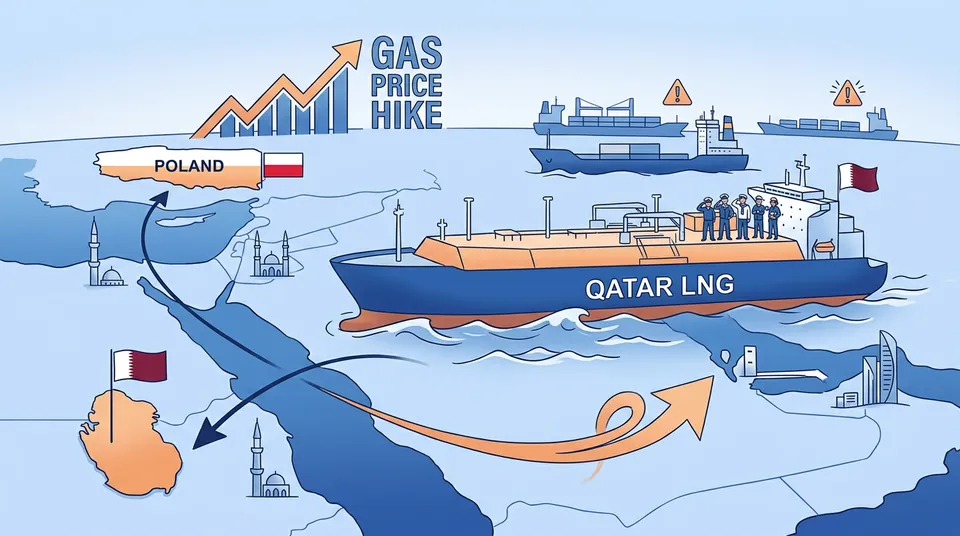
A Qatari LNG tanker bound for Poland is moving north through the Red Sea, a route normally avoided because of Houthi threats. The shipment speeds delivery compared with the usual Cape of Good Hope detour, which can add almost two weeks.
European storage sites were reported 74% full this week, compared with over 86% at the same time last year and across the past five years.1
LNG flows remain more than 75% below their levels before the Iran war.1
The usual Cape of Good Hope detour can add almost two weeks to a one-way trip to Europe.2
Story
Qatari LNG cargo takes rare Red Sea route, cutting delivery time by up to two weeksA Qatari LNG tanker loaded in August is now travelling north in the Red Sea toward Poland, a route described as rare because of security concerns.1 Bloomberg’s vessel‑tracking data identified Poland as the intended destination, confirming the cargo’s European endpoint.12 The cargo is part of a term contract that QatarEnergy holds with Poland’s Orlen, alongside other European buyers.12 The shipment’s significance stems from the fact that most LNG carriers avoid the Red Sea, preferring the longer Cape of Good Hope passage.2 With European gas storage at just 74% of capacity, the expedited delivery helps mitigate price spikes that have reached four‑year highs.1 Analysts note that such rare Red Sea passages can temporarily ease supply tightness for countries like Poland that depend on LNG imports.1
Transit through the Red Sea shortens the journey by nearly two weeks compared with the Cape of Good Hope route, making the shipment valuable for European markets.12 This time saving is especially important because European gas inventories are only 74% full this week, well below the 86% level of the same period in prior years.1 Low storage levels have pushed gas prices to four‑year highs, increasing the incentive to expedite deliveries.1 Consequently, the cargo proceeds despite heightened security risks in the Red Sea and Bab el‑Mandeb Strait.1 The reduced inventory also means that any delay in shipments would exacerbate price volatility, making speed a critical factor for market stability.1
Security threats in the region have intensified, illustrated by a recent incident where a skiff fired at an LNG tanker southeast of Al Mukalla and the vessel’s security team returned fire.2 UK Maritime Trade Operations confirmed the encounter but provided no further details, noting that the Poland‑bound carrier was the only LNG tanker in the area at the time.2 The tanker continued its voyage after the skirmish, indicating that risk mitigation measures are in place for such high‑value cargoes.2 QatarEnergy did not comment on the incident or the Red Sea transit.2
Since the onset of the Iran‑related conflict, the Strait of Hormuz has been closed, and drone attacks have damaged Qatar’s Ras Laffan liquefaction complex, the world’s largest facility of its kind.1 QatarEnergy has responded by extending force majeure on deliveries each month since early March.1 These force‑majeure extensions, announced each month since March, reflect QatarEnergy’s ongoing challenges in maintaining consistent output amid repeated attacks.1 These disruptions have kept global LNG flows more than 75% below pre‑conflict levels.1 Even limited transits through Hormuz by some Qatari and UAE cargoes have been insufficient to shift the global LNG balance.1
The current shipment therefore represents a notable deviation from the prevailing pattern of dark‑mode, untracked voyages through Hormuz.1 By choosing the Red Sea, the carrier avoids the need for darkness‑only navigation and gains a clearer tracking profile.1 Because the vessel is sailing in daylight through the Red Sea, satellite monitoring can confirm its position, contrasting with the opaque dark‑mode routes through Hormuz.1 This visibility aids analysts in estimating flows and supply balances more accurately.1 Nevertheless, the overall contribution of such shipments to global LNG supply remains modest.1
European gas reserves are currently at their lowest seasonal level in over a decade, heightening concerns about price volatility as winter approaches.2 The scarcity of gas amplifies the strategic importance of any additional supply, even if the volume is limited.1 Poland’s reliance on the cargo underscores the broader European dependence on imported LNG amid constrained domestic production.12 Poland’s Orlen has historically relied on diversified LNG sources, and this shipment reinforces its strategy to secure energy amid regional supply disruptions.12 The shipment’s arrival could modestly improve Poland’s inventory position ahead of the heating season.1
The Red Sea route’s rarity is highlighted by the fact that most commercial vessels now prefer the Cape of Good Hope detour to avoid conflict zones.2 Choosing the Cape of Good Hope route typically extends a voyage by roughly fourteen days and raises transportation expenses, which highlights the economic importance of the present Red Sea passage despite security concerns.12 The decision to accept those risks reflects a calculation that the benefits of faster delivery outweigh the potential security costs.1 Analysts will monitor whether this precedent encourages more Red Sea transits as European gas demand remains elevated.1
In summary, a single Qatari LNG tanker is navigating a hazardous but shorter Red Sea corridor to supply Poland, cutting delivery time by up to two weeks.1 The move occurs against a backdrop of reduced global LNG flows, low European storage, and heightened security threats in the Red Sea and Hormuz.12 While the cargo’s volume will not shift the global balance, its timely arrival may ease short‑term supply pressures in Europe.12 Future shipments will depend on the evolving security environment and the ability of QatarEnergy to maintain output despite ongoing force majeure extensions.12
History
How it came to this- AugustCargo loaded in QatarThe tanker loaded LNG in Qatar before heading toward Poland.
- Early MarchQatarEnergy announced force majeureThe company first announced force majeure on deliveries and has extended it each month since.
- After Ras Laffan was hit in MarchOrlen shipments under its QatarEnergy contract were canceledThe plant was hit by drone strikes, affecting shipments under the long-term supply deal.
- MondayVessel-tracking data indicated Poland as the destinationBloomberg’s compiled tracking data showed the tanker moving north through the Red Sea toward Poland.
- Now74% European gas storage level as the Qatari cargo takes the Red Sea route
Impact
Spreading outward, level by level- Level 1Transit time
The Red Sea passage avoids the Cape of Good Hope detour, which can add almost two weeks to a one-way journey to Europe.12
Fact - Level 2European storage
Storage sites were 74% full this week, compared with over 86% for the same period last year and the past five years.1
Fact - Level 3Security exposure
The cargo is using a route described as dangerous amid Houthi threats to vessels in the southern Red Sea and Bab el-Mandeb Strait; a separate report describes a skiff firing at an unnamed LNG tanker in the Gulf of Aden.12
Fact - Level 4Wider LNG supply
The single cargo may help with timely European delivery, but the available facts do not establish that it changes the broader supply balance; LNG flows remain over 75% below pre-war levels.
Analysis
Sources
What each source supportsWritten by AI from the sources listed below: every fact was checked word for word against its source, and inference is marked apart. How we write