

TSMC Explores Equipment Alternatives as Taiwan Targets 50 Percent Rare-Earth Self-Sufficiency
In response to Chinese export licensing rules on critical minerals, TSMC is assessing machinery with fewer rare earths to protect advanced chip lines. Meanwhile, Taiwan is backing research to supply half its domestic demand within three years.
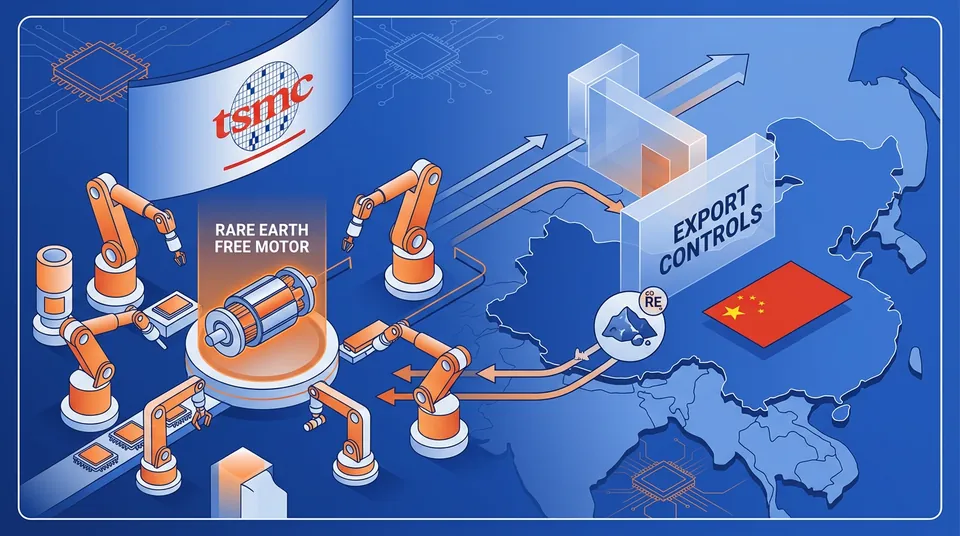
People familiar with the matter revealed that TSMC is looking into alternatives to rare-earth components in factory machinery.1
An upcoming pilot production line is projected to fulfill half of Taiwan's domestic rare-earth demand.2
Insiders reported that initial discussions have not resulted in a broad rollout of rare-earth-free equipment.1
Story
TSMC Explores Rare-Earth Substitutes to Safeguard Advanced ChipmakingTaiwan Semiconductor Manufacturing Company has started investigating possible alternatives to rare-earth components utilized across its factory equipment, according to accounts from three people familiar with the matter.1 A report from Reuters disclosed that the chipmaker is specifically evaluating production hardware configured to run with a decreased volume of these critical mineral inputs.3 The primary motivation behind this technical reassessment is to limit operational exposure to potential delivery interruptions that might stem from Chinese export policies.13 By examining machinery that circumvents or reduces these restricted materials, the company intends to lower the probability of operational stoppages at its manufacturing plants.1 These manufacturing facilities are responsible for producing the most technologically advanced semiconductor chips anywhere in the world.1
The operational review was triggered by regulatory trade restrictions that Beijing implemented during the previous calendar year.1 Under those regulatory changes, Chinese authorities placed selected rare-earth materials, specialized permanent magnets, and associated processing technology under direct export controls.1 The implementation of those administrative controls established a mandatory licensing process for any overseas shipments leaving the country.1 Available evidence supports the understanding that TSMC's initiative to identify rare-earth-free equipment serves as a direct reaction against these export-control restrictions.1 Those restrictive export mandates created immediate concerns that international access to vital fabrication hardware components could be compromised or cut off.1
The core vulnerability for advanced semiconductor fabrication plants arises from the heavy reliance on rare-earth magnets inside critical manufacturing machinery.1 Industrial motors regularly incorporate these powerful magnets to provide driving torque for moving mechanical parts throughout sophisticated processing equipment.1 Facilities run by TSMC feature an exceptionally high degree of cleanroom automation that depends continuously on these motorized components to handle delicate production stages.1 Because these automated machines require specialized magnetic assemblies to operate, disruptions in the supply of rare earths pose a structural hazard to daily factory functions.1 This engineering dependency explains why internal evaluations are focused specifically on identifying alternative machinery designs that eliminate or minimize rare-earth elements.13
Cleanrooms that fabricate leading-edge microchips rely on uninterrupted operations to maintain precise manufacturing cycles for global clients.1 Supported findings indicate that the threat to critical component supply lines directly jeopardizes operations inside these premier wafer manufacturing plants.1 Because Beijing's licensing measures encompass both raw materials and related processing techniques, securing replacements across all mechanical subsystems presents a significant technical challenge.1 Corporate planners were driven to act primarily by growing anxiety over potential logistical bottlenecks originating from China.1 Ensuring that fabrication machinery can continue running without rare-earth components has therefore become an essential operational priority for insulating factories against external disruptions.1
A failure to secure these specialized machinery parts could send destabilizing shockwaves through multiple high-technology industries that depend on advanced microprocessors.1 A shortage of such customized equipment hardware threatens to halt or delay chip deliveries across global client ecosystems.1 Among the commercial sectors vulnerable to production interruptions are smartphone manufacturers and the developers of complex artificial intelligence systems.1 Large-scale data center infrastructure and critical defense procurement pipelines also rely directly on these advanced semiconductor manufacturing runs.1 The risk of widespread disruption across consumer, enterprise, and military hardware reinforces the necessity of safeguarding manufacturing continuity at these advanced facilities.1
Although TSMC is actively assessing possible alternatives, these technical investigations remain in their preliminary phase.1 Two individuals with direct knowledge of the matter confirmed that current discussions have not led to a widespread deployment of rare-earth-free equipment across production plants.1 Transitioning factory equipment away from established magnetic components requires exhaustive testing to ensure automated machinery preserves required precision.1 When questioned about these prospective equipment adjustments and supplier discussions, TSMC declined to comment on the matter.2 Consequently, the chipmaker's exploration of non-rare-earth equipment remains an internal technical evaluation rather than an active, plant-wide standard.13
In tandem with corporate evaluations, the Taiwanese government has launched institutional measures to safeguard access to vital materials and technologies.2 Taiwan's Economy Minister, Kung Ming-hsin, announced that the government intends to back the Industrial Technology Research Institute in creating new rare-earth technologies.2 The research body, widely known as ITRI, verified that it is actively collaborating with the economic ministry's Department of Industrial Technology to map out a dedicated rare-earth project.2 Kung stated that this state-backed program is scheduled to establish a pilot production facility within a three-year development window.2 This initiative is designed to create domestic technical capacity that shields local industrial operations from geopolitical supply vulnerabilities.12
Government projections estimate that the planned pilot production facility could ultimately satisfy 50 percent of the island's domestic rare-earth requirements.2 Reaching this 50 percent milestone within three years would significantly alter Taiwan's reliance on foreign processing infrastructure for critical mineral elements.2 Such self-reliance targets respond directly to trade policies enacted last year, when China imposed strict licensing requirements on materials, magnets, and processing techniques.12 By pairing state-guided research under ITRI and the Ministry of Economic Affairs, the initiative seeks to establish an independent domestic supply buffer.2 This government effort complements factory-level steps by manufacturers seeking to minimize the impact of external trade controls on chip production.123
The push to build resilience against mineral export restrictions extends beyond domestic Taiwanese programs to encompass international partnerships.2 In June, the director of the American Institute in Taiwan, Raymond F. Greene, stated that the United States is working alongside Taiwan and other partner nations.2 Greene emphasized that these coordinated efforts seek to build alternative supply sources, expand regional processing capacity, and construct more durable supply chains.2 According to an observer at a United States-based think tank, American officials have taken a distinct interest in the research spearheaded by ITRI.2 Those officials have held direct discussions with the institute focused on creating diversified supply lines for essential critical minerals.2
Direct engagement between United States representatives and ITRI reflects shared strategic priorities regarding mineral diversification across allied industrial sectors.2 These international consultations complement Taiwan's domestic plan to meet 50 percent of its mineral needs through the state-supported three-year pilot line.2 Supported analysis underscores that TSMC's private search for machinery with fewer rare earths was prompted directly by China's export-licensing restrictions.13 Even as TSMC declines to publicly discuss its equipment reviews, collaborative governmental and commercial efforts to mitigate trade vulnerabilities continue to accelerate.2 Protecting the production lines of the world's most advanced microchips remains essential for preventing cascading shortages across smartphone, artificial intelligence, enterprise data center, and military defense networks.1
Structure
Who is connected to whom- 1TSMC
- ← customer ofFact
- supplies →Fact
- ← competes withFact
- ← agreement withFact
- uses →Fact
History
How it came to this- Last yearChina introduces export controls on rare earthsBeijing imposed export controls requiring licenses for specific rare-earth materials, magnets, and processing technology.
- JuneUS and Taiwan pursue supply chain resilienceThe American Institute in Taiwan director stated that the United States is collaborating with Taiwan and partners to expand mineral processing and supply sources.
- Now50 % Estimated share of Taiwan's domestic rare-earth demand a planned pilot production line could meet
Impact
Spreading outward, level by level- Level 1TSMC manufacturing equipment
TSMC has begun evaluating factory machinery that uses fewer or no rare-earth parts to protect operations at its leading-edge fabrication facilities.13
Fact - Level 2Global technology and defense supply chains
A lack of specialized magnetic motor components could interrupt advanced chip manufacturing for smartphones, artificial intelligence systems, data centers, and defense hardware.1
Fact - Level 3Taiwan domestic mineral capacity
Taiwan's economic ministry and ITRI are planning a rare-earth project to establish a pilot production line aimed at meeting an estimated 50 % of domestic demand within three years.2
Fact - Level 4Allied critical mineral strategy
Joint initiatives between the United States and Taiwan to expand mineral processing and develop alternative supply lines aim to protect advanced semiconductor manufacturing from external trade restrictions.
Analysis
Sources
What each source supportsWritten by AI from the sources listed below: every fact was checked word for word against its source, and inference is marked apart. How we write