

Nurse killed, health worker severely injured in attack on Ebola response in eastern Congo
The attack happened in Bafwasende while the workers were responding to an Ebola alert, the World Health Organization said. It comes amid reported resistance to outbreak measures and an outbreak now recorded across four African countries.
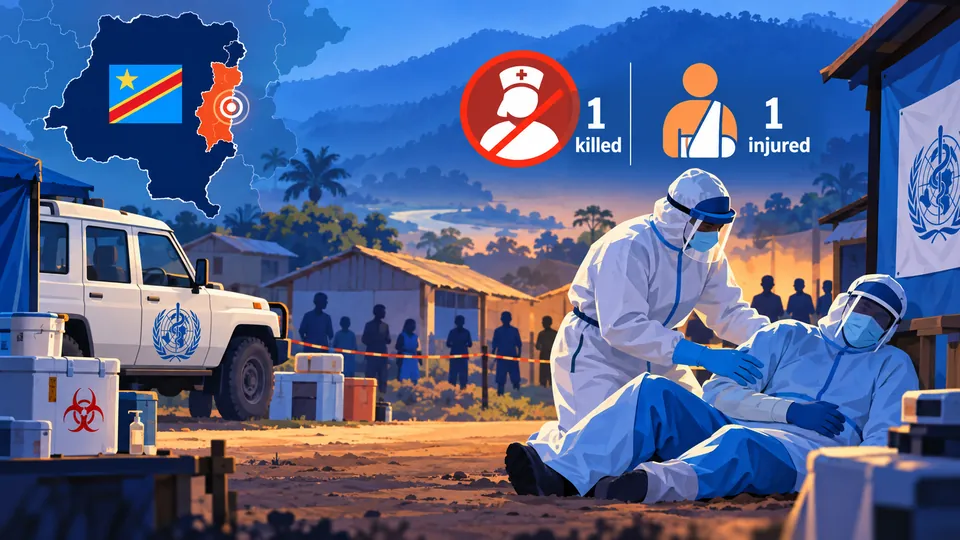
The attack happened in Bafwasende, in eastern Tshopo province.1
The outbreak has been reported across four countries in eastern, central and western Africa.1
Uganda announced a 21-day quarantine for returning citizens with a history of travel to the DRC.1
Story
An attack on Ebola responders in BafwasendeA nurse was killed and another health worker was severely injured while the pair were responding to an Ebola alert in the Democratic Republic of the Congo, according to the World Health Organization.1 The assault occurred on Saturday in Bafwasende, a town in eastern Tshopo province, Tedros Adhanom Ghebreyesus said.1 The reported toll is limited to those two workers: one death and one severe injury; the account does not provide further details about their identities or the circumstances of the attack.1 The incident took place during a response to an alert, rather than being described as an attack on a treatment centre or a general outbreak announcement.1
Tedros disclosed the attack in a post on X on Sunday, the day after it took place, according to the report.1 The account identifies him as the World Health Organization’s director-general and attributes the location and timing to his post.1 The WHO’s regional director for Africa, Dr Mohamed Yakub Janabi, also condemned the violence in a post on X.1 The available account says that Janabi condemned the attack, but does not supply his wording or describe any additional action he announced.1
The attack sits within a record of other reported hostility toward Ebola-related work in the Democratic Republic of the Congo.1 Last month, a politician in North Kivu was beaten to death after publicly backing the government’s response to Ebola.1 In May, residents set fire to two tents at health centres in separate attacks that occurred within one week.1 Responders have also reported that team members were held against their will or threatened in areas designated for health work.1
The reports describe different forms of resistance: a fatal beating of a public supporter, fires at health-centre tents, threats or confinement of response teams, and the assault on the workers in Bafwasende.1 They also refer to different places and time frames, including North Kivu last month, two health centres in May, and Bafwasende on Saturday.1 The account does not establish that the incidents involved the same people or shared a single cause.1 It does show that the Bafwasende assault was not the only reported instance of hostility toward people or facilities connected with the response.1
The outbreak is now reported in four countries across eastern, central and western Africa, a geographic reach described as the widest for any Ebola outbreak on the continent to date.1 That description concerns the spread across countries and regions; it does not give a total number of infections or deaths.1 The report names Kenya and Nigeria as places where people who had recently travelled through Uganda later tested positive.1 It does not identify those two people as the full number of cases in either country, or specify their travel dates.1
Uganda’s health minister, Chris Baryomunsi, announced that citizens returning from the Democratic Republic of the Congo with a history of travel there would be quarantined for 21 days.1 That measure applies to returning citizens matching the stated travel condition, rather than being described as a quarantine for every traveller.1 Uganda says it has no current Ebola outbreak, having declared its latest outbreak over in July.1 The reported positive tests in Kenya and Nigeria followed recent passage through Uganda, while the account does not say that those people were infected there.1
The stated quarantine period is 21 days, and the WHO says Ebola symptoms may take as long as that period to appear.1 These are two matching durations, but the report does not explain the minister’s reasoning or claim that the quarantine announcement was prompted by the later positive tests.1 Ebola is transmitted through direct contact with bodily fluids from infected people, according to the report.1 The report gives this transmission route alongside the symptom window; it does not provide a further account of how the Bafwasende workers were exposed.1
The strain named in connection with the current outbreak is Bundibugyo, for which there is no approved vaccine or specific treatment.1 The report identifies this as a limitation on available prevention and treatment options for this strain, without describing other forms of care.1 Separately, authorities adopted an approach centred on villages, but residents resisted it, with some dismissing Ebola as a hoax.2 The account links distrust of the government to earlier outbreaks and persistent corruption, while not assigning those views to every resident.2
Supported: the reporting backs the conclusion that attacks on health workers, including the killing and severe injury in this incident, deepen community distrust and obstruct attempts to bring the outbreak under control.1 That conclusion connects the harm to workers with the wider difficulties described in communities, including resistance to the village-centred approach and threats against response teams.12 The account presents the Bafwasende attack, the wider geographic spread and the reported distrust as parts of the current response setting, but does not quantify how much any one factor affects transmission.12 The established details are the workers’ reported injuries, the Saturday attack in Tshopo, the officials’ public responses, and the separate outbreak and resistance facts described above.12
History
How it came to this- MayHealth-centre tents set alightResidents set fire to tents at health centres in two separate incidents within one week.
- Last monthPolitician killed after supporting Ebola responseA politician in North Kivu was beaten to death after publicly defending the government’s Ebola response.
- SaturdayAttack in BafwasendeA nurse was killed and another health worker severely injured while responding to an Ebola alert.
- SundayWHO director-general reports the attackTedros Adhanom Ghebreyesus posted about the incident on X.
- NowA nurse killed Nurse killed while responding to Ebola alert
Impact
Spreading outward, level by level- Level 1Health response workers
The attack killed a nurse and severely injured another health worker responding to an Ebola alert.1
Fact - Level 2Community response
The village-centred approach faced resistance, and responders have reported threats or confinement of team members. The attack adds to the reported hostility toward response work.12
Fact - Level 3Outbreak control
Reporting supports the assessment that attacks on health workers deepen distrust and hinder efforts to control the outbreak, though it does not quantify the effect of this incident.1
Fact - Level 4Regional setting
The outbreak has been reported in four countries across eastern, central and western Africa, making safe and effective response work consequential beyond the attack’s immediate location.
Analysis
Sources
What each source supportsWritten by AI from the sources listed below: every fact was checked word for word against its source, and inference is marked apart. How we write