

Google launches Universal Cart, letting U.S. users shop in Search and Gemini
The feature began rolling out in the U.S. on October 15, drawing on Google’s product data and connecting multiple retailers. Shopping discovery and tracking are consolidated in Google’s interface, but each merchant still handles payment separately.
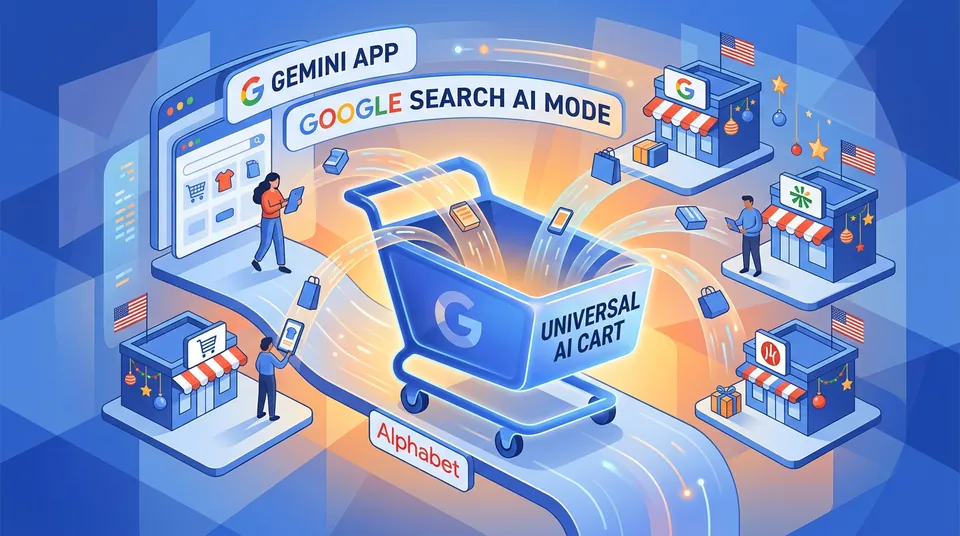
Universal Cart uses more than 60 billion product listings from the continuously updated Google Shopping Graph.1
Walmart ranked No. 2 in Digital Commerce 360's ranking of North American online retailers by annual web sales.1
Suresh Ganapathy said Universal Cart began rolling out in Google Search and the Gemini app in the United States on October 15.1
Story
Shopping comes together; transactions remain separateGoogle has made its AI-powered Universal Cart available to shoppers ahead of the 2026 holiday shopping season.1 Suresh Ganapathy said the feature began rolling out in the U.S. on October 15 in Google Search and the Gemini app.1 It brings product discovery and tracking across multiple stores into Google’s interface, but does not combine products from different merchants into a single payment.25 So a consolidated interface does not amount to unified checkout; each retailer continues to process transactions independently.2
The service was first unveiled at Google I/O in May and has since begun opening up to consumers.1 Merchants supporting the feature include Ulta Beauty, Walmart, Wayfair, some Shopify merchants and Newegg.1 It relies on more than 60 billion continuously updated product listings in Google’s Shopping Graph.1 This information forms the basis for product discovery; available information does not specify how many distinct products or merchants that volume of product data represents.1
Participating merchants hold different positions in the ranking of North American online retailers by annual web sales.1 Walmart ranks No. 2, Wayfair No. 11, Ulta Beauty No. 37 and Newegg No. 86.1 The rankings come from Digital Commerce 360’s Top 1000 Database and are based on annual web sales.1 These rankings show the retailers’ relative positions in that database, not Universal Cart usage or transaction volume.1
The cart system operates under a universal commerce protocol, allowing consumers to complete transactions through Google Pay or send products to a cart on a merchant’s website.2 Purchases must be initiated within Google, rather than first being started on an individual merchant’s website.2 Even when products come from different stores, they are not thereby combined into a single payment transaction.5 When selecting products across stores, the system can also identify compatibility issues between products before checkout.5
The shopping feature also alerts users if saved products have fallen in price or come back in stock.4 It can also help users choose a payment method that makes better use of their credit card benefits.4 These capabilities focus on saved products, inventory changes and payment choices; the available information does not specify how often alerts are sent or how much users actually save.4 The feature can help users address compatibility between products from different stores before placing an order, but merchants’ payment processes still operate separately.25
Earlier that year, Google released an open standard designed to let retailers and AI agents work together on shopping and checkout.4 The standard concerns coordination in shopping and checkout, while Universal Cart uses a protocol to support the purchasing process.24 Shopify is encouraging AI agents to access product data on its platform and exploring ways for those agents to participate in commercial transactions.5 In May, Karen Webster said Universal Cart combines the capabilities of Google Wallet, Google Pay and Gemini, putting Google at the forefront of agentic transactions.3
Google plans to bring Universal Cart to YouTube and Gmail in the future, but has not announced a launch date.5 Those services are therefore future plans and should not be confused with the Search and Gemini features that have begun rolling out in the U.S.15 Meta is highlighting the shopping assistance capabilities of its newly launched AI agent, Muse.2 Amazon and OpenAI have also brought agentic commerce features to chatbots, showing that Google is not alone in advancing these kinds of shopping tools.4
The industry assessment supported by the information is that large digital platforms and online retail platforms are both developing or enabling AI-powered agentic shopping tools.1 This assessment summarizes the participation of platforms and retailers; it does not mean that all products use the same transaction structure.12 Another report by Gladstone AI said that, among researchers surveyed at Anthropic, OpenAI and DeepMind, most believed recursive self-improvement could begin within 3 to 12 months.7 The report describes researchers’ views on AI development, not Universal Cart’s shopping features or rollout plans.17
Chartbeat data show that traffic to news publishers’ websites from Google fell 40 percent between July 2025 and July 2026.8 In August, the French daily newspaper association Apig alerted France’s competition authority, saying Google’s AI summaries violated a 2022 agreement with news publishers.8 This information concerns Google’s traffic and agreement relationships with news publishers, a separate issue from Universal Cart’s product transaction process.28 In the broader context, Google is expanding AI-assisted shopping entry points while also facing disputes over search traffic and agreements on news content.18
Structure
Who is connected to whom- 1Alphabet
- invests in →Fact
- uses →Fact
- partners with →Fact
- agreement with →Fact
- produces →Fact
History
How it came to this- Earlier that yearGoogle launches the Universal Commerce ProtocolThe open standard is designed to help retailers work with AI agents on shopping and checkout.
- MayUniversal Cart is first unveiledThe feature was first previewed at Google I/O.
- October 15Universal Cart begins rolling out in the United StatesThe feature rolls out to users in the United States through Google Search and the Gemini app.
- NowOctober 15 Universal Cart launch date in Google Search and the Gemini app in the United States
- Future, date not announcedGoogle plans to integrate Universal Cart with YouTube and Gmail, but has not announced a launch date.
Impact
Spreading outward, level by level- Level 1Shopping entry point
Users can discover and track products from multiple stores in Google's interface; purchases must be initiated from within Google.2
Fact - Level 2Transaction processing
Users can complete purchases through Google Pay or transfer items to a retailer's website cart; items from different merchants are not combined into a single payment, and each retailer continues to process transactions separately.25
Fact - Level 3Product and payment assistance before ordering
The system can alert users when saved products drop in price or come back in stock, help them choose a payment method that maximizes credit card rewards, and identify compatibility issues between products from different stores before checkout.45
Fact - Level 4Competitive landscape
Other companies are also developing AI shopping assistance or agentic commerce features, showing that these tools are not unique to Google; the information does not indicate that these products use the same transaction structure.124
Fact
Ahead
Checked automatically when due; the result goes to the track recordGoogle plans to integrate Universal Cart with YouTube and Gmail, but has not announced a launch date.
Sources
What each source supportsWritten by AI from the sources listed below: every fact was checked word for word against its source, and inference is marked apart. How we write