

WHO plans Ebola vaccine trial in DR Congo by end of October amid outbreak exceeding 9,000 cases
The trial is intended to test whether a vaccine approved for one Ebola strain can protect against the Bundibugyo strain driving the outbreak. The WHO has also described other vaccine candidates, persistent obstacles to research and separate public-health concerns in Russia and mental-health care.
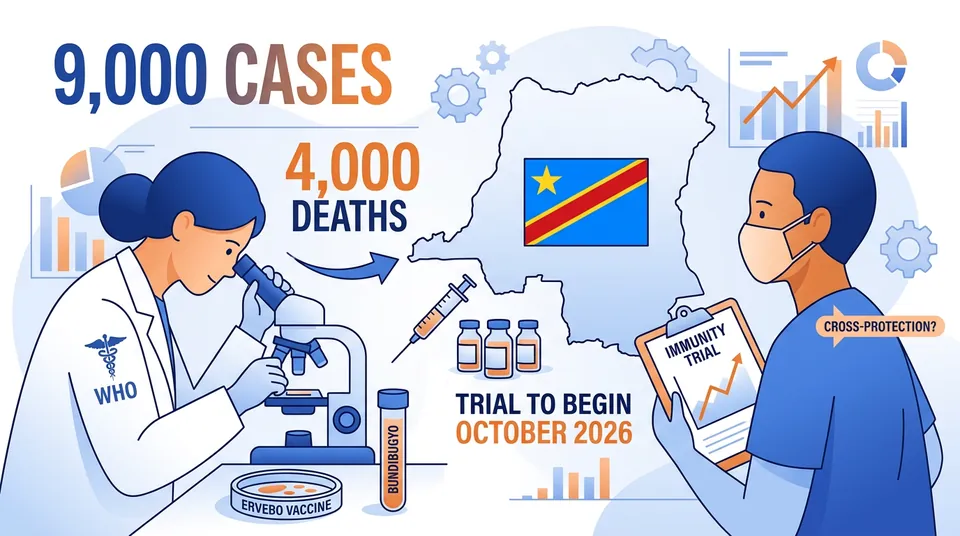
The DRC outbreak has passed 9,000 cases.1
The DRC outbreak has passed 4,000 deaths.1
Anthony Scott said the trial should begin before October ends, citing strong reassurances.1
Story
A trial to close an evidence gapThe World Health Organization expects the first Ebola vaccine clinical trial in the Democratic Republic of Congo to begin by the end of October, as the outbreak there has exceeded 9,000 cases and 4,000 deaths.1 The planned study addresses an outbreak caused by the Bundibugyo species, for which no vaccine or treatment has been approved.1 Instead of testing a vaccine already authorized for that strain, the trial will examine whether Ervebo, approved against the Zaire strain, also protects against Bundibugyo.1 That distinction makes the study an effort to establish evidence for cross-protection, not a confirmation that Ervebo is already effective against the current outbreak strain.1 The WHO's expected start date is framed as a target within the month, while the outbreak figures describe the scale of the emergency the research is intended to address.1
Anthony Scott said the trial should get under way before October ends, pointing to strong reassurances about its start.1 The timetable is significant because standardized trial evidence has not yet established whether Ervebo can protect against Bundibugyo.1 The WHO's Strategic Advisory Group of Experts on Immunization, or SAGE, cautioned that signs suggesting possible cross-protection cannot replace evidence produced through standardized vaccine trials.1 Thus, the existence of indications is not the same as a demonstrated result, and the trial is meant to provide a firmer basis for assessing the vaccine.1 Scott said the resulting efficacy data on Ervebo against Bundibugyo disease would be urgently needed and could help shape policy choices.1
The study is called Tumaini and is designed as one trial framework for examining the effectiveness of more than one vaccine.1 That shared structure is intended to accommodate Ervebo as well as candidates developed specifically for Bundibugyo, rather than limiting the programme to the existing vaccine.1 One of those candidates is ChAdOx1, an adenoviral-vector vaccine developed at Oxford.1 The other is a Moderna candidate that uses mRNA technology.1 The framework therefore offers a route for testing the Zaire-approved vaccine and, potentially, later candidates aimed at Bundibugyo within the same overall trial design.1
Before the Oxford and Moderna products can be considered for the larger trial, a WHO technical advisory group is due to examine evidence from small-scale studies of those candidates.1 Scott welcomed the faster development of vaccines designed specifically for Bundibugyo, alongside Tumaini's planned examination of Ervebo.1 O'Brien said the Oxford candidate could be added to Tumaini quickly if initial findings on safety and immunogenicity were positive and reassuring and doses were available.1 O'Brien also said at least two products were positioned to advance quickly.1 Those statements describe readiness and conditions for moving forward, not confirmed trial entry for either candidate.1
The WHO has identified insecurity and population displacement as practical constraints on the response, according to Scott.1 He said those conditions limit access to care, interfere with surveillance and hold up research, including vaccine studies.1 SAGE has separately voiced deep concern about continuing barriers to bringing the outbreak under control.1 The planned trial therefore sits alongside problems that can affect both health services and the process of gathering evidence.1 Doctors Without Borders is also examining Ervebo's effectiveness among frontline health workers in provinces badly affected by the outbreak, but its project is not a full clinical trial.1
In that Doctors Without Borders study, volunteers are offered Ervebo as an interim measure while researchers examine its effectiveness among frontline workers.1 That setup differs from Tumaini, which is intended as a clinical-trial framework for assessing vaccine efficacy.1 The distinction matters when comparing what the studies can establish: the frontline-worker project is explicitly not a full trial, while Tumaini is designed to test efficacy.1 The available facts do not give a participant count or a numerical estimate of how well Ervebo works against Bundibugyo.1 The scale currently stated for the emergency is the outbreak total, which has passed 9,000 cases and 4,000 deaths, not a count of trial participants.1
In a separate report, the WHO said it did not know what had caused the death of a young worker at a Russian laboratory focused on plague and other illnesses.3 The organization referred to early reports that had not been confirmed and that suggested pneumonic plague in the worker's case.3 Pneumonic plague can pass between people and lead to severe pneumonia, while prompt diagnosis and treatment are associated with high recovery rates.3 The WHO called for the case to be investigated further in its first full Disease Outbreak News report since the incident emerged earlier that month.3 It said that greater confidence in its assessment would require more clinical, epidemiological and laboratory material, including confirmation of the deceased worker's diagnosis.3
Russian health officials said they had carried out more than 5,500 tests and had found no evidence of dangerous pathogenic microorganisms.3 That statement reports the officials' testing and findings; it does not provide confirmation of the deceased worker's diagnosis.3 The WHO also referred to a purported second case that it had earlier connected with British and Serbian tabloid stories based on unspecified reports from Russia.3 Russia denied that a second case existed.3 The WHO's stated need for further information and the disagreement over the alleged second case leave those details distinct from a confirmed diagnosis.3
The WHO has also called on countries to move away from long-term psychiatric hospital care and toward community services that respect people's rights, needs and choices.5 It announced a guide intended to help people leave long-term mental-health institutions and return to community life.5 Director-General Tedros Adhanom Ghebreyesus said ongoing mental-health care should not require people to give up freedom, dignity or their place in society.5 The WHO said around half of people in psychiatric hospitals and social-care institutions stay there without their consent, for periods from months to decades.5 This figure concerns people in those institutions and describes both the share said to remain involuntarily and the wide range of time involved.5
The WHO said that changing mental-health care requires housing, healthcare, social support, education, employment and assistance for families.5 It also said people with direct experience of mental-health services should take part in shaping decisions and policies that affect them.5 Across these separate issues, the WHO's stated actions include building evidence through vaccine trials, seeking further investigation in the Russian laboratory case and supporting a shift in mental-health services.135 The circumstances and measures differ: Tumaini is intended to test vaccine efficacy, the Russian case remains under investigation, and the mental-health guide concerns community reintegration.135 The common thread in the WHO's described work is the need for decisions to draw on trial evidence, case information or the participation of people affected by services.135
Structure
Who is connected to whom- 1World Health Organization
- located in →Fact
- part of →Fact
- partners with →Fact
- operates in →Fact
- serves →Fact
History
How it came to this- By the end of OctoberFirst DRC Ebola vaccine trial expected to beginThe planned trial is to test whether Ervebo provides cross-protection against Bundibugyo.
- Nowby the end of October Expected start of the first Ebola vaccine clinical trial in the DRC
Impact
Spreading outward, level by level- Level 1Evidence on Ervebo
The trial is intended to produce efficacy data on Ervebo against Bundibugyo disease and inform policy decisions; SAGE says indications of possible cross-protection are not a substitute for standardized trial evidence.1
Fact - Level 2Bundibugyo-specific candidates
Tumaini is a shared framework intended to test multiple vaccines, including Bundibugyo-specific candidates from Oxford and Moderna.1
Fact - Level 3Trial delivery
Insecurity and population displacement are restricting care, disrupting surveillance and delaying research, including vaccine trials.1
Fact
Sources
What each source supportsWritten by AI from the sources listed below: every fact was checked word for word against its source, and inference is marked apart. How we write