

Moderna-Merck melanoma vaccine combination cut recurrence-or-death risk by 42%
Late-stage findings indicate that intismeran autogene, given with Keytruda, reduced the risk of melanoma returning or death. The study enrolled 1,137 people whose melanoma had been surgically removed, but its full results have not yet appeared in a peer-reviewed journal.
A total of 1,137 individuals who previously had their melanoma surgically removed participated in the late-stage study.2
Adding the personalized vaccine to Keytruda decreased the likelihood of melanoma spreading by 38%.4
Moderna's share price dropped by 18% following the public disclosure of the clinical trial data on Thursday.7
Story
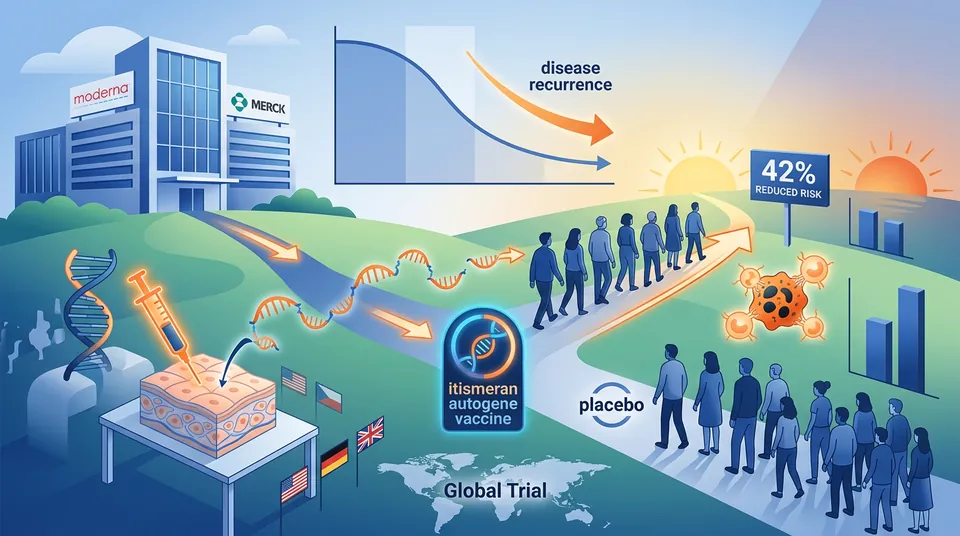
What the melanoma vaccine trial foundModerna and Merck reported that adding the personalized vaccine intismeran to Keytruda was associated with a 42% reduction in the risk of melanoma recurrence or death in a late-stage trial. The comparison was between patients receiving the vaccine alongside Keytruda and patients receiving Keytruda with a placebo, rather than between the combination and no treatment. This makes the reported result a comparison of two treatment approaches built around the same immunotherapy drug. The headline figure concerns recurrence or death together, while a separate reported result addresses cancer spreading.1234 The study findings were announced on Thursday by Moderna and Merck. Coverage said the data were disclosed publicly that day, and the announcement was followed by an 18% fall in Moderna's share price, as reported by The Associated Press. That market movement describes a change in the company's stock, not a measure of whether the treatment worked for patients. The trial's clinical result and the share-price response are distinct developments, even though they followed the same public disclosure.78 The reported two-year figures offer another way to see the difference between the study groups. At that point after treatment began, 82% of those receiving Keytruda with intismeran had not experienced a recurrence, compared with 70% of those receiving Keytruda with a placebo. That difference represents a direct comparison of the reported proportions. These figures describe remaining recurrence-free; they are not the same measure as the 42% reduction in the combined risk of recurrence or death.1234 A further result concerned the likelihood of melanoma spreading. Coverage attributed to the BBC reported that the treatment pairing reduced that likelihood by 38%. This is a separate outcome from both recurrence-free status at two years and the combined recurrence-or-death risk. The three results therefore describe related but nonidentical measures: whether melanoma returns, whether it spreads, and whether recurrence or death occurs. The reported figures should not be treated as interchangeable estimates of one endpoint.14
Intismeran is made using genetic material taken from the individual patient's tumor. The vaccine is designed to direct the immune system toward proteins found on cancer cells, so that it can recognize and destroy those cells if the cancer comes back. Its personalized basis is therefore linked to material from a patient's own tumor, rather than to a vaccine described as identical for every participant. The trial assessed this candidate as an addition to Keytruda, not as a replacement for that drug.123 Keytruda was given to every participant in the study. Merck makes the drug, which is intended to help the immune system act against cancer cells. Because both groups received Keytruda, the comparison isolates the difference between adding intismeran and adding a placebo within the trial's treatment setup. It does not compare Keytruda with no Keytruda, and the reported figures do not describe the vaccine being used alone.238 The trial included 1,137 people whose melanoma had previously been removed through surgery. Of that total, 757 were assigned to receive intismeran, while 380 received a placebo. Those group counts add up to the full enrollment, according to a supported account of the study breakdown. The counts show how participants were divided, not how many experienced recurrence, spread, or death.23 The vaccine group was larger than the placebo group: 757 participants compared with 380. Both groups nevertheless shared Keytruda as their baseline therapy, so the treatment difference described in the findings was the addition of intismeran rather than a difference in whether patients received Keytruda. The 82% and 70% recurrence-free figures are proportions within their respective groups, not raw patient counts. The available facts do not give the number of individual patients behind either percentage.234
The findings were scheduled for presentation on Saturday at an ESMO conference in Madrid. The announcement by Moderna and Merck had come on Thursday, so the public disclosure preceded the planned conference presentation. The complete trial dataset had not been published in a peer-reviewed academic journal at the time described by the reporting. That publication status matters when distinguishing the reported topline findings from a full account of the study's methods and results.58 Investigators plan to continue observing participants over time. One question they intend to assess is whether the treatment is associated with improved survival rates over a longer period. The reported recurrence-free percentages describe outcomes at two years after treatment started, while longer-term survival remains an intended subject of follow-up. The information available here does not state the eventual survival result.46 Reported side effects included soreness or pain where the injection was given, tiredness, and a mild fever. These are the effects identified in the available trial reporting, rather than a complete accounting of every possible adverse event. The facts provided do not give the frequency of each effect or compare their rates between the vaccine and placebo groups. They also do not quantify the balance between these effects and the reported clinical outcomes.6 A separate report identified Tony Hout as having an examination with Dr. Hussein Tawbi at UT MD Anderson Cancer Center in Houston on October 19, 2026. That information describes an examination and names the clinician and institution involved. The available facts do not establish that Hout was a trial participant or connect the examination to the trial results. It therefore provides no basis for drawing conclusions about his treatment or health from the study findings.7
History
How it came to this- ThursdayTrial results announcedModerna and Merck announced late-stage trial findings for intismeran combined with Keytruda, followed by an 18% decline in Moderna shares.
- Now42% Reduction in risk of melanoma recurrence or death with intismeran and Keytruda
- SaturdayThe trial findings are scheduled for presentation at an ESMO conference taking place in Madrid.
Impact
Spreading outward, level by level- Level 1Melanoma recurrence and spread
Combining intismeran with Keytruda reduced the risk of melanoma recurrence or death by 42% and the chance of spreading by 38%, with 82% of combination patients recurrence-free at two years versus 70% on Keytruda with placebo.14
Fact - Level 2Patient tolerability
Trial participants reported adverse effects that included pain or tenderness at the injection site, exhaustion, and mild fever.6
Fact - Level 3Market valuation
Following the public disclosure of the trial results on Thursday, Moderna's stock price fell by 18%.7
Fact - Level 4Long-term therapeutic validation
Because the complete dataset has not yet appeared in a peer-reviewed publication, extended monitoring remains necessary to determine whether the individualized mRNA approach translates into higher overall survival rates.
Analysis
Ahead
Checked automatically when due; the result goes to the track recordThe trial findings are scheduled for presentation at an ESMO conference taking place in Madrid.
Sources
What each source supportsWritten by AI from the sources listed below: every fact was checked word for word against its source, and inference is marked apart. How we write