

North Korea takes landmine accusation to Security Council after blast injures three South Korean soldiers
Pyongyang says Seoul fabricated the explosion and denies responsibility, while South Korea attributes it to North Korean mines. The exchange reaches the Security Council as the two governments also dispute border activity and possible steps to reduce the risk of accidental clashes.
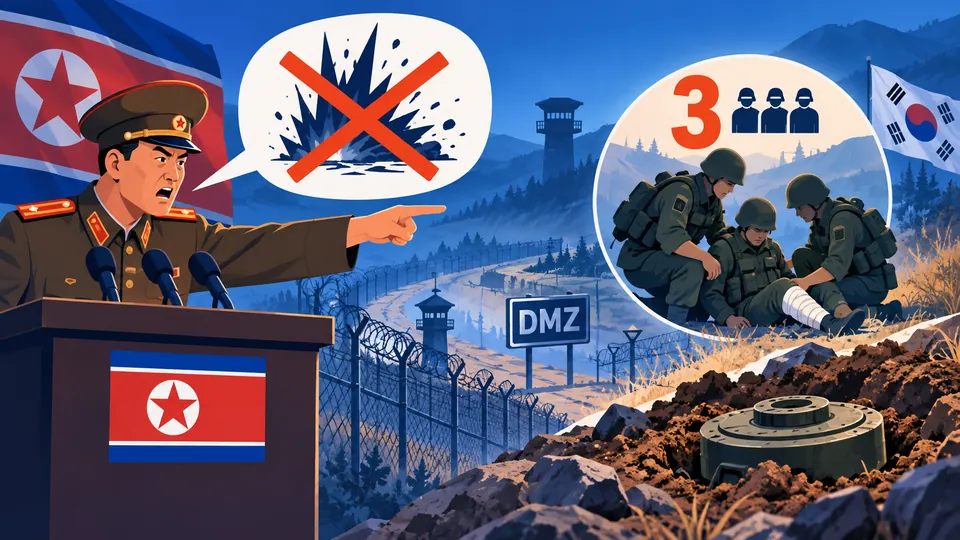
The explosion injured three South Korean soldiers inside the Demilitarised Zone.1
A report placed the explosion on September 21.3
The United States-led UN Command said mine placement violated the Armistice Agreement, signed in 1953.4
Story
A landmine blast becomes an exchange of claims at the UNNorth Korea has brought its denial of responsibility for a landmine blast to the UN Security Council, accusing South Korea of inventing the incident. Three South Korean soldiers were injured in the explosion, which occurred inside the Demilitarised Zone, the buffer between the two countries. South Korea says North Korean mines caused the blast, while North Korea rejects that account. The Security Council letter makes the competing explanations part of an exchange between the two governments at the United Nations.1 The allegations concern not only who caused the explosion but also what military activity near the boundary means. North Korea says Seoul is using the mine claim to depict its border fortification as an invasion and obstruct that work. It calls the South Korean charge a provocation and says blame is being assigned without grounds. These are North Korea's stated arguments in its letter, rather than findings about the blast's cause.1 The factual record provided here identifies injuries and competing accusations, but does not establish which account of the blast is correct. North Korea's representative warned that violations of its sovereignty could lead to self-defence. North Korea also presents its border construction as an exercise permitted under the UN Charter. That framing places the construction and the blast within a wider argument about sovereignty and security.13 North Korea's permanent representative to the United Nations sent the letter to the Security Council. Reports place the communication in late October: one account, dated October 26, said state media reported that the accusation had been sent, while another said the letter went on Sunday and state media announced it on Monday. Those accounts describe the transmission and its public announcement separately. They do not alter the central dispute over responsibility for the explosion.1256
A report specified September 21 as the day of the explosion. The blast was inside the DMZ, where the Military Demarcation Line runs through the buffer separating the Koreas. South Korea says it fires warning shots to make North Korean soldiers return north when they cross that line. The two sides therefore describe military activity around the same boundary in sharply different terms.13 North Korea's letter criticizes South Korea for firing warning shots at troops engaged in fortification work. KCNA said those shots breached Article 2 (4) of the UN Charter, which it described as requiring states to avoid force or threats against territorial integrity. This is North Korea's characterization of the firing, not a neutral determination included in the facts. South Korea, by contrast, says the shots are intended to turn back soldiers who cross the demarcation line.13 North Korean personnel have been constructing tactical roads and fences near the Military Demarcation Line in recent years. North Korea describes its fortification work as lawful under the Charter, while South Korea's account of warning fire connects the work to soldiers' movements across the line. The facts do not specify the extent of the construction or the number of soldiers involved. They show that the boundary activity is part of the dispute, alongside the unresolved account of the mine blast.13 North Korea presents the dispute as an effort by South Korea to avoid responsibility for growing tensions on the peninsula. That is Pyongyang's interpretation of Seoul's allegation and its conduct, not an independently established explanation. The blast injured three people, but the available facts do not state the severity of their injuries. The figure therefore records how many South Korean soldiers were hurt, not the extent of the harm.1
South Korea also sent a letter to the Security Council president during the previous week. Its Foreign Ministry again attributed the explosion to North Korean mines and described it as a breach of the armistice agreement. This places South Korea's account before the Council as well as North Korea's denial and accusation of fabrication. The two submissions offer opposed claims, rather than a shared account of what happened.1 The United States-led UN Command said that placing mines in the area violated the Armistice Agreement. That agreement was signed in 1953 to end hostilities in the Korean War. The UN Command's position is distinct from South Korea's accusation and North Korea's denial, though all concern whether the alleged mines and the blast breached the agreement. The facts provided do not say that the Security Council reached a finding on either claim.14 South Korea proposed military discussions focused on identifying the border's exact location and considering the return of communication channels. Its Defence Ministry also presented the talks as a way to reduce the chance of accidental clashes through clarification of the boundary. The proposal addresses a practical risk alongside the wider political confrontation; that assessment is supported by the stated purpose of the talks, rather than a claim that the risk has been resolved. The facts do not report that North Korea accepted the proposal.15 The proposal followed shortly after Kim Yo Jong said North Korea had repositioned new troop units into firing positions along the border. The timing links the suggested talks to a period of reported military tension, but does not establish that the troop movement caused the proposal. South Korea's stated aim was to clarify the boundary and restore communication channels. Those measures would address contact and border management, not settle the competing accounts of who caused the blast.1
The dispute is taking place alongside other visible military activity near the border. A North Korean 122-mm self-propelled howitzer was seen close to the boundary, in a deployment described as a rare public sighting of artillery of that type. A professor at Kyungnam University in Seoul called the conspicuous display highly unusual. These reports add context to the border tensions, but do not connect the artillery sighting to the landmine explosion.17 The exchange also coincided with events involving North Korea and China. Kim Jong Un arrived in the Chinese border city of Dandong on Saturday before an anniversary, crossing over the New Yalu River Bridge, according to a South Korean government source. Pyongyang and Beijing mark October 25 as the date associated with Chinese troops entering the Korean War on North Korea's side. These details place the border dispute within a period that also carried historical and diplomatic significance for North Korea and China.7 The bridge between Dandong and Sinuiju opened earlier that month after construction lasting more than a decade. It was expected to strengthen economic ties between the two countries. The reported journey across it and the anniversary are separate from the claims exchanged over the DMZ blast. The facts do not state that either event affected the Security Council letters or the proposed military discussions.7 The core question raised by the letters remains responsibility for an explosion that injured three South Korean soldiers. South Korea attributes it to North Korean mines and calls it an armistice violation, while North Korea denies responsibility and says Seoul fabricated the accusation. Alongside that dispute, the governments contest the meaning of construction and troop activity near the boundary, and South Korea has proposed talks on its location and communications. The facts show diplomatic accusations and military activity occurring together, without reporting a resolution of the blast's cause or the talks proposal.1
Structure
Who is connected to whom- 1North Korea
- depends on →Fact
- partners with →Fact
Disagreements
Where the sources do not matchResponsibility for the landmine blast
jowhar.com1
jowhar.com1
Reason: The sources describe opposing claims by the two governments; the supplied facts do not establish which account is correct.
Timing of the UN letter's transmission and announcement
Possibly: These accounts may refer to separate events—the letter's transmission and its public announcement—rather than conflicting dates for the same event.
History
How it came to this- September 21Explosion in the DMZA report dated the blast, which injured South Korean soldiers, to September 21.
- Previous weekSouth Korea wrote to the Security Council presidentSouth Korea again blamed North Korean mines and called the blast an armistice violation.
- Late OctoberNorth Korea's accusation reached the Security CouncilA report dated October 26 said North Korea had sent its accusation, according to state media.
- Shortly after Kim Yo Jong's statementSouth Korea proposed military talksThe proposal addressed the border's precise location and restoring communication channels.
- Nowthree South Korean soldiers injured in the DMZ landmine blast
Impact
Spreading outward, level by level- Level 1Competing accounts of the blast
South Korea attributes the blast to North Korean mines, while North Korea denies responsibility and calls the allegation fabricated. The supplied facts do not resolve the cause.1
Fact - Level 2Diplomatic dispute
Both Koreas have put their positions before the Security Council, making the competing accounts part of a diplomatic exchange.
Analysis - Level 3Border management
South Korea proposed talks to confirm the boundary and discuss restoring communication channels; the proposal addresses a practical risk of accidental clashes as well as the wider confrontation.15
Fact - Level 4Wider military context
The accusations are occurring alongside reported military activity near the border, including a visible artillery deployment.17
Fact
Sources
What each source supportsWritten by AI from the sources listed below: every fact was checked word for word against its source, and inference is marked apart. How we write