

EU defence spending reached €418 billion in 2025, up 20% from 2024
Commissioner Dombrovskis said strengthening Europe’s defence was at the top of the EU agenda. The bloc is pursuing investment, industrial programmes and drone initiatives while also developing security partnerships with Ukraine, Canada and India.
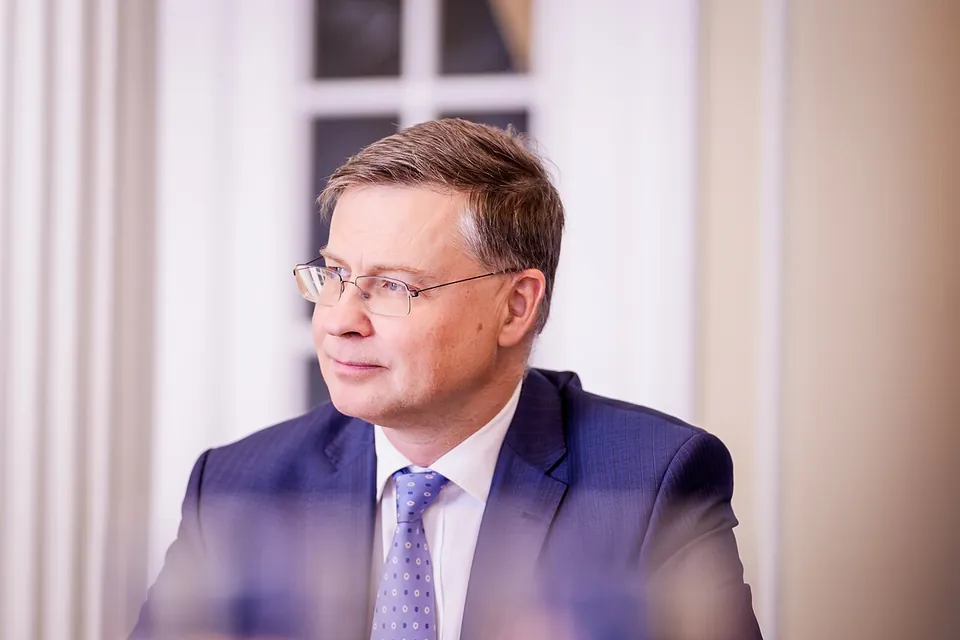
EU Member States’ defence spending in 2025 was 20% higher than in 2024.1
The Defence Readiness Agenda aims to mobilise up to €800 billion in defence investment.1
SAFE finances investment in missile defence, drones and cybersecurity across Europe.1
Story
The EU’s expanding defence agendaDefence spending by the EU’s 27 Member States totalled €418 billion in 2025, 20% more than in 2024.1 The Commission projects that spending by those countries will reach €454 billion in 2026.1 At NATO FUSE 2026, Commissioner Dombrovskis said that strengthening Europe’s defence had become a leading EU priority.1 The spending totals describe Member States’ defence outlays, while the Commission’s separate readiness agenda seeks to mobilise as much as €800 billion in defence investment.1 That investment goal sits alongside the reported annual spending figures, and the Commission has also identified particular instruments and programmes for defence-related work.1
One of those instruments is SAFE, a €150 billion facility financing work in missile defence, drones and cyber security across Europe.1 The European Defence Industry Programme, or EDIP, was set up to update the defence industry, expand its production capacity and protect Europe’s technological position.1 A different programme, the €7.3 billion European Defence Fund, supports companies working on new defence technologies and equipment designed to function across systems.1 These initiatives address different parts of the agenda: SAFE finances specified investment areas, EDIP targets industrial development, and the fund backs company research and development.1 The figures attached to SAFE and the Defence Fund are stated as the size of those instruments, while the €800 billion figure is the amount the readiness agenda seeks to mobilise.1
The Commission has also changed the fiscal framework to give Member States more room in their budgets to mobilise defence investment.1 That adjustment accompanies the EU-wide spending increase reported for 2025 and the further rise projected for 2026.1 The spending total for 2025 covers the EU’s 27 Member States, whereas Latvia’s announced commitment is expressed differently: its defence spending is set to equal 5% of GDP next year.1 The Latvian figure is a share of the country’s economic output, not a euro total comparable in form to the EU-wide amounts.1 Latvian industry and research organizations are also involved in more than thirty cross-border European defence research and development projects.1
Drones and counter-drone systems form another part of the EU’s capability work, which includes joint purchasing and delivery as well as innovation, operational testing and rapid expansion.1 Latvia, Croatia, Denmark, the Netherlands and Spain are leading the Capability Coalition associated with this area.1 DECODER is among the first five European Defence Projects of Common Interest created under EDIP.1 Its purpose is to help European countries develop and deploy drones, while also expanding technologies intended to stop hostile drones.1 The project connects the wider industrial programme with a specific effort to build and use drone and counter-drone capabilities.1
The Commission plans to introduce AGILE early next year as a way to shorten the path from disruptive defence technology development to battlefield use.1 The initiative is intended to help SMEs, startups and scaleups progress from developing technologies to wider market uptake.1 The planned European Drone Technology Hubs have a later stated timetable: the first two are scheduled for establishment in 2027.1 The first site is planned for Latvia’s Selonia military training area and is to cover land and air drone systems, including counter-drone technology.1 The other planned hub, in Scheveningen in the Netherlands, is to work on naval capabilities, seabed security, harbour protection and critical underwater infrastructure.1
The two proposed hubs divide their stated focus between land and air activity at Selonia and maritime and underwater concerns at Scheveningen.1 Both are part of the scheduled first pair of European Drone Technology Hubs, with the 2027 date applying to their planned establishment.1 The Commission’s drone capability work also includes procurement, delivery, testing and efforts to scale up, alongside the hubs’ specified technical areas.1 AGILE is described separately as an initiative to move disruptive technologies toward battlefield use and to assist smaller and newer businesses in reaching the market.1 Together, these announcements identify different stages of the work, from developing technology and testing it to procurement, deployment and commercial uptake.1
Ukraine is another element of the EU’s defence relationships: the Union said it had supplied more than €230 billion in financial support since February 2022.1 The EU aims to sign a Defence Industry Pact with Ukraine by the end of the year.1 The proposed pact is designed to ease the formation of joint companies, the exchange of technology and the incorporation of Ukraine’s defence sector into Europe’s industrial base.1 The reported support figure concerns financial assistance since February 2022, while the pact remains an agreement the EU aims to sign by year’s end.1 The pact’s stated purpose is industrial cooperation and integration; the facts describe it in terms of ventures, technology transfer and links between defence industries.1
The EU is also discussing a closer relationship with Canada, although the proposed label for that relationship remains disputed among EU countries.23 At the Canada-EU summit in Montreal, Commission President Ursula von der Leyen said the sides wanted greater cooperation in AI, climate, energy and security.2 Von der Leyen described the proposed arrangement as an association without accession and said it might come closer to membership than earlier partnerships.3 She also said the EU and Canada continued to consider whether Canada could become the union’s first associate member, a term Germany and other EU countries oppose.2 Canadian Prime Minister Mark Carney said he was not concerned about the associate-member label or other names for the alliance, and emphasized its effect on Canadians’ lives.3
An EU official told AFP that Canada and the EU sought to bring their policies closer on climate, energy and artificial intelligence, potentially allowing Ottawa to join some EU programmes.3 The reported Canadian discussions concern policy alignment and possible participation in some programmes, while the proposed association is not described as accession.3 The EU also has a Security and Defense Partnership with India, signed in January, followed by its first formal Security and Defense Dialogue in March.3 That partnership establishes a framework for closer engagement, but it does not create a joint security commitment.3 The Canada discussions and the India framework therefore have distinct stated forms: one concerns a proposed association and policy alignment, while the other sets out a basis for engagement without a shared security guarantee.23
Structure
Who is connected to whom- 1European Union
- ← partners withFact
- finances →Fact
- ← exports toFact
- uses →Fact
- imports from →Fact
History
How it came to this- 2025Member State spending reaches €418 billionThe EU’s 27 Member States spent €418 billion on defence, 20% more than in 2024.
- 2026Further spending increase projectedThe Commission projects Member State defence spending of €454 billion.
- NATO FUSE 2026Defence set as a leading EU priorityCommissioner Dombrovskis said strengthening Europe’s defence was at the top of the EU agenda.
- Now€418 billion EU Member States’ defence spending in 2025
- Early next yearThe Commission plans to launch AGILE to shorten the route from disruptive defence technology development to battlefield use and help smaller and newer firms reach the market.
Impact
Spreading outward, level by level- Level 1Member State budgets
The Commission introduced flexibility in EU fiscal rules to create room for Member States to mobilise defence investment.1
Fact - Level 2EU investment and industry
The investment agenda combines a mobilisation target with distinct instruments and programmes: SAFE finances specified areas, EDIP is intended to modernise the defence industry and expand capacity, and the European Defence Fund supports companies developing defence technologies and equipment.1
Fact - Level 3Research and capability development
Latvian industry and research organizations participate in more than thirty cross-border European defence R&D projects, while EU drone work includes joint procurement, testing and rapid scale-up.1
Fact - Level 4European defence readiness
The reported spending increase and the separate investment initiatives indicate several routes for strengthening defence readiness; the stated figures describe different measures and should not be treated as one fund.
Analysis
Ahead
Checked automatically when due; the result goes to the track recordThe Commission plans to launch AGILE to shorten the route from disruptive defence technology development to battlefield use and help smaller and newer firms reach the market.
The first two European Drone Technology Hubs are scheduled to be established: one at Latvia’s Selonia military training area and the other in Scheveningen in the Netherlands.
The EU aims to sign its Defence Industry Pact with Ukraine, intended to facilitate joint ventures, technology transfer and integration of Ukraine’s defence industry into Europe’s industrial base.
Sources
What each source supportsWritten by AI from the sources listed below: every fact was checked word for word against its source, and inference is marked apart. How we write