

EU and Canada launch a new alliance alongside a proposed €90 billion Ukraine loan
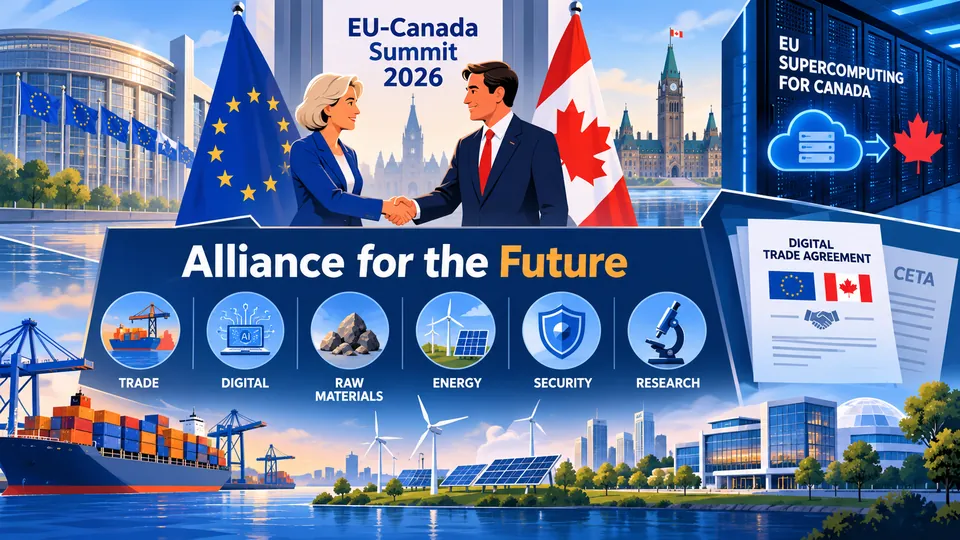
The Montréal summit launched the Alliance for the Future and discussed a closer association that would stop short of EU membership. Canada also said it would take part in the EU’s €90 billion Ukraine Support Loan, with an initial contribution of 500 million euros ($558m).
The EU Ukraine Support Loan is €90 billion, and Canada said it would participate.1
Carney identified 500 million euros as Canada’s initial contribution to the loan.3
Carney said the summit established more than twenty measures for affordability, opportunity and sovereignty.3
Story
A new EU-Canada alliance, and a proposal for closer associationThe European Union and Canada have launched the Alliance for the Future, a shared framework described as supporting growth, prosperity, resilience and economic security.1 At the same summit, the two sides discussed a possible Canadian association with the EU, using an “association without accession” approach rather than full membership.1 The EU’s €90 billion Ukraine Support Loan provides a separate, concrete measure of the summit’s commitments: Canada said it would participate, and Mark Carney identified an initial contribution of 500 million euros ($558m).13 That initial Canadian amount is smaller than the full loan figure; the two numbers describe, respectively, Canada’s stated first contribution and the overall support loan.13 The association proposal is intended to bring Canada substantially closer to the EU than its present relationship, while leaving it outside full EU membership.1
The summit was hosted in Montréal by Canadian Prime Minister Mark Carney, with European Commission President Ursula von der Leyen and European Council President António Costa also taking part.1 The Chinese-language report said the Alliance announcement came after a summit that lasted two days.2 During the meeting, the sides considered closer alignment across policy, programmes and governance as the basis for Canada’s proposed association.1 Von der Leyen presented the proposed relationship as potentially closer to EU membership than any partnership the Union had previously formed.1 She also described the arrangement in terms of more alignment in policy, governance and participation in each other’s programmes.1
The Alliance spans several areas rather than a single trade or security file: its stated coverage includes trade, digital matters, critical raw materials, energy, financial services, security and preparedness.1 The parties also set out a people-to-people dimension, with Horizon Europe and Erasmus+ identified as channels for shared study, work, research and innovation opportunities.1 The EU and Canada concluded negotiations on a Digital Trade Agreement, which is intended to sit alongside and complement their existing free trade agreement, CETA.1 They also agreed to begin negotiations on expanding Ottawa’s participation in Erasmus+, so that programme’s role is both part of the Alliance’s stated ambition and the subject of a further negotiation.13 Together, these items show the range of activity announced or envisaged, but they do not all have the same status: one digital trade negotiation was concluded, while Erasmus+ participation is to be negotiated further.13
The critical-minerals work illustrates another difference in status: the European Commission account said an arrangement for European Investment Bank investment in Canadian resources was still being finalised.1 Al Jazeera, meanwhile, reported an announced agreement for the bank to invest in Canadian critical resources, with particular attention to raw minerals.3 The accounts therefore describe an investment initiative, while the Commission’s description makes clear that its agreement had not yet reached final form in that account.13 A supported reading of the initiative is that it could link European demand for critical minerals with the development of Canadian resources; the same account identifies infrastructure investment as a constraint on starting Canada’s mining industry.12 The Chinese-language report described Canada as having substantial rare earth and critical-mineral resources, while Europe mainly imports such materials from China and Canadian mining development requires major infrastructure investment.2
Technology cooperation includes a plan for Canada to access the EU supercomputer network, intended to support joint research and work on trustworthy artificial intelligence.1 The parties also agreed to deepen cooperation involving satellite connectivity, navigation and artificial intelligence.2 Other areas covered modernised coordination on competition, digital credentials and identity wallets, trust services, and possible collaboration on Galileo, IRIS2, EU GOVSATCOM and Arctic connectivity.1 The Commission account described governance as potentially involving more shared work between the European Commission and the Canadian government, alongside cooperation between parliaments and courts.1 These are described as areas of agreement, planned access or possible cooperation, rather than as one uniform programme with a single implementation status.1
The two sides also connected their partnership to support for Ukraine: Canada said it would join the EU’s €90 billion loan, and Carney stated that its first contribution would be 500 million euros ($558m).13 The supported comparison is that Canada’s stated initial contribution is below the total value of the loan, so the contribution figure should not be read as the size of the entire financing package.1 Carney said the summit had produced more than twenty measures intended to improve affordability, create opportunities and support sovereignty on both sides of the Atlantic.3 The joint statement said sovereignty depends on reliable supplies and systems, naming critical minerals, semiconductors, payment systems, energy, vaccines, communications from space and artificial intelligence.3 The loan contribution is one specific figure among these commitments, while Carney’s count of more than twenty refers to the wider set of measures he said the summit established.3
The proposed association has a political label but no settled legal standing in the material reported: Al Jazeera said the phrase “associate member” lacks a legal basis and faces opposition from some EU countries.3 Germany and several other EU states opposed using that label, and it was omitted from the joint declaration, according to the South China Morning Post.4 The same report separately noted that the disputed wording did not appear in the declaration.4 Carney said Canada and the EU wanted the closest partnership possible without moving to full membership.3 The supported account therefore treats associate-member status as a political ambition, not an established legal category, and distinguishes that ambition from the closer cooperation the proposal seeks.13
The summit took place amid trade threats from US President Donald Trump, which the reports said were leading Washington’s traditional allies to pursue closer connections elsewhere.3 A Chinese-language report also said both Canada and the EU had faced US tariffs and threats from the United States.2 That report noted that Canada had announced a 16亿加元 investment in its artificial-intelligence company Cohere on Thursday.2 Von der Leyen said the EU and Canada were exploring associate-member status and seeking stronger cooperation in artificial intelligence, climate, energy and security.4 Taken together, the reported context places the new alliance alongside trade pressure, resource concerns and efforts to expand cooperation, while the sources do not establish that any one of those factors alone caused the agreements.234
The Alliance for the Future gives the EU and Canada a shared label for work across economic, technological and security-related areas, while the proposed association would add closer policy, programme and governance alignment.1 Some elements are already described as concluded or announced, including the Digital Trade Agreement negotiations and the Alliance launch; others remain proposed, in progress or subject to further talks.13 The distinction matters especially for the association label, which is contested and absent from the joint declaration, and for the minerals investment, which the Commission account said was still being finalised.14 The sources describe a broad agenda and specific commitments, but they do not give a single measure of the Alliance’s total value or a timetable for completing all of its parts.13
Structure
Who is connected to whom- 1European Union
- ← partners withFact
- finances →Fact
- ← exports toFact
- uses →Fact
- imports from →Fact
Disagreements
Where the sources do not matchStatus of the European Investment Bank critical-minerals investment agreement
European Commission Press1
Al Jazeera3
Possibly: The accounts may reflect different stages or descriptions of the initiative; the sources do not explain the difference.
Impact
Spreading outward, level by level- Level 1Alliance scope
The Alliance covers trade, digital matters, critical raw materials, energy, financial services, security and preparedness.1
Fact - Level 2People-to-people cooperation
Horizon Europe and Erasmus+ are identified as channels for cooperation in study, work, research and innovation.1
Fact - Level 3Closer EU–Canada alignment
The proposed association could extend cooperation across policies, programmes and governance, while stopping short of full EU membership.1
Fact - Level 4Wider coordination
The combination of economic, technology, security and political cooperation could make the Alliance a broader coordination framework; this is an interpretation of the announced scope.
Analysis
Sources
What each source supportsWritten by AI from the sources listed below: every fact was checked word for word against its source, and inference is marked apart. How we write