

OCC releases supervisory framework for bank use of Super Intelligence
The Office of the Comptroller of the Currency issued a technology‑neutral framework that guides examiners in assessing AI and agentic AI use. The guidance does not impose new standards but supplements existing risk management practices.
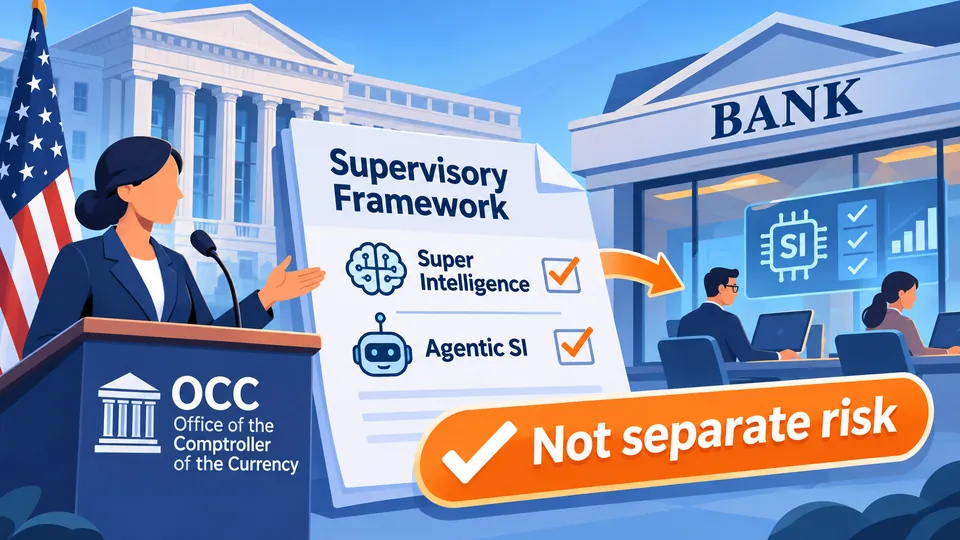
The OCC announced that it had issued the supervisory framework.2
The OCC says banks need not create a distinct risk appetite for Super Intelligence.1
The OCC says it will update the framework as Super Intelligence evolves and stakeholders provide feedback.2
Story
OCC supervisory framework for Super Intelligence in bankingThe OCC announced a supervisory framework that examiners can use to evaluate banks’ deployment of artificial intelligence and agentic AI in routine operations.12 The guidance is not a set of enforceable standards or prescriptive requirements for banks.1 It also does not create a separate risk category for Super Intelligence, nor does it require banks to define a distinct SI risk appetite.1 That distinction matters because the framework gives examiners a way to assess the use of these technologies without establishing a new category of binding rules for banks.1 Banks therefore face examination of AI and agentic AI use in normal business activities, but the framework itself does not prescribe a separate SI risk appetite or enforceable standard.1
Instead, the OCC will apply a technology‑neutral approach that encourages safety, soundness and innovation regardless of the underlying method.1 Examiners are expected to treat activities that use traditional tools and those that employ novel AI technologies alike, consistent with applicable laws and regulations.2 This approach places the focus on how banking activities are conducted, rather than whether a bank relies on traditional methods or emerging technology.12 For banks, the stated aim is to pursue innovation while keeping activities safe and sound and in line with applicable laws and regulations.12 The framework’s technology neutrality also means that novel AI applications are not singled out as exempt from the standards that apply to other banking activities.12
The framework allows examiners to identify Super Intelligence‑specific considerations that complement existing model risk management, governance, technology, compliance and operational‑risk practices.1 These considerations are intended to supplement, not replace, the banks’ current risk controls.1 That structure connects SI review to the risk management areas banks already use, rather than describing it as a replacement for those practices.1 The areas named in the framework span model risk management, governance, technology, compliance and operational risk, giving examiners several existing practices to consider when assessing SI use.1 Banks’ existing practices remain relevant in this approach, while examiners may add considerations specific to Super Intelligence where appropriate.1
The OCC previously highlighted AI as both a risk and an opportunity in its spring 2026 Semiannual Risk Perspective.1 In that earlier communication, the agency recommended that banks strengthen security measures to mitigate AI‑enabled cyber risks.1 The OCC’s earlier framing paired potential risks with potential opportunities, rather than presenting AI solely as a threat.1 Its recommendation on more stringent security measures identifies cyber risk as a practical concern for banks using AI-enabled activity.1 Together, those points show that the agency’s discussion of AI includes both the possible benefits and the security measures it says banks should take to reduce cyber risks.1
The new framework reflects the agency’s view that Super Intelligence and agentic Super Intelligence are novel, rapidly evolving technologies that banks are already deploying across new use cases.2 By framing the guidance as technology‑neutral, the OCC signals that the same supervisory expectations apply whether a bank uses legacy systems or cutting‑edge AI.1 The rapid evolution described by the OCC means the technologies and the ways banks deploy them across use cases are continuing to change.2 That context helps explain why the framework is aimed at examiners assessing bank activities, rather than limiting its attention to a fixed set of AI applications.12 Traditional systems and novel AI applications remain within the same technology-neutral approach, even as banks continue deploying SI and agentic SI across new use cases.12
The OCC indicated that the framework will be updated regularly to incorporate evolutions in Super Intelligence and feedback from stakeholders.2 Regular revisions are intended to keep the guidance aligned with the fast‑moving AI landscape.2 The update plan acknowledges two sources of change: developments in SI and views shared by stakeholders.2 For banks and examiners, regular updates mean the framework is not presented as a document that will remain unchanged as the technology evolves.2 The OCC’s stated plan links future revisions to both technological evolution and stakeholder feedback, without specifying a fixed schedule or particular changes.2
Banks are therefore not required to create a separate risk appetite for Super Intelligence, simplifying their overall risk management structures.1 Instead, they can integrate SI considerations into existing risk frameworks as directed by examiners.1 This means banks do not have to define a distinct SI risk appetite under the framework, while examiners may still consider SI-specific issues alongside established practices.1 The distinction is between creating a separate risk category and using existing risk management areas to address relevant SI considerations.1 For banks, the OCC’s stated approach keeps the existing practices in view without requiring a separate SI risk appetite.1
The OCC’s press release on November 4, 2026, emphasized that the framework is part of a broader effort to ensure safe and sound banking practices while fostering innovation.2 The agency’s stance underscores a balance between regulatory oversight and the encouragement of technological advancement.1 The announcement date identifies when the OCC said it had issued the framework, while its stated principles concern both safe and sound activity and innovation.12 Those principles apply to bank activities whether they rely on traditional methods or novel technologies, according to the OCC’s technology-neutral approach.12 The framework thus places innovation alongside safety and soundness, rather than describing those aims as alternatives.12
Overall, the supervisory framework provides a structured yet flexible tool for examiners to assess AI use without imposing new regulatory burdens, aligning with the OCC’s long‑term vision for responsible innovation in the banking sector.1 Its practical role is to help examiners evaluate AI and agentic AI in normal bank activities and identify considerations that supplement existing risk practices.1 The framework’s limits are also clear: it does not establish enforceable standards or prescriptive requirements, and it does not require a separate SI risk appetite.1 At the same time, technology neutrality does not remove the OCC’s stated expectation that bank activities remain safe and sound and consistent with applicable laws and regulations.12 The result is guidance for examination that brings SI-specific considerations into existing practices while keeping traditional and novel technologies within the same general approach.1
Structure
Who is connected to whom- 1Office of the Comptroller of the Currency
- sanctions →Fact
- ← regulated byFact
- ← agreement withFact
- partners with →Fact
- enables →Fact
History
How it came to this- Spring 2026OCC discusses AI risks and opportunitiesThe agency highlighted AI as both a risk and an opportunity and recommended stronger security measures against AI-enabled cyber risks.
- November 4, 2026OCC announces the frameworkThe OCC announced a framework for examiners reviewing banks’ use of Super Intelligence.
- NowIssued OCC supervisory framework for bank use of Super Intelligence
- Future updatesThe OCC says it will update the framework regularly in response to developments in Super Intelligence and stakeholder feedback; no update date is specified.
Impact
Spreading outward, level by level- Level 1Examiners’ reviews
Examiners may use the framework to assess banks’ AI and agentic AI use in normal business activities.1
Fact - Level 2Existing risk practices
The framework allows SI-specific considerations to supplement established risk management and control practices.1
Fact - Level 3Bank requirements
Banks are not given enforceable standards or prescriptive requirements by this framework, and they are not required to define a separate SI risk appetite.1
Fact - Level 4Technology and innovation
The OCC’s technology-neutral approach may enable banks to pursue novel technologies while remaining subject to its stated safety, soundness, and legal expectations.
Analysis
Ahead
Checked automatically when due; the result goes to the track recordThe OCC says it will update the framework regularly in response to developments in Super Intelligence and stakeholder feedback; no update date is specified.
Sources
What each source supportsWritten by AI from the sources listed below: every fact was checked word for word against its source, and inference is marked apart. How we write