

U.S. Penalizes Bank of America More Than $1.21 Billion Over Anti-Money Laundering and Sanctions Breaches
Federal authorities penalized the nation's second-largest financial institution after extensive screening breakdowns left billions in suspicious transfers unreported. The settlement includes regulatory credits, structural oversight mandates, and an earnings reduction for the bank's third quarter.
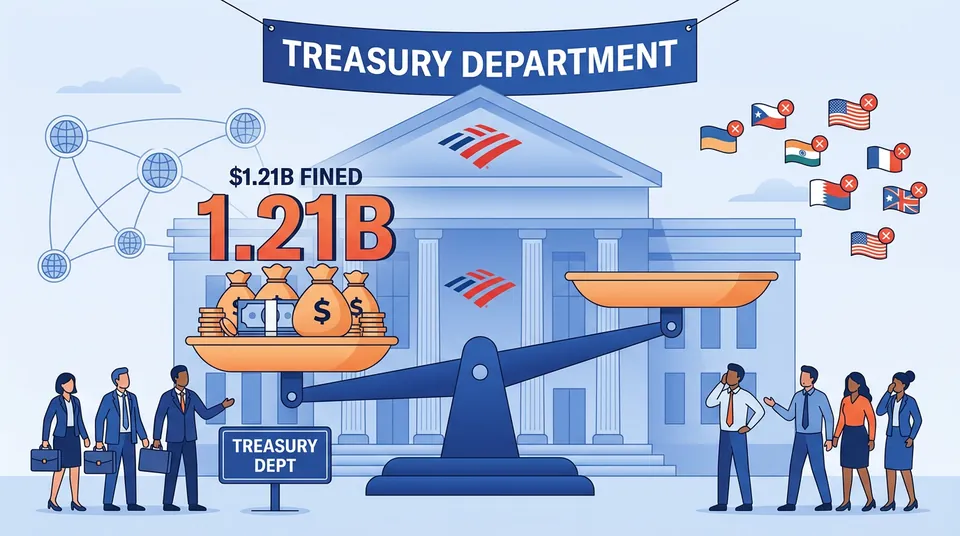
The institution failed to report over $5 billion in suspicious transactions to federal authorities.5
The Office of the Comptroller of the Currency assessed the largest civil money penalty in its history.2
Story
Federal Regulators Fine Bank of America $1.21 Billion for Severe Oversight FailuresThe United States Department of the Treasury has assessed financial sanctions exceeding $1.21 billion against Bank of America.6 These aggregate enforcement penalties penalize extensive lapses involving domestic anti-money laundering controls along with international sanctions statutes.6 The enforcement action directly affects the second-largest banking establishment currently operating inside the United States.2 Within the historical records of the Treasury Department, this $1.2 billion total ranks as the third-largest sum ever levied.4 As part of the government's legal resolution, Bank of America formally conceded that it willfully violated the Bank Secrecy Act of 1970.4
The headline penalty consists of interconnected actions across distinct federal regulatory bodies.6 Specifically, the $1.2 billion Financial Crimes Enforcement Network assessment credits an earlier $750 million fine established by the Office of the Comptroller of the Currency.6 Regulatory documentation supports that this $750 million agency fine does not represent an additive cost but stands as an embedded segment of the broader FinCEN penalty.6 For the Office of the Comptroller of the Currency, that $750 million figure constitutes the largest civil money penalty ever recorded by the bureau.2 In addition to these banking levies, the Treasury's Office of Foreign Assets Control concluded an $11.6 million settlement addressing 475 apparent violations across several sanction programs, spanning illicit activity connected to Russia, Iran, and international terrorism networks.5
Federal investigations revealed extensive operational breakdowns across the bank's internal processing pipelines.57 Supervisory bodies determined that automated monitoring programs maintained by the institution failed to screen trillions of dollars moving across financial conduits.7 Because of these systemic screening deficiencies, the bank neglected to transmit mandatory alerts regarding over $5 billion in suspicious transactions to FinCEN.5 More than $1 billion of those neglected transaction filings involved urgent matters of national security.5 These high-priority security lapses encompassed transfers linked to Chinese Money Laundering Networks as well as unlawful financing schemes along the southwest border of the United States.5
These statutory breaches occurred despite previous regulatory interventions intended to overhaul the institution's surveillance framework.2 In December 2024, the Office of the Comptroller of the Currency issued a formal cease-and-desist order instructing the lender to remediate its deficient anti-money laundering structure.2 Investigators concluded that even after receiving the 2024 directive, managerial leaders failed to make compliance an institutional priority and completed only minimal milestones necessary to build a viable defense.7 Available evidence supports that Bank of America's systemic vulnerabilities persisted over an unbroken span of at least two full years, connecting the initial 2024 warning to the monetary penalties imposed in 2026.6 Regulators also highlighted severe staffing weaknesses, determining that the chief compliance officer and internal personnel lacked adequate professional capabilities and domain knowledge to execute their assigned roles.7
To address legacy surveillance lapses, the terms of the settlement obligate Bank of America to retain an outside independent entity.7 This third-party contractor must execute a formal lookback investigation over historical ledger activity.7 The primary objective of this retrospective review involves locating, evaluating, and properly submitting alerts for questionable activities that previously passed unnoticed through processing lines.7 Such remediation mandates reflect official concerns regarding the systemic vulnerabilities created when major banking organizations neglect surveillance obligations.47 Treasury Secretary Scott Bessent noted that acute operational oversights inside an institution of this magnitude introduce substantial dangers to the stability of the entire American financial framework.4
Following the announcement of the disciplinary penalties, Bank of America issued a statement addressing its supervisory programs.2 The financial institution announced that it has already channeled billions of dollars toward enhancing internal systems.2 Executive leadership maintained that the enterprise remains dedicated to finishing all operational upgrades specified by supervising regulators.2 Nevertheless, the admission of willful noncompliance under the Bank Secrecy Act emphasizes the severity of historical lapses prior to these announced outlays.24
The monetary assessment produced an immediate drag on the bank's corporate accounting ledgers.15 Bank of America's financial statements for the third quarter will book a $1.2 billion charge that cannot be deducted for corporate tax calculations.5 This mandatory legal settlement expense reduced the corporation's third-quarter earnings per share by exactly $0.17.1 Market analysis supports that this specific $1.2 billion financial charge served as the immediate factor driving the $0.17 per-share profitability drop.5
The regulatory fine compounds preexisting operational pressures observed during the quarterly period.1 Even before factoring in the costs of the government penalty, Bank of America generated an earnings per share figure of $1.08.1 That baseline performance came in two cents lower than consensus projections compiled by Wall Street analysts.1 The convergence of missing baseline expectations and incurring a record regulatory punishment amplified investor scrutiny during third-quarter earnings evaluations.15
Financial markets reacted swiftly to the enforcement disclosures and the resulting corporate charges.15 On October 14, following the public dissemination of the regulatory findings, shares of Bank of America fell 4.76%.1 The equities concluded that trading session at an afternoon closing price of $51.39.1 This price drop reflected broader market adjustments to the bank's non-tax deductible balance sheet charge and heightened regulatory scrutiny.15
Structure
Who is connected to whom- 1Bank of America
- regulated by →Fact
- located in →Fact
- serves →Fact
- operates in →Fact
- ← part ofFact
History
How it came to this- December 2024OCC issues cease-and-desist orderRegulators ordered Bank of America to overhaul its deficient anti-money laundering program, though few remedial steps were taken.
- October 14, 2026Treasury announces penalties and admissionsBank of America admitted to willfully violating the Bank Secrecy Act and faced over $1.21 billion in aggregate penalties.
- Nowmore than $1.21 billion Total Treasury Department penalties assessed against Bank of America
- Post-settlement reviewA third-party consultant will conduct a comprehensive lookback review across historical transaction records to discover and report illicit transactions that previously escaped detection.
Impact
Spreading outward, level by level- Level 1Corporate earnings and share valuation
Bank of America booked a $1.2 billion non-tax deductible charge reducing third-quarter earnings per share by $0.17, contributing to a 4.76% decline in its share price.15
Fact - Level 2Regulatory compliance and operational oversight
The bank must hire an independent third party to conduct a lookback investigation to identify and submit previously missed suspicious activity reports.7
Fact - Level 3National security and systemic financial risk
Regulators highlighted that unmonitored transaction pipelines allowed illicit flows tied to Chinese Money Laundering Networks and border finance, creating broader systemic risks across the financial sector.457
Fact
Ahead
Checked automatically when due; the result goes to the track recordA third-party consultant will conduct a comprehensive lookback review across historical transaction records to discover and report illicit transactions that previously escaped detection.
Sources
What each source supportsWritten by AI from the sources listed below: every fact was checked word for word against its source, and inference is marked apart. How we write