

YYForce plans Workforce OS in a Months 0–6 robotics roadmap
The company says its modular system will connect human workers with commercial robots, beginning with hotel and food-service tasks. The announced stages move from guest workflows toward multi-robot and humanoid work, while the company cautions that its plans may not unfold as described.
The opening stage is intended to establish navigation, conversational guest workflows and front-desk integration.3
The next planned stage covers robotic-arm work for banquets and food-and-beverage operations.3
The later stage is intended to test collaborative robots, including pilot-stage Unitree humanoids, at hotel events.2
Story
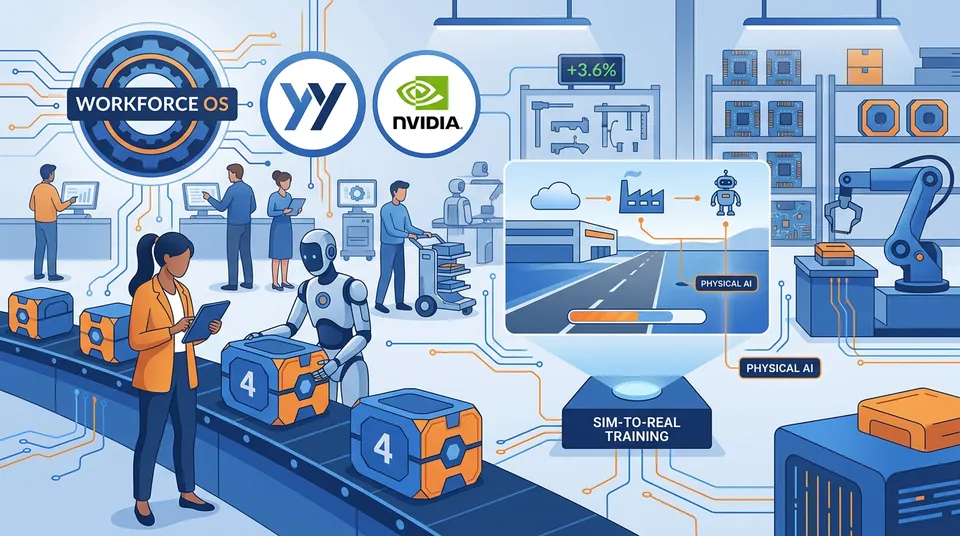
A hotel-first plan for a broader robotics systemYYForce has announced plans to build and expand Workforce OS, a modular robotics architecture intended to link human staff with embodied AI in commercial settings. Its announced roadmap runs through stages labeled Months 0–2, Months 2–4 and Months 4–6, moving from guest-service workflows toward robot work at banquets and events. The company presents this sequence as a way to establish reliability in controlled hospitality operations before taking on less structured work. The announcement describes an intended development program, not a report that these capabilities are already deployed. YYForce also says the plans, features, schedules and commercialization may not happen in the way described.23 Workforce OS is described as a standard system that can work across different robot hardware. Its planned functions include visual sensing, movement planning, object handling, interaction through ordinary language and coordination across robot fleets. That range makes the proposal broader than a single robot or one task, although the announcement frames it as architecture under development. YYForce says it intends to combine the system with robots in commercial deployments where human workers remain part of the operation. The roadmap therefore concerns both robot capability and how machines are integrated into working environments.23 The proposed computing arrangement assigns different roles to NVIDIA hardware. Jetson modules are intended to handle onboard perception, the combination of sensor inputs and motor control, while RTX GPUs are designated for inference and processing at the edge. YYForce also says it plans to use Project GR00T and Isaac Sim, with Omniverse, to train through simulation, create synthetic data and check tasks in digital twins before physical use. Those tools are presented as preparation for real deployments rather than evidence that a given task has already succeeded in them. The company has also identified Isaac ROS for faster visual localization and navigation, and TensorRT for making deep-learning inference more efficient.123 The roadmap begins with intended work on navigation, conversational processes for guests and links to front-desk operations during Months 0–2. In Months 2–4, the plan shifts to fixed and wheeled robotic arms for banquet and food-and-beverage tasks. Those tasks include grasping objects, balancing loads and handing items between workers or robots. The progression places guest interaction and service logistics ahead of more complex physical work. These are stated stages in a plan, not completed milestones.3 During Months 4–6, YYForce intends to test collaborative work involving multiple robots at live hotel banquets and events. The company says pilot-stage Unitree humanoids would be part of that testing. This later stage differs from the earlier arm deployments because it is framed around robots operating together in active event settings. The announced order moves from navigation and guest workflows to food-service manipulation, then to multi-robot operation. YYForce’s longer-term aim extends beyond those settings to less structured activities such as facility maintenance and industrial cleaning.123
The company presents the staged approach as a way to assess stability in controlled enterprise hospitality before pursuing harder, less predictable tasks. It specifically contrasts that sequence with spending extended research time on work such as cleaning wet facilities. The plan places hospitality in two roles: as an early intended setting for the system and as a source of operating experience for later robotics development. That connection is a supported interpretation of the stated deployment sequence and the company’s description of hotel operations as a learning source. It does not establish that the planned learning or later capabilities have already been achieved.23 The hotel work has a separate history from the Workforce OS announcement. Before that announcement, YYForce and Novotel Singapore on Stevens and Mercure Singapore on Stevens had announced a service-robot partnership covering a hotel precinct with 772 rooms. The partnership combines an operational rollout with research that uses hotel workflows to develop future hospitality capabilities. The setting includes 772 guestrooms as well as restaurants and event spaces. The hotels are described as contributing operating expertise, while YYForce supplies robotics capabilities and technical support.45 The confirmed initial phase of the hotel partnership covers guest deliveries, food-and-beverage logistics, scheduled cleaning and concierge support. Preparation includes connecting robots to lifts, mapping their routes, establishing network requirements and notifying guests. A distinct second phase is intended to examine YYForce’s humanoid system through selected housekeeping and banquet tasks. That work is subject to permitted observation and agreed arrangements for data use. The first phase is thus described as operational service work, while the humanoid phase is a separate planned effort.4 YYForce’s hotel partners say they want more consistent service and less repetitive work, so hotel employees can give greater attention to guests. That stated objective describes the intended division of work, not a measured result from the rollout. A pre-deployment comparison estimated monthly costs for selected operations to be approximately 10% lower when robot costs were included. The comparison was an estimate made before deployment, and actual costs, productivity and guest-service outcomes were left for assessment after rollout. A separate planning assumption estimated a potential 5% reduction in overtime costs in the rooms department.45 The approximately 10% estimate and the potential 5% overtime estimate use different bases, and the factsheet says they are not combined. They should therefore not be read as parts of one overall projected saving; that is a supported interpretation of the stated difference in their calculation bases. The first estimate concerns selected operations and includes robot costs, while the second is specifically about rooms-department overtime. Neither figure is presented as a confirmed post-rollout result. The factsheet says actual outcomes remain to be assessed after implementation.45
YYForce says it is deploying an engineering task force whose leads cover navigation, perception and multimodal interaction, manipulation control, embodied VLA models and distributed systems. The company also expects its engineering structure to emphasize coordination across fleets, allocation of labor as conditions change and compatibility with its operating network. These areas align with the proposed system’s intended combination of robot control, interaction and fleet management. YYForce’s chief executive, Mike Fu, has described the company’s ambition as owning the software intelligence layer that makes different commercial robots useful in live business settings. That statement expresses the company’s strategic aim rather than evidence that the planned layer is complete.23 The company situates the robotics plan alongside its existing YY Circle platform, which supports workforce deployment and management across hospitality, food and beverage, retail and other service industries. YYForce describes itself as headquartered in Singapore and operating across Asia and beyond as a workforce-management and integrated-facility-management provider. Those details place Workforce OS within a business already described as serving several kinds of service operations. The hotel partnership provides a specific operating setting within that wider activity. The available facts do not establish the scale of the robotics business or the number of systems that will ultimately be deployed.234 The hotel factsheet cites Singapore Tourism Board figures showing average hotel occupancy of 81.9% in 2025, compared with 81.4% in 2024, alongside 16.9 million international visitor arrivals. These figures describe the broader hotel and visitor setting, rather than results from the YYForce partnership. The occupancy figures compare two annual averages, while the visitor-arrival figure records a separate measure. They provide context for the hospitality environment in which the partners’ work is planned, but do not show that the robotics system changed hotel performance. YYForce’s announcement remains a forward-looking plan whose timing, features and commercial rollout may differ from what has been proposed.34
Structure
Who is connected to whom- 1YYForce
- uses →Fact
- operates in →Fact
- serves →Fact
- depends on →Fact
- revenue exposure →Fact
History
How it came to this- Before the Workforce OS announcementHotel service-robot partnership announcedYYForce and the Singapore hotel partners described an operational rollout and research using hotel workflows.
- Months 0–2Guest workflows and navigation plannedThe first roadmap stage is intended to establish navigation, conversational guest processes and front-desk integration.
- Months 2–4Robotic-arm service work plannedThe roadmap then calls for stationary and wheeled arms to handle banquet and food-service tasks.
- Months 4–6Multi-robot event testing plannedYYForce intends to test collaborative robot operations, including pilot-stage humanoids, at live hotel banquets and events.
- NowMonths 0–2 Workforce OS roadmap: first planned stage
Impact
Spreading outward, level by level- Level 1Commercial robotics architecture
The announced system is intended to connect human workers with embodied AI and provide a hardware-agnostic set of functions spanning perception, navigation, manipulation, language interaction and fleet coordination.23
Fact - Level 2Hospitality workflows
The planned progression starts with guest and front-desk workflows, then moves to banquet and food-service tasks before testing multi-robot work at events.23
Fact - Level 3Future robotics development
The company presents controlled hospitality work as a way to assess stability before pursuing less structured work such as facility maintenance and industrial cleaning; the later capabilities remain targets, not established outcomes.
Analysis - Level 4Execution uncertainty
The announced plans, features, timelines and commercialization may not occur as described, so the roadmap should not be read as evidence of completed deployment.3
Fact
Sources
What each source supportsWritten by AI from the sources listed below: every fact was checked word for word against its source, and inference is marked apart. How we write