

Federal Regulators Sue REPS & Company Over $1.3 Billion Bulk Ticket Scheme
The Federal Trade Commission and Justice Department accuse the secondary ticket broker of evading purchase caps across tens of thousands of performances. Regulators allege the firm extracted over $120 million in profit by deploying disguised accounts to harvest millions of passes.
The complaint alleges that the defendants spent more than $1.3 billion acquiring tickets.2
The FTC says the complaints allege that REPS earned at least $120.8 million in resale profit.12
The FTC complaint alleges that REPS bought more than eight tickets for at least 83,500 events.1
Story
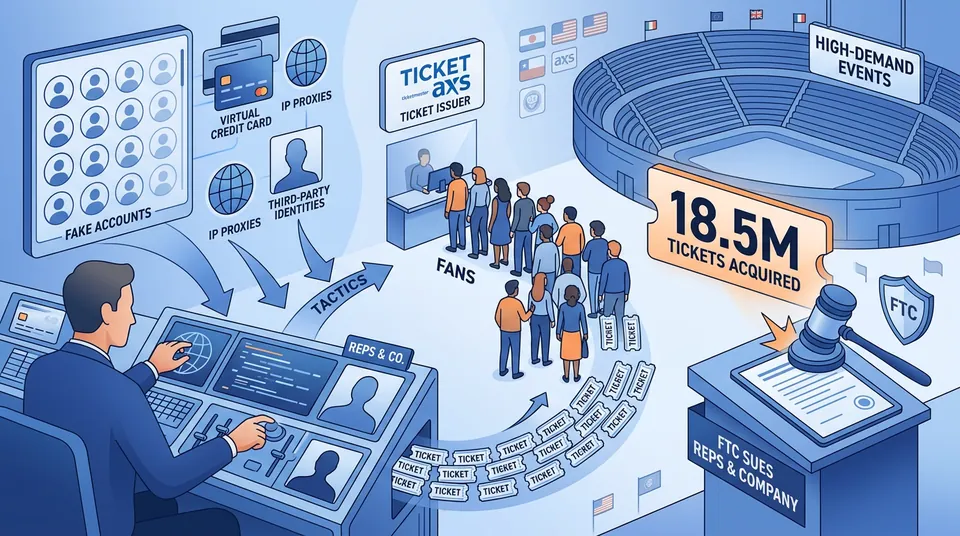
Federal Regulators Challenge Bulk Ticket Operation Over Alleged Anti-Bot ViolationsFederal consumer protection authorities have initiated legal proceedings against REPS & Company Inc., accusing the ticket reseller of systematically subverting transaction caps set for online sales.1 The enforcement action, brought collaboratively by the Federal Trade Commission and the Department of Justice, targets the California enterprise over alleged breaches of federal commercial standards.2 According to the government complaint, the broker deployed more than $1.3 billion in capital to amass an inventory exceeding 18.5 million passes.2 The business then routed those admissions into secondary markets, taking in upwards of $120.8 million in net gains from the sales.1 Regulators assert that this vast accumulation of event access relied on deliberate maneuvers that evaded technological checkpoints established by primary distributors.12
The scale of the alleged operation spanned a sweeping array of public entertainments nationwide.2 Federal filings state that the defendants regularly circumvented numerical caps at thousands of separate presentations.2 In documentation submitted by the commission, REPS is described as having procured more than eight admissions apiece for at least 83,500 distinct dates.1 A substantial portion of these transactions targeted high-demand gatherings that were anticipated to exhaust available seats rapidly.1 By accumulating massive inventories for shows facing imminent sellouts, the firm allegedly maximized its ability to generate secondary revenue across its portfolio of 18.5 million acquired tickets.2
To illustrate the financial mechanics of the enterprise, regulators highlighted a single high-profile arena performance from 2023.1 During the Kansas City, Missouri stop on the Beyoncé Renaissance tour, the broker obtained 7,624 individual seats.1 The agency established that REPS deployed approximately 1,300 separate profiles to complete this localized cluster of purchases.1 From that singular concert alone, the broker recorded $833,000 in trading profit by disposing of the seized inventory on secondary exchanges.1 This performance served as an example within the complaint of how the organization allegedly applied concentrated purchasing power to high-profile events.1
The joint federal action charges REPS with breaking the Federal Trade Commission Act alongside the Better Online Ticket Sales Act.2 Enacted by Congress, the BOTS Act explicitly bans the evasion of technological barriers that ticket vendors install to regulate maximum order sizes or checkout protocols.1 The statute protects rules governing digital transactions, making it an infraction to intentionally breach software restrictions that preserve posted limits.1 Government investigators allege that the defendant corporation and its leadership initiated these prohibited circumvention practices starting in 2022.1 The pending lawsuit contends that these routines were sustained continuously to fuel the entity's secondary redistribution trade.12
Primary ticketing vendors have structured their checkout platforms to restrict bulk purchasing and maintain distributed customer access.1 Companies such as AXS and Ticketmaster rely on strict ceiling values on their quantity selectors to prevent single buyers from monopolizing allotments.1 These vendors additionally enforce automated verification procedures designed to screen for authenticated, legitimate personal identities.1 Their protective software screens buyers by inspecting contact data, individual payment credentials, and originating internet protocol addresses to catch duplicate transactions.1 Such mechanisms are configured to prevent automated scripts and repeat purchasers from bypassing standard consumer allowances.1
To maneuver around vendor screening architecture, REPS allegedly built an elaborate international operational footprint.1 The complaint reveals that company workers, situated predominantly in the Philippines, were tasked with evading security hurdles set up by platform operators.1 These staff members operated through multi-session browsing environments and internet proxy networks that masked their geographic origins.1 Orders were placed using synthetic identity combinations featuring phone lines, physical mailing addresses, and names linked to third parties.1 The firm supported these digital purchases with disposable virtual payment cards and communication lines directly controlled by REPS.1
The acquisition apparatus was formalized through internal arrangements organized by corporate leadership.1 According to the legal filing, REPS signed formal compacts with external partners and staff to harness their personal details for registration on ticketing portals.1 When primary ticketing services detected suspicious activity, their systems routinely initiated order rejections or account terminations.1 Rather than halting activity, the brokerage counteracted these enforcement responses by executing slight textual alterations to customer names and residential addresses.1 Through these iterative shifts, the enterprise allegedly sustained access across dozens of thousands of shows beginning in 2022.1
The federal filing focuses accountability directly on the corporate hierarchy governing the California business.12 Chief Executive Officer Ryan Pancheri is named as an individual defendant alongside the corporate entity in the federal action.1 The complaint similarly identifies company President Brian Archibald as a co-defendant responsible for corporate operations.1 Chief Operating Officer Nicholas Totagrande is also joined in the proceedings alongside the other executive leaders.1 Prosecutors assert that these three corporate officers guided the systemic bypassing of retail quantity limits to accumulate inventory.12
Federal officials characterized the enforcement suit as a vital defense of ordinary entertainment consumers.12 Christopher Mufarrige, leading the FTC's Bureau of Consumer Protection, stated that the broker's operating strategy was structured around gathering tickets for secondary sale at elevated markups.1 Mufarrige warned that the agency will pursue legal action against market participants engaged in that manner of conduct.1 Assistant Attorney General Brett A. Shumate emphasized that the Department of Justice will persist in policing BOTS Act provisions.2 Shumate asserted that government oversight seeks to shield buyers from entities that inflate public admission costs by overriding transaction limits and marking up resale pricing.2
The litigation proceeded to federal court following unanimous administrative approval within the regulatory commission.1 Commission members recorded a 2-0 tally to submit the matter to the Justice Department, which subsequently submitted the action in federal court in Southern California.1 The FTC forwards civil penalty claims whenever commissioners conclude that targets are breaking or approaching a violation of law and that judicial intervention serves public welfare.1 Authorities emphasize that the statements outlined in the complaint remain unproven allegations, and legal fault has not been established.12 Supported records clarify that the cited metrics regarding $1.3 billion in expenditures, 18.5 million admissions, and $120.8 million in trading gains represent formal claims in active litigation rather than binding legal determinations.12
Structure
Who is connected to whom- 1REPS & Company Inc.
- uses →Fact
- agreement with →Fact
- uses →Fact
History
How it came to this- Beginning in 2022Alleged circumvention beginsThe complaint alleges that REPS and its operators began using unlawful tactics to bypass ticket-issuer security measures.
- 2023Kansas City concert cited as an exampleThe FTC complaint cites alleged purchases of 7,624 tickets using 1,300 accounts for a Beyoncé Renaissance tour concert, with $833,000 in profit.
- Date not specifiedFederal complaint filedAfter a 2-0 Commission vote, the Justice Department filed the complaint on the FTC's behalf in federal court in Southern California.
- Nowmore than 18.5 million Tickets allegedly acquired by REPS & Company
Impact
Spreading outward, level by level- Level 1Ticket acquisition and resale
The complaint alleges the defendants exceeded limits for thousands of events and resold tickets on the secondary market.2
Fact - Level 2Issuer security controls
Ticketmaster and AXS use ticket-quantity caps and checks involving accounts, payment and contact details, and IP addresses; the complaint alleges REPS used tactics to bypass issuer security measures.1
Fact - Level 3Legal case
The complaint alleges violations of the FTC Act and BOTS Act. The claims remain allegations, and the court will decide the case.12
Fact
Sources
What each source supportsWritten by AI from the sources listed below: every fact was checked word for word against its source, and inference is marked apart. How we write