

Trump administration asks Supreme Court to block California ballots from more than 20,000 voters
The emergency filing seeks to stop the state from counting ballots while citizenship status is checked. It follows losses in two lower courts and arrives amid a dispute over the federal list used to identify voters.
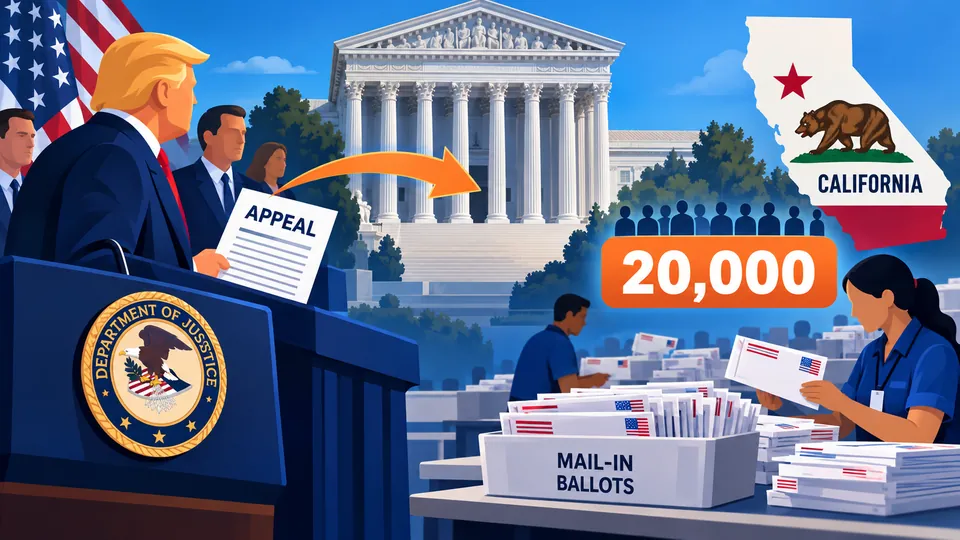
The Justice Department alleges about 20,000 registered voters may be non‑citizens.1
California has more than 23 million registered voters.4
The Department of Homeland Security earlier announced up to 190,000 non‑citizens on California voter rolls.4
Story
A last-stage appeal over California’s disputed voter listThe Trump administration has asked the Supreme Court to halt California’s counting of mail-in ballots cast by more than 20,000 registered voters whom federal officials say may not be United States citizens.1 The Justice Department wants those ballots held back until officials can establish the citizenship status of each person on the disputed list.1 The request targets a defined group of ballots, not a general suspension of California’s mail voting, and the record does not establish that the listed voters are non-citizens.1 The case therefore turns on whether ballots associated with the list should be excluded temporarily while individual status checks take place.12 For voters named on the list, the department’s request would mean their ballots are not counted until their citizenship status can be checked.1
The department’s Supreme Court petition followed a ruling by the Ninth Circuit that refused to undo a lower federal court order protecting the ballots from the requested restriction.2 That appellate decision came three days before the Supreme Court filing, and the petition itself was submitted one day before Election Day.2 Earlier, a federal judge had refused the department’s application to separate ballots associated with a list assembled by Homeland Security.2 The Supreme Court filing thus sought emergency relief after the administration had already been turned away by the trial court and the appeals court.2 The sequence shows that the Justice Department brought its request to the Supreme Court after both the trial judge and the appeals court rejected its efforts to block the ballots.2
The dispute began with a Justice Department lawsuit against California, filed on Oct. 15 in federal court in Los Angeles.2 Its complaint asked that state election workers not count ballots attributed to people described as likely non-citizens in the coming federal election before their status was resolved.2 The request was an unusual federal intervention in election administration in the weeks before voting, according to the account of the filing.3 A separate account places a judge’s rejection of the temporary halt six days before the midterm elections, while the Supreme Court petition is described as filed one day before Election Day.23 The lawsuit’s requested remedy would have affected state election officials’ handling of ballots linked to the alleged non-citizens, rather than all ballots in the state.2
Before suing, the department provided Los Angeles County officials with a thumb drive listing voters it said might be non-citizens.2 The Guardian’s account says federal officials also delivered a USB drive to election officials in both Los Angeles and Sacramento, describing its contents as names of 20,000 non-citizens on the state rolls.4 The accounts describe electronic lists supplied to local election officials, while the lawsuit and emergency request concern whether ballots linked to such names may be counted.124 The Justice Department gave officials 48 hours to examine the list and warned that it would sue if they did not set the ballots aside.4 The short review window meant local officials were asked to assess the supplied names quickly before deciding whether to set related ballots aside.4
The scale of the disputed list is set against a state electorate of more than 23 million registered voters, according to The Guardian.4 That comparison describes the list as a small portion of the registered electorate, but it does not establish how many listed people are eligible or ineligible to vote.14 The Guardian reports that non-citizen voting is extremely rare, while federal law makes voting by non-citizens in federal elections illegal.34 Those points explain why citizenship matters to the dispute, but they do not resolve whether the people on this particular list are citizens.134 The comparison places the disputed voters in the context of California’s much larger registered electorate, while leaving the status of individuals on the list unsettled.14
The list’s reliability is contested: Democracy Docket reported that the method used to create it appeared seriously flawed.3 In Los Angeles County, one in four voters appearing on the list were born in the United States, according to Al Jazeera’s account.3 That figure concerns birthplace among people on the county list; it does not, by itself, determine the citizenship status of every person named there.13 California has also challenged the basis of the federal claims, describing its own protections as robust and the department’s underlying information as suspect.3 The county finding and the reported concerns about the list’s creation give context to California’s challenge, but neither fact establishes the citizenship of every listed voter.3
The dispute sits within a broader Justice Department effort: Al Jazeera reports that the department issued more than 100 subpoenas in 13 states while examining alleged non-citizen voting.3 A government whistleblower said scrutiny of voters across the country formed part of a federal inquiry called the Unlawful Voter Initiative.3 The federal activity is broader than the California lawsuit, which concerns ballots linked to a particular list and asks for action by California election officials.23 The available accounts do not establish that the subpoenas or the wider inquiry produced findings about the individuals named in the California dispute.3 The subpoenas across several states and the California case are both part of the reported scrutiny, but the facts do not connect the broader inquiry’s findings to this particular list.23
The department’s list followed an earlier Homeland Security announcement in July that it had identified as many as 190,000 non-citizens on California voter rolls.4 That earlier number is larger than the more-than-20,000 voters at the center of the present ballot dispute, but the accounts do not explain how the lists relate to one another.14 The trial judge, David Carter, rejected the department’s attempt to use the Homeland Security list to require ballots to be set aside.2 His ruling framed the case around citizens’ voting rights and objected to federal pressure on state and local governments to abandon their established election procedures just before an election.2 Because the relationship between the earlier rolls figure and the disputed ballots is not explained, the two reported totals should not be treated as the same group.14
The Justice Department appealed Carter’s decision to the Ninth Circuit, which declined to grant the department’s request; the Supreme Court petition followed that loss.2 The department also threatened prosecution of California election officials if they counted ballots from non-citizens, according to The Guardian’s account.4 Former Justice Department prosecutor Sam Trepel said that threatened prosecution lacked a legal basis, as reported by The Guardian.4 The immediate question presented by the emergency filing remains whether California may count the disputed ballots before each voter’s citizenship has been verified.1 The threat was directed at election officials responsible for counting ballots, while the emergency request sought to pause counting until citizenship checks were completed.14
Structure
Who is connected to whom- 1California
- requires →Fact
- uses →Fact
- enables →Fact
- ← regulated byFact
- ← located inFact
History
How it came to this- Oct 15 2026DOJ files lawsuit against California
- Early October 2026Judge Carter denies DOJ request to set aside ballots
- Mid‑October 20269th Circuit denies DOJ appeal
- One day before Election Day, 2026DOJ files emergency petition to Supreme Court
- July 2026DHS announces up to 190,000 non‑citizens on rolls
- Now20,000 Disputed non‑citizen voter list
Impact
Spreading outward, level by level- Level 1Immediate legal effect
If granted, the Supreme Court could halt counting of the 20,000 disputed mail‑in ballots.1
Fact - Level 2Election administration
A halt could delay final vote tallies in California and affect perception of election integrity.
Analysis - Level 3National scrutiny
The case adds to broader federal investigations into alleged non‑citizen voting across multiple states.3
Fact
Sources
What each source supportsWritten by AI from the sources listed below: every fact was checked word for word against its source, and inference is marked apart. How we write