

SK Hynix operating profit reaches 83.3 trillion won as AI demand surges
The September quarter brought a sharp increase in profit, revenue and net income, alongside reports of customer demand exceeding available memory supply. The company also outlined shareholder returns and described capacity commitments, investment plans and shortages that it expects to persist.
Third-quarter revenue rose 327.9% year on year.3
Net profit attributable to parent-company shareholders increased 213.9% year on year.3
Customers requested more than twice the memory volume SK Hynix said it could supply.4
Story
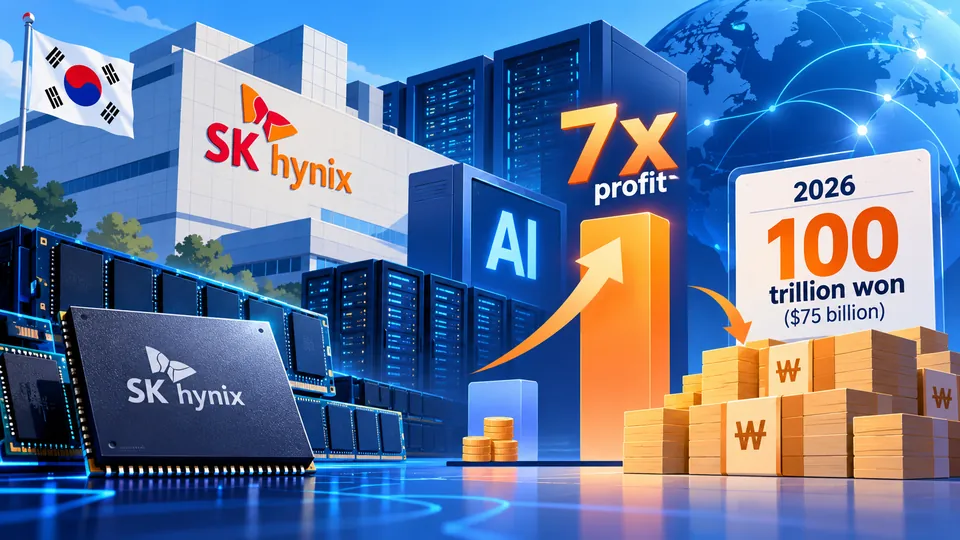
Profit growth, constrained supply and longer-term commitmentsSK Hynix reported operating profit of 83.3 trillion won for the September quarter, more than 7% above projections, while another report described quarterly profit as seven times its earlier level.12 The comparison in the detailed operating-profit figures is with 11.4 trillion won in the same quarter a year earlier, a marked increase alongside the reported rise in earnings.3 Revenue was reported as 104.62 trillion won, a year-on-year increase of 327.9%, while net profit attributable to parent-company shareholders reached 39.53 trillion won, up 213.9%.3 A separate account rounded revenue to 104.6 trillion won and its annual growth to 328%, figures that describe the same broad sales increase with less precision.3 Taken together, these results show revenue rising faster year on year than net profit, while the operating-profit comparison records a large increase from the prior September quarter.3
The company linked the expanding need for memory to wider use of artificial intelligence, which it said was producing productivity improvements and new income opportunities in software development, customer service and search.3 SK Hynix said investment in AI infrastructure was no longer confined to a handful of companies, but was spreading among businesses and countries.3 It expects the market for global AI data-center infrastructure to continue growing steadily, providing context for its account of rising demand for memory.3 For the near term, the company identified AI use by enterprises and consumers as the main sources of memory demand, while it expects autonomous vehicles and robotics to matter more over the medium and long term.3 That distinction places current demand drivers alongside sectors that SK Hynix expects to contribute later, rather than treating all anticipated demand as immediate.3
The company said customers were asking for more than twice the memory volume it could supply, a gap that captures demand relative to available output rather than a count of customers.4 SK Hynix also said shortages of memory used in Nvidia accelerators would last at least through 2030.1 It expects the broader supply shortfall to persist through 2030, attributing the constraint to greater difficulty in advancing manufacturing processes and the time required to construct new facilities.3 The company’s statement that supply would remain tight through 2030 is supported by its report that requests are more than two times the volume it can provide.134 The reported imbalance therefore covers both a specific use of memory in Nvidia accelerators and the company’s broader account of demand outpacing supply.134
SK Hynix said its combined DRAM and high-bandwidth memory capacity through 2029 was nearly sold out when confirmed long-term orders and customer discussions were considered together.3 The company described the open discussions as grounded in clear purchasing plans and said it considered them highly likely to become finalized orders.3 That sales visibility rests on two different kinds of evidence: agreements already signed and potential demand still being discussed with customers.3 SK Hynix said it had supply agreements with 14 major customers and was negotiating longer terms with several other customers.3 These contracts commonly run for 5 years, and the signed agreements alone cover more than 50% of total capacity for 2027 and 2028.3
The chief executive said that binding orders and ongoing customer talks had made the company’s medium- and long-range sales outlook substantially clearer.3 That visibility is not based solely on signed contracts: the company’s near-sold-out assessment through 2029 also includes demand still under discussion.3 The distinction matters because signed commitments and prospective orders are not the same measure, even though SK Hynix said the discussions were supported by specific purchase plans.3 The company also said that fourth-quarter shipments and revenue contribution from its next-generation HBM4 would both exceed the corresponding contributions from HBM3E.4 That comparison concerns the newer product’s expected role in shipments and revenue contribution during the fourth quarter, not a reported full-year total.4
SK Hynix announced a 2026 shareholder-return program valued at 100 trillion won ($75 billion), presenting it as an additional program.2 The stated components include 30 trillion won in cash dividends and 60 trillion won in share repurchases and cancellations, with the latter amount including a 40 trillion won buyback plan announced in August.3 The company separately said it would return 60 trillion won to shareholders during the remainder of the fiscal year through buybacks and dividends, in addition to the previously announced 40 trillion won.1 Another description of the policy sets out more than 30 trillion won in cash dividends and more than 60 trillion won in buybacks and cancellations through fiscal 2026, based on returning more than 50% of free cash flow each year.4 The 100 trillion won overall figure and the 60 trillion won and 40 trillion won components describe the program and its additional and previously announced parts, rather than separate totals to add together.123
For the third quarter, the board approved a cash dividend of 2萬韓圜 per share, combining a regular payment with a special distribution connected to gains from the Kioxia investment.4 The report gave the total value of that dividend as 14兆韓圜.4 The company’s return plans thus include both a specific quarterly dividend and broader commitments covering cash distributions, repurchases and cancellations through fiscal 2026.34 SK Hynix said it was preparing buildings and supporting infrastructure for major investments, including the Yongin semiconductor complex, to respond to limits in process scaling and move toward products with greater value.4 It said the timing of equipment installation and cleanroom activation would be adjusted in light of demand and profitability.4
In early Seoul trading, SK Hynix shares gained more than 7%, while Samsung Electronics shares advanced more than 8%.1 Those reported market moves occurred after SK Hynix published its results; the figures describe early trading rather than a later closing price.1 Samsung was due to publish its own quarterly earnings the following day, giving investors another company result to consider after SK Hynix’s report.1 An analyst quoted by Bloomberg Intelligence said sales and operating profit appeared positioned to rise further in 2027, citing AI demand and higher memory prices, particularly for high-bandwidth memory.1 That outlook is an analyst’s assessment, distinct from the company’s reported quarterly results and its own statements about orders, capacity and shortages.13
The figures describe several different measures: operating profit, revenue and net profit, each reported for the September quarter, alongside year-on-year comparisons and a comparison with projections.13 The operating-profit estimate comparison is more than 7%, while the separate annual comparisons report revenue growth of 327.9% and net-profit growth of 213.9%.13 The company’s capacity statements also use different scopes: near-full sales through 2029 combine confirmed agreements with discussions, whereas the more-than-50% figure refers to signed agreements against total capacity in 2027 and 2028.3 Together, the reported results and forward-looking statements describe a company whose earnings rose sharply while customer demand continued to exceed what it said it could supply.34 The company’s expectations about future markets, orders and shortages remain its stated outlook, while the quarterly amounts and growth rates are reported results.13
Structure
Who is connected to whom- 1SK hynix
- ← part ofFact
- ← competes withFact
- partners with →Fact
- supplies →Fact
- located in →Fact
History
How it came to this- 2026-10-27Earlier signal: quarterly profit beat estimatesAn earlier signal highlighted a profit beat on AI memory demand.
- 2026-10-28Earlier signal: SK Hynix rejected claims of slowing HBM demandThe earlier signal emphasized capacity sales; the company later described near-sold-out capacity through 2029 when orders and discussions are considered together.
- Now83.3 trillion won SK Hynix September-quarter operating profit
- The day after SK Hynix’s resultsSamsung was scheduled to report its own quarterly earnings, offering another company result for investors to consider.
Impact
Spreading outward, level by level- Level 1Customer demand and supply
SK Hynix said customer requests exceeded the volume it could supply by more than two times.4
Fact - Level 2Memory availability
The company expected shortages of memory used in Nvidia accelerators and the broader supply shortfall to continue through 2030.13
Fact - Level 3Capacity and sales visibility
SK Hynix said combined DRAM and HBM capacity through 2029 was nearly sold out when signed orders and discussions were included; signed agreements covered more than half of total capacity for 2027 and 2028.3
Fact - Level 4Future earnings outlook
An analyst said sales and operating profit looked set to keep rising in 2027, citing AI demand and higher memory prices, especially for HBM.1
Fact
Ahead
Checked automatically when due; the result goes to the track recordSamsung was scheduled to report its own quarterly earnings, offering another company result for investors to consider.
Sources
What each source supportsWritten by AI from the sources listed below: every fact was checked word for word against its source, and inference is marked apart. How we write