

China overtakes the United States as the leading clinical-trial venue
A Senate report and a House hearing have raised concerns about China’s new position, while an opinion column cautions that trial volume is not the same as drug innovation. The debate also touches pharmaceutical supply, genetic data, military biotechnology and how quickly the United States can develop medicines.
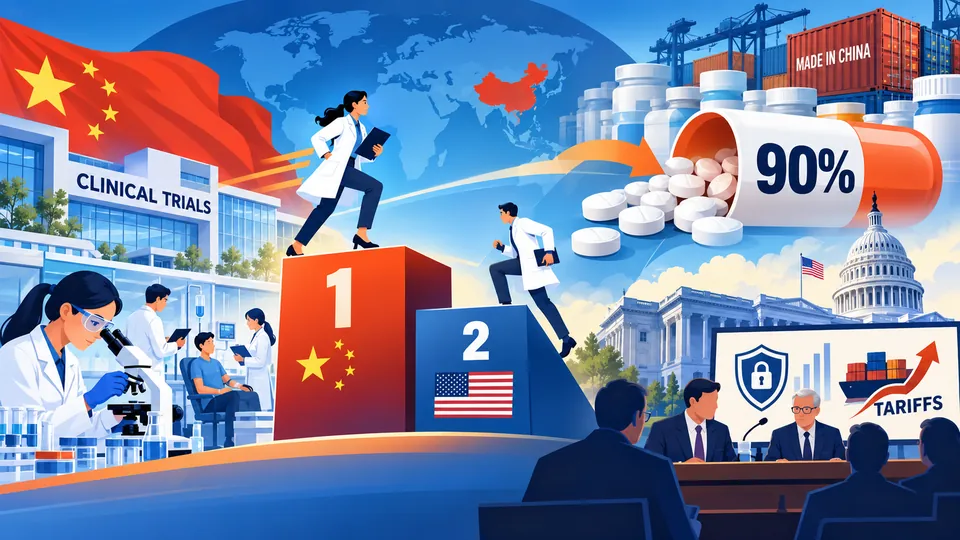
The column says ingredients sourced from China are used in medicines such as ibuprofen and acetaminophen, including a share as high as the stated figure of widely used U.S. medicines.1
The biotechnology commission cited China’s stated aim of having a “world-class” military by this year.1
At COP30, China helped secure a climate-finance work programme lasting this long.5
Story
Trial leadership is not the same as innovationChina has moved ahead of the United States as the leading location for clinical trials, according to a Senate report and a House hearing cited in a newspaper column.1 The reports raised concern about the change, but the available account gives no trial totals or margin showing how large the lead is.1 The column’s central distinction is that hosting more trials does not establish that a country is originating the most important medicines.1 It defines innovation more narrowly, as creating drug targets or technologies that are first of their kind, rather than simply running studies.1 That difference matters to the argument: China’s expanded role in testing is presented as a competitive shift, not proof that its drugs are clinically superior.1
The account attributes China’s pace in part to developers’ ability to take drug candidates into human studies and obtain initial clinical evidence sooner than most U.S. companies.1 Such early results can help developers learn sooner whether a candidate merits further investment, the column argues.1 The author says that faster learning can spare years of work and hundreds of millions of dollars in investment.1 Those potential savings are weighed against concerns that speed and careful safeguards may pull in different directions once medicines are tested in people.1 The column says Chinese studies may follow less extensive safety work before human testing and may select participants in ways that limit the breadth of the resulting evidence.1
If trial participants do not reflect a wide range of people, the findings may be less useful for predicting how a medicine will work across different populations.1 The source does not provide participant counts or demographic breakdowns, so it does not quantify the extent of this concern.1 The author also says Chinese developers have produced medicines closely resembling existing products, along with incremental variations on them.1 In the author’s assessment, none has yet established clinical superiority as a genuinely first-in-class drug.1 This is the basis for separating leadership in the number or location of trials from leadership in originating medicines with distinct clinical value.1
The column points to obesity medicines based on GLP-1 and cancer treatments aimed at HER2, TROP2 and B7H3 as areas crowded with competing development efforts.1 It says the unmet medical need in those fields is diminishing, framing further activity there as less consequential than progress in areas where needs remain unmet.1 The source provides no comparative trial totals for those targets, so their mention illustrates the author’s argument rather than measuring China’s overall contribution.1 The column’s proposed test of innovation is whether developers originate new targets and technologies, not whether they add studies to already busy fields.1 That framework does not deny China’s growing trial role; it cautions against treating trial activity alone as evidence of breakthrough medicines.1
The security argument also reaches beyond clinical research to the ingredients used in medicines sold in the United States.1 The column says Chinese-sourced ingredients go into as many as 90 percent of widely used U.S. medicines, naming ibuprofen and acetaminophen as examples.1 That figure describes the share of medicines said to use ingredients from China; it is not a count of clinical trials or a measure of drug innovation.1 The author reports that a Commerce Department inquiry identified this dependence as a national-security risk.1 The column links that finding to a presidential tariff proclamation issued in April 2026, making medicine supply part of the policy debate around China.1
The column places this U.S. reliance alongside a Chinese push for greater domestic capacity in pharmaceuticals and medical devices.1 It says Xi Jinping called for self-sufficiency after foreign companies had dominated China’s higher-end markets in those sectors.1 Separate concerns focus on genetic information: Washington put BGI subsidiaries on the Commerce Department’s Entity List, partly over fears that such data could reach Chinese military research.1 The Intelligence Authorization Act assigns U.S. intelligence agencies a role in supporting assessments of China’s efforts to obtain data.1 The author adds that rules on cross-border movement of data connected to Chinese trials apply in both countries.1
A broader warning comes from the National Security Commission on Emerging Biotechnology, which said China was advancing quickly toward a leading position in biotechnology.1 The commission also warned that biotechnology could become part of China’s military modernization.1 Its concern included the possibility of soldiers enhanced through genetic means and China’s stated aim of building a “world-class” military by 2049.1 These issues extend the security debate from where trials take place and where ingredients come from to how genetic data might be used.1 The column therefore presents trial leadership as one part of a wider set of concerns, rather than as the sole measure of biotechnology competition.1
The author’s proposed response is to make U.S. drug development faster and less expensive, including by simplifying work before human trials.1 The proposals also include easing regulatory requirements in Phase 1 and Phase 2 and reconsidering how many participants and endpoints studies need.1 These are recommendations in the column, not evidence that the United States has adopted the changes or that they would produce a particular result.1 Japan offers another example of an effort to speed development: the column says it has created an office focused on development, startup financing and trials alongside its counterpart to the FDA.2 That example places the U.S. proposals in a wider contest over development systems, while the source supplies no figures comparing their costs or outcomes.12
Other reports describe security concerns involving China that are separate from clinical trials and pharmaceutical supply.1345 A U.S. Defence Intelligence Agency report set out a timeline in which China might deploy directed-energy weapons in orbit by the end of the 2020s.3 Victoria Samson of the Secure World Foundation said she would be greatly surprised if China had space-based laser weapons by the late 2020s.3 The account says China already has ground-based energy weapons that can interfere with satellites, with their capabilities expected to grow by the end of the 2020s.3 Brendan Mulvaney said satellite disruption could affect U.S. forces more heavily than the People’s Liberation Army because the United States relies more on space, particularly in a Taiwan conflict.3
A separate report says China’s military announced that naval and air units carried out readiness patrols near Scarborough Shoal on Friday.4 The military described the patrols as an effort to reinforce control of the area’s airspace and waters and to oppose what it called rights violations and provocations.4 China and the Philippines exchanged accusations around the end of a two-day ASEAN defence ministers’ meeting on Thursday, according to the report.4 In climate diplomacy, attention is turning to COP31 in Turkey and the position China will take in negotiations.5 At COP30, China helped establish a dialogue on climate-linked unilateral trade measures and a two-year programme concerning climate finance.5 China’s environment vice-minister Li Gao said the country would support an open and effective trade system that helps clean-energy technologies spread.5
Structure
Who is connected to whom- 1China
- member of →Fact
- partners with →Fact
- exports to →Fact
- restricts exports to →Fact
- ← operates inFact
History
How it came to this- April 2026Medicine ingredients enter the security debateThe column connects a Commerce Department finding about reliance on Chinese-sourced ingredients with a presidential tariff proclamation.
- UndatedSenate report and House hearing raise concernThe cited report and hearing say China has overtaken the United States as the leading clinical-trial venue.
- NowLeading China becomes leading venue for clinical trials
Impact
Spreading outward, level by level- Level 1Clinical development
The column says Chinese developers can reach human testing and generate early clinical data faster than most U.S. developers, while raising concerns about preclinical safety work and selective enrollment.1
Fact - Level 2Interpretation of innovation
The author argues that trial counts alone do not show who is originating first-in-class targets or technologies; the account therefore treats trial leadership and innovation leadership as distinct.1
Fact - Level 3Medicine supply and national security
The column links reliance on Chinese-sourced pharmaceutical ingredients to a Commerce Department security finding and a tariff proclamation.1
Fact - Level 4Data and biotechnology security
The account describes concerns involving genetic data, military research and biotechnology as extending beyond trial location and medicine supply.1
Fact
Sources
What each source supportsWritten by AI from the sources listed below: every fact was checked word for word against its source, and inference is marked apart. How we write